 creator@scienceexplore.site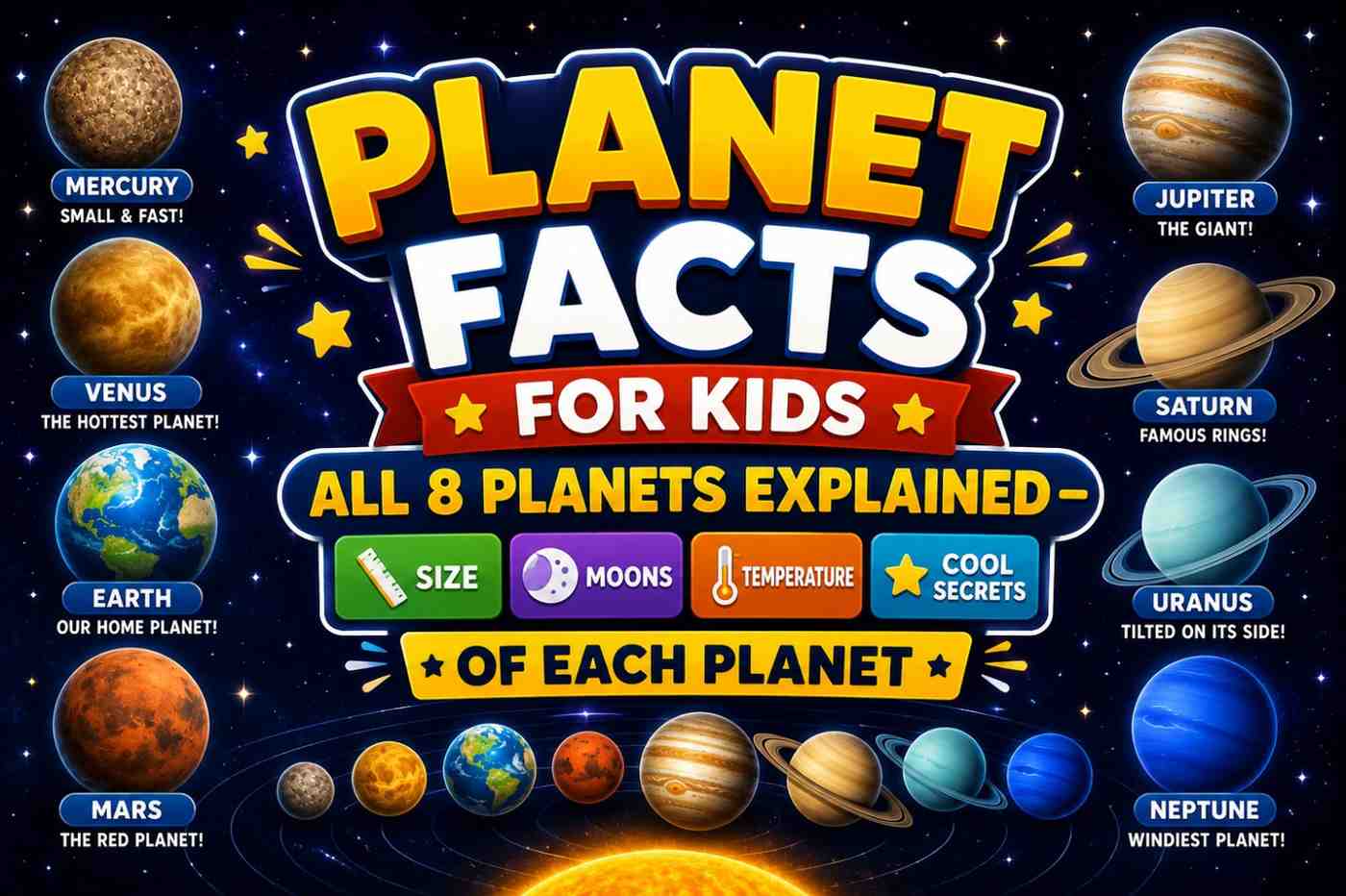
Our solar system has eight extraordinary worlds, each completely different from the others—and every one of them packed with surprising secrets. This complete guide to planet facts for kids, explaining all 8 planets, takes you on a tour from the scorching surface of Mercury to the icy, wind-whipped atmosphere of Neptune.
Planet Facts for Kids: All 8 planets explained in clear, simple language—with sizes, temperatures, moon counts, and one genuinely amazing secret about each planet that most adults don’t even know.
Whether you are studying for school, satisfying your curiosity, or just looking for the coolest facts in the universe—this is your complete guide to planet facts for kids: all 8 planets explained in 2026.
The 8 Planets: A Quick Overview
Before we dive deep, here is a quick reference snapshot of planet facts for kids: all 8 planets explained at a glance.
| Planet | Type | Size vs Earth | Moons | Distance from Sun |
|---|---|---|---|---|
| Mercury | Rocky | 0.38x | 0 | 57.9 million km |
| Venus | Rocky | 0.95x | 0 | 108 million km |
| Earth | Rocky | 1x (reference) | 1 | 150 million km |
| Mars | Rocky | 0.53x | 2 | 228 million km |
| Jupiter | Gas Giant | 11x | 95 | 778 million km |
| Saturn | Gas Giant | 9x | 146 | 1.43 billion km |
| Uranus | Ice Giant | 4x | 27 | 2.87 billion km |
| Neptune | Ice Giant | 3.9x | 16 | 4.5 billion km |
Now let us explore each planet in full detail. This is Planet Facts for Kids: All 8 planets explained—one world at a time.
Planet 1: Mercury — The Speedy Scorched World
Basic Facts
- Type: Rocky (terrestrial)
- Diameter: 4,879 km (about 38% of Earth)
- Moons: 0
- Distance from Sun: 57.9 million km
- Year length: 88 Earth days
- Day length: 59 Earth days
- Temperature range: -180°C to 430°C
What Makes Mercury Special
Mercury is the smallest planet and the closest to the Sun — and it moves faster than any other planet, which is why the ancient Romans named it after their fastest god, the messenger Mercury.
Despite being closest to the Sun, Mercury is NOT the hottest planet. That title belongs to Venus. Mercury has no atmosphere to trap heat, so the side facing the Sun bakes at 430°C, while the night side plunges to -180°C—a swing of over 600°C between day and night.
Mercury’s Amazing Secret
On Mercury, because it rotates so slowly relative to its orbit, the Sun appears to rise, stop, go backwards briefly, and then continue rising — a completely unique sunrise experience in our solar system.
Mercury also has cliffs up to 3 km high stretching for hundreds of kilometers—formed when the planet’s core cooled and shrank, wrinkling the surface like a dried grape.
Planet 2: Venus — The Hottest, Strangest Neighbour
Basic Facts
- Type: Rocky (terrestrial)
- Diameter: 12,104 km (95% of Earth)
- Moons: 0
- Distance from Sun: 108 million km
- Year length: 225 Earth days
- Day length: 243 Earth days
- Temperature: 465°C (constant — day and night)
Related Post: How Rockets Work for Kids Step by Step: A Complete Guide to Space Travel 2026
What Makes Venus Special
In this complete planet facts for kids all 8 planets explained guide, Venus may be the most startling entry. It looks similar to Earth in size, but the surface is a hellscape. The atmosphere is 96% carbon dioxide, creating a runaway greenhouse effect that keeps the temperature at a constant 465°C — hot enough to melt lead.
Venus also spins backwards compared to most planets. On Venus, the Sun rises in the west and sets in the east. Nobody knows exactly why.
Venus’s Amazing Secret
A day on Venus (one full rotation) takes 243 Earth days — longer than a Venus year (225 Earth days). This means on Venus, you complete a full orbit around the Sun before you finish one day. It is one of the most mind-bending planet facts for kids: all 8 planets explained in the whole solar system.
In 2026, multiple space agencies — including ESA, NASA, and ISRO — are planning new Venus missions after decades of neglect. Venus may have had oceans billions of years ago before its atmosphere spiraled into its current extreme state.
Planet 3: Earth — Our Extraordinary Home
Basic Facts
- Type: Rocky (terrestrial)
- Diameter: 12,742 km
- Moons: 1 (The Moon)
- Distance from Sun: 150 million km (1 AU — the standard unit)
- Year length: 365.25 days
- Day length: 24 hours
- Temperature range: -88°C to 58°C (surface extremes)
What Makes Earth Special
Earth is the largest of the four rocky inner planets and the densest planet in the solar system. It is the only planet known to host life — thanks to liquid water on the surface, an oxygen-rich atmosphere, a protective magnetic field, and just the right temperature range.
Earth’s Moon is unusually large relative to its host planet—larger in proportion than the moon of any other planet except Pluto (a dwarf planet). Many scientists believe the Moon’s stabilizing gravitational pull on Earth’s axial tilt helped create the stable climate conditions that allowed life to evolve.
Earth’s Amazing Secret
Earth is the only planet in the solar system not named after a Greek or Roman deity. “Earth” comes from Old English and Germanic words meaning “ground” or “soil.” Every other planet — Mercury, Venus, Mars, Jupiter, Saturn, Uranus, Neptune — is named after a classical god.
Earth also has plate tectonics—the slow movement of the crust in large pieces—a process that recycles carbon, drives mountain building, and may be essential for long-term planetary habitability. No other planet in the solar system is known to have active plate tectonics.
Planet 4: Mars — The Red Planet We May One Day Live On
Basic Facts
- Type: Rocky (terrestrial)
- Diameter: 6,779 km (53% of Earth)
- Moons: 2 (Phobos and Deimos)
- Distance from Sun: 228 million km
- Year length: 687 Earth days
- Day length: 24 hours and 37 minutes
- Temperature range: -125°C to 20°C
What Makes Mars Special
Mars is the most Earth-like planet in the solar system—and the most likely destination for future human exploration. It has seasons, polar ice caps, weather patterns, and days that are almost the same length as Earth’s. Its thin atmosphere is 95% carbon dioxide, but it also contains traces of nitrogen and argon.
Mars is red because its surface is covered in iron oxide—essentially rust. The entire planet is coated in rusty dust.
Mars’s Amazing Secret
Mars is home to Olympus Mons—the tallest volcano in the entire solar system at approximately 22 km high and 600 km wide. It also contains Valles Marineris—a canyon system so enormous it would stretch from one side of the United States to the other. By comparison, Earth’s Grand Canyon is tiny.
As of 2026, NASA’s Perseverance rover is actively searching for signs of ancient microbial life preserved in Martian rocks—and initial results have been very encouraging. Mars may have hosted liquid water — and possibly life — billions of years ago.
Planet 5: Jupiter — The King of the Solar System
Basic Facts
- Type: Gas Giant
- Diameter: 139,820 km (11x Earth)
- Moons: 95 confirmed (as of 2026)
- Distance from Sun: 778 million km
- Year length: 11.86 Earth years
- Day length: 10 hours
- Temperature (cloud tops): -110°C
What Makes Jupiter Special
Jupiter is the largest planet in the solar system — more than twice the mass of all other planets combined. It is so massive that the Sun and Jupiter actually orbit a point in space (called the barycenter) that lies slightly outside the Sun’s surface.
Jupiter has 95 confirmed moons as of 2026—the most of any planet. Its four largest moons — Io, Europa, Ganymede, and Callisto — were discovered by Galileo in 1610 and are called the Galilean moons.
Jupiter’s Amazing Secret
Jupiter’s Great Red Spot is a storm that has been raging continuously for over 350 years, since at least the 1660s. It is larger than Earth. However, the Great Red Spot has been slowly shrinking over recent decades and may eventually disappear entirely—one of the most watched ongoing events in planetary astronomy.
Jupiter also acts as a planetary shield — its enormous gravity attracts and captures asteroids and comets that might otherwise strike the inner solar system, including Earth. Jupiter may be one of the reasons complex life was able to evolve on Earth.
Planet 6: Saturn — The Jewel of the Solar System
Basic Facts
- Type: Gas Giant
- Diameter: 116,460 km (9x Earth)
- Moons: 146 confirmed (as of 2026)
- Distance from Sun: 1.43 billion km
- Year length: 29.4 Earth years
- Day length: 10.7 hours
- Temperature (cloud tops): -178°C
What Makes Saturn Special
Saturn is the most visually stunning planet in the solar system—its magnificent ring system is visible through even a small telescope. The rings are made of billions of pieces of ice and rock, ranging from tiny grains to chunks as large as a house. The rings stretch 282,000 km from edge to edge but are only 10–100 meters thick.
Saturn is the least dense planet in the solar system — less dense than water. If you could find an ocean large enough, Saturn would float in it.
Saturn’s Amazing Secret
Saturn has 146 confirmed moons—the most of any planet in the solar system. Its largest moon, Titan, is bigger than Mercury and is the only moon in the solar system with a thick atmosphere. Titan has rivers, lakes, and rain — but they are made of liquid methane, not water. NASA’s Dragonfly mission is set to fly a drone across Titan’s surface in the early 2030s.
Another moon—Enceladus—shoots enormous jets of water vapor from geysers at its south pole, suggesting a liquid ocean beneath its icy surface. Where there is liquid water, there might be life.
Planet 7: Uranus — The Planet That Rolls Through Space
Basic Facts
- Type: Ice Giant
- Diameter: 50,724 km (4x Earth)
- Moons: 27 confirmed
- Distance from Sun: 2.87 billion km
- Year length: 84 Earth years
- Day length: 17.2 hours (retrograde — spins backwards)
- Temperature (cloud tops): -224°C (coldest planet atmosphere)
What Makes Uranus Special
Uranus is unique in the solar system for its extreme axial tilt — it spins at 98 degrees, essentially on its side. Scientists believe this was caused by a massive collision with an Earth-sized object early in the solar system’s history. As a result, Uranus’s poles experience 42 years of continuous sunlight and 42 years of complete darkness.
Uranus is also the planet with the coldest atmosphere in the solar system at -224°C—even colder than the more distant Neptune. The reasons for this are not fully understood.
Uranus’s Amazing Secret
Uranus is a pale blue-green color because its atmosphere contains methane gas, which absorbs red light and reflects blue-green light. All of Uranus’s 27 known moons are named after characters from Shakespeare’s plays and Alexander Pope’s poetry—the only planet in the solar system whose moons follow this naming convention. Titles include Oberon, Titania, Ariel, Miranda, and Puck.
Planet 8: Neptune — The Stormy Blue Giant at the Edge
Basic Facts
- Type: Ice Giant
- Diameter: 49,528 km (3.9x Earth)
- Moons: 16 confirmed
- Distance from Sun: 4.5 billion km
- Year length: 165 Earth years
- Day length: 16.1 hours
- Temperature (cloud tops): -214°C
What Makes Neptune Special
Neptune is the farthest planet from the Sun and has never been visited by a spacecraft other than Voyager 2’s brief flyby in 1989. It has the fastest winds in the solar system—reaching 2,100 km/h—despite being so far from the Sun and receiving so little solar energy. Where all that energy comes from is still not fully understood.
Neptune completed its first full orbit since its discovery in 1846 only in 2011 — 165 years later. An entire Neptunian year passed between its discovery and 2011.
Neptune’s Amazing Secret
Neptune’s largest moon—Triton—orbits backwards, in the opposite direction to Neptune’s rotation. This strongly suggests Triton was not formed alongside Neptune but was captured by Neptune’s gravity from the Kuiper Belt billions of years ago.
Triton is also geologically active, with geysers of nitrogen gas erupting from its surface. It is slowly spiraling inward toward Neptune and will eventually be torn apart by Neptune’s gravity—in about 3.6 billion years—creating a ring system that may rival Saturn’s in size and beauty.
The 4 Rocky Planets vs. the 4 Giant Planets
A key part of planet facts for kids, all 8 planets explained, is understanding the two main planet types:
Rocky Planets (Inner Solar System): Mercury, Venus, Earth, Mars — small, solid surfaces, relatively close to the Sun.
Giant Planets (Outer Solar System): Jupiter and Saturn (gas giants); Uranus and Neptune (ice giants)—enormous, made mostly of gas and ice, with no solid surface to land on.
The dividing line between them is the asteroid belt—a ring of rock and dust between Mars and Jupiter that marks the transition from the rocky inner solar system to the gas and ice giant outer solar system.
FAQ: Planet Facts for Kids All 8 Planets Explained
Q1. Which is the biggest planet in the solar system? Jupiter is the largest planet — 11 times the diameter of Earth and more than twice the mass of all other planets combined. In the complete planet facts for kids all 8 planets explained guide, Jupiter is the undisputed king.
Q2. Which planet has the most moons? Saturn holds the record with 146 confirmed moons as of 2026—slightly more than Jupiter’s 95. Astronomers are discovering new small moons regularly as telescope technology improves.
Q3. Could humans live on any other planet in the solar system? Mars is the most realistic possibility for future human habitation. It has a day length similar to Earth’s, seasons, and water ice at its poles. Other planets are far too hot, cold, or high-pressure or lack any solid surface. Planet Facts for Kids: All 8 planets explained make clear how uniquely suited Earth is for life.
Q4. Why is Pluto not a planet anymore? In 2006, the International Astronomical Union redefined “planet” to require that an object has “cleared the neighborhood” around its orbit. Pluto shares its orbital zone with many other Kuiper Belt objects, so it was reclassified as a “dwarf planet.” This remains one of the most controversial decisions in the history of astronomy.
Q5. Which planet is most like Earth? Mars is the most Earth-like in terms of day length and seasons. Venus is the closest in size to Earth. But in terms of potential for life and surface conditions, Mars wins the comparison in this planet facts for kids all 8 planets explained guide—even though its conditions are still extremely harsh by Earth standards.
Conclusion
Eight planets. Eight completely different worlds. Each one with its own personality, its own mysteries, and its own secrets waiting to be discovered.
From Mercury’s extreme temperature swings to Neptune’s raging supersonic winds, the planet facts for kids—all 8 planets explained in this guide—reveal a solar system far stranger, more dramatic, and more beautiful than any science fiction story.
The best part? We are still learning. New moons are being discovered. Rovers are digging into Martian soil. Future missions will explore Titan’s methane seas. The story of our solar system is still being written—and the next chapters may be the most exciting of all.
Keep exploring the planets. Use the NASA Solar System Exploration website, download a stargazing app, and on a clear night look up—Jupiter and Saturn are often visible to the naked eye. You are looking at real worlds, real places, right there in the sky.