 creator@scienceexplore.site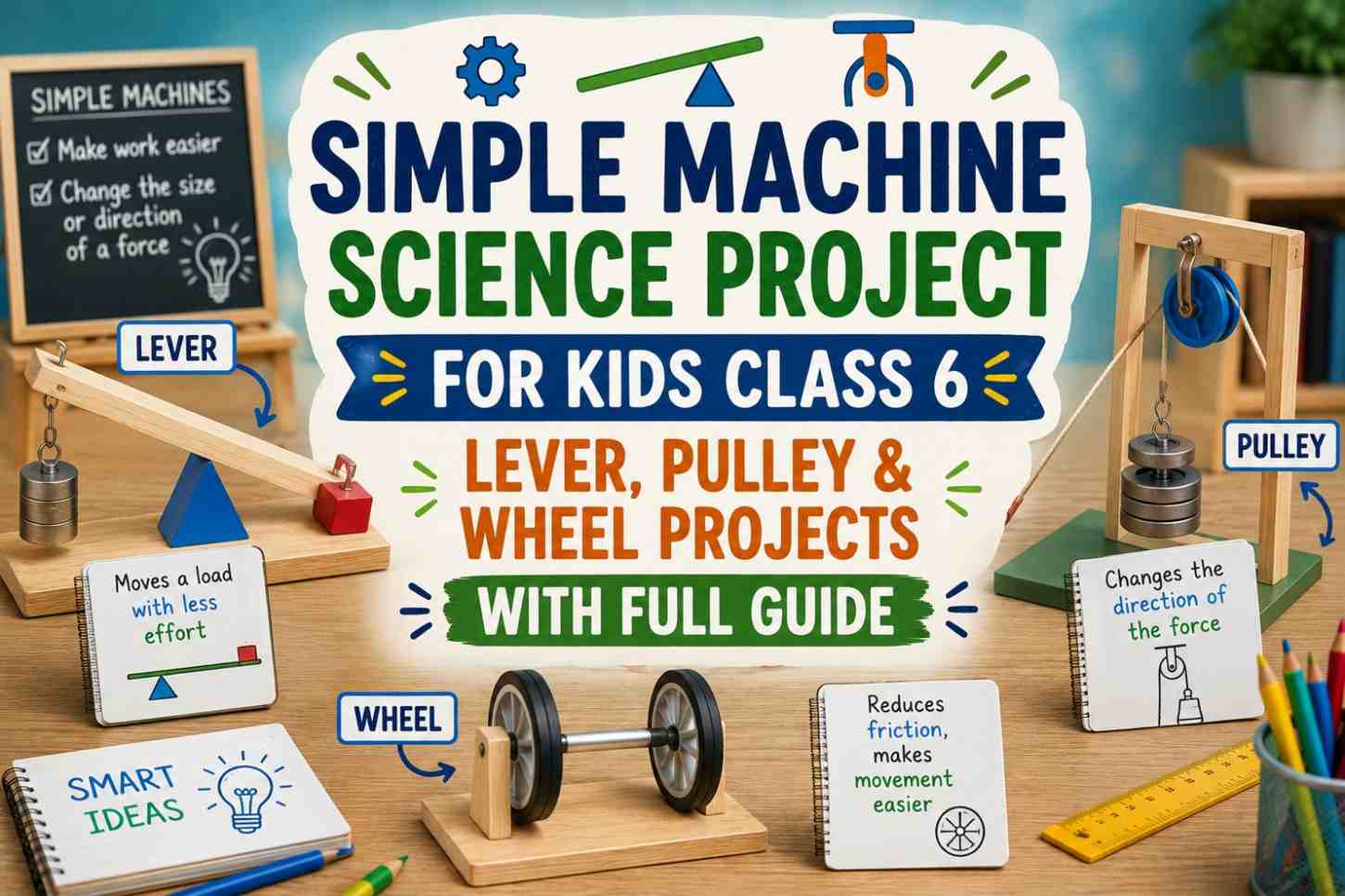
Introduction: The Machines That Built Civilization
The simple machine science project for kids class 6 is one of the most intellectually rewarding science fair categories available. Why? Because simple machines are everywhere — in every door handle, every bicycle, every construction crane — and understanding how they work is foundational to all of engineering.
Class 6 students are at exactly the right age to explore levers, pulleys, wheels and axles, inclined planes, wedges, and screws. These six simple machines are the building blocks of every complex mechanical device humans have ever created.
This guide gives you 10 outstanding simple machine science project ideas for class 6, with complete instructions, materials lists, and judge-ready explanations for each type.
The Six Simple Machines: A Quick Reference
Before building your project, know your machines:
- Lever — A rigid bar that pivots on a fulcrum (seesaw, crowbar, scissors)
- Pulley — A wheel with a rope used to lift loads (flagpole, crane, window blinds)
- Wheel and Axle — A wheel attached to a central rod (bicycle, doorknob, steering wheel)
- Inclined Plane — A sloped surface for moving loads (ramp, staircase, slide)
- Wedge — Two inclined planes joined (axe, knife, nail, zipper)
- Screw — An inclined plane wrapped around a cylinder (bolt, jar lid, drill bit)
Each of these is a powerful subject for a simple machine science project for kids class 6.
10 Simple Machine Science Projects for Class 6
1. Class 1 Lever: The Mechanical Advantage Tester Build a seesaw from a ruler balanced on a pencil (the fulcrum). Place a 100g weight on one side at various distances from the fulcrum. Add weights to the other side at different distances and find the balance point. Calculate mechanical advantage (load ÷ effort). Test how changing the fulcrum position changes the mechanical advantage. This is a rigorous, data-rich experiment that directly demonstrates the lever law: Load × Load Distance = Effort × Effort Distance.
2. Pulley System: Fixed vs. Moveable Comparison Build a fixed pulley by threading a rope over a spool mounted to a doorframe. Build a moveable pulley by threading a spool that moves with the load. Use a spring scale to measure the force required to lift a 500g weight with each system. Compare the effort required. Students learn that a moveable pulley halves the required effort — one of the most satisfying “aha moments” in mechanical science.
3. Compound Pulley (Block and Tackle) Extend the pulley experiment by combining two fixed and two moveable pulleys into a compound system. Measure force requirements with 2 pulleys, then 4 pulleys. Calculate the theoretical vs. actual mechanical advantage. This is one of the most impressive simple machine science project for kids class 6 options at district-level fairs.
4. Wheel and Axle: Doorknob Force Experiment Build a wooden wheel of three different diameters (5 cm, 10 cm, 15 cm) that each attach to the same small axle (1 cm dowel). Use a spring scale to measure the force needed to turn the axle and lift a weight using each wheel size. Plot the relationship between wheel diameter and mechanical advantage. Students discover why large steering wheels require less effort than small ones.
5. Inclined Plane: Angle vs. Effort Relationship Build a ramp from a flat board. Attach a spring scale to a small weighted cart. Measure the force required to pull the cart up the ramp at angles of 15°, 30°, 45°, and 60°. Record and graph the results. Students discover the inverse relationship between ramp angle and the effort required — steeper angles need more force but cover less distance, perfectly demonstrating the energy trade-off in all simple machines.
6. Screw vs. Inclined Plane Comparison Drive identical screws with different thread pitches (coarse and fine) into a block of foam or soft wood. Count the number of turns required to drive each screw to the same depth. Measure the force required using a calibrated screwdriver setup. Students discover that finer thread pitches (more turns per inch) require less force per turn but more total turns — demonstrating the screw’s role as a force multiplier.
7. Wedge Efficiency Test Build wedges of different angles from wooden blocks (10°, 30°, 60°). Test each wedge’s ability to split soft clay by measuring the force applied and the work accomplished. Students learn that a sharper wedge (smaller angle) splits more easily with less force — the same reason a sharp knife cuts more easily than a dull one.
8. Compound Machine: Build a Catapult Build a catapult that combines a lever (the throwing arm), a fulcrum (the pivot point), and a wedge or wheel to hold the arm back. Measure how far it launches a small ball at different arm lengths and fulcrum positions. Catapults elegantly combine multiple simple machines into one compound machine — making this a naturally fascinating and historically rich project.
9. Straw and Pin Gear System Build a simple gear system using cardboard circles of different diameters with toothpick “teeth” glued around the edges. Mount them on a cardboard frame. Turn the large gear and count how many times the small gear turns. This demonstrates the wheel and axle principle in a gear context — the basis of every clock, car transmission, and bicycle ever made.
10. Ramp vs. Stairs: Energy Comparison Set up two identical routes for moving a heavy book from floor to table height: one using a steep ramp, one using a flat staircase shape. Measure and compare the force required for each route using a spring scale. Discuss which requires more force per step but covers more ground per step. This real-world comparison directly connects to why ramps (for wheelchairs and moving trucks) replace stairs in so many accessibility and logistics contexts.
Key Vocabulary for Presentation Day
Knowing these terms will significantly impress your science fair judges:
- Mechanical advantage (MA): The ratio of load force to effort force produced by a machine.
- Fulcrum: The pivot point of a lever.
- Load: The weight being moved.
- Effort: The force applied to move the load.
- Work: Force × Distance (measured in Joules).
- Friction: The resistance force that reduces a machine’s efficiency.
Use these terms naturally in your presentation — it signals to judges that you have moved beyond the surface level of the topic.
For additional simple machine resources, the Physics Classroom Simple Machines Tutorial provides clear, free explanations suitable for students and teachers.
Frequently Asked Questions
Q: Which simple machine science project for kids class 6 is easiest to build for beginners? A: The Class 1 lever experiment and the inclined plane angle test are the easiest to build and require only a ruler, pencil, small weights, and a spring scale. Both also generate clean quantitative data that makes for an excellent display.
Q: How do I calculate mechanical advantage for my display board? A: Mechanical Advantage = Load Force ÷ Effort Force. Measure both forces with a spring scale during your experiment, then divide. A MA of 3 means your machine multiplies your input force by three times.
Q: Can I combine multiple simple machines into one project? A: Yes — and you should! Compound machines that combine two or more simple machines (like the catapult combining a lever and a wedge) are more sophisticated and score higher than single-machine demonstrations.
Q: How long does a simple machine science project take to complete? A: Most of the projects in this guide take 2–4 hours to build and 1–2 additional hours to run the experiments and collect data. Allow extra time for preparing your display board and practicing your explanation.
Q: Do I need a spring scale for simple machine experiments? A: A spring scale (Newton meter) is highly recommended because it gives you quantitative data — actual force measurements — rather than just observations. They are inexpensive and available at most science supply shops or online for under ₹150 / $3.
Related Articles
- Best Science Fair Projects for Class 5 Students — 15 Award-Winning Ideas
- Bridge Building Science Project for Kids — Which Design Holds the Most Weight?
- Working Model Science Project Ideas for Kids 2026 — 12 Weekend Builds
Conclusion
The simple machine science project for kids class 6 is not just a school assignment — it’s a gateway into the fundamental principles of physics and engineering that have shaped human civilization for thousands of years. From the pyramids of Egypt (built using inclined planes and levers) to modern skyscrapers (built using pulleys and gear systems), simple machines are the foundation of everything we build.
Choose your machine, run your experiment carefully, collect real data, and present your mechanical advantage calculations confidently. You won’t just be demonstrating a science project — you’ll be explaining the physics of the ancient and modern world.
That’s the kind of science fair project judges remember long after the fair ends.