 creator@scienceexplore.site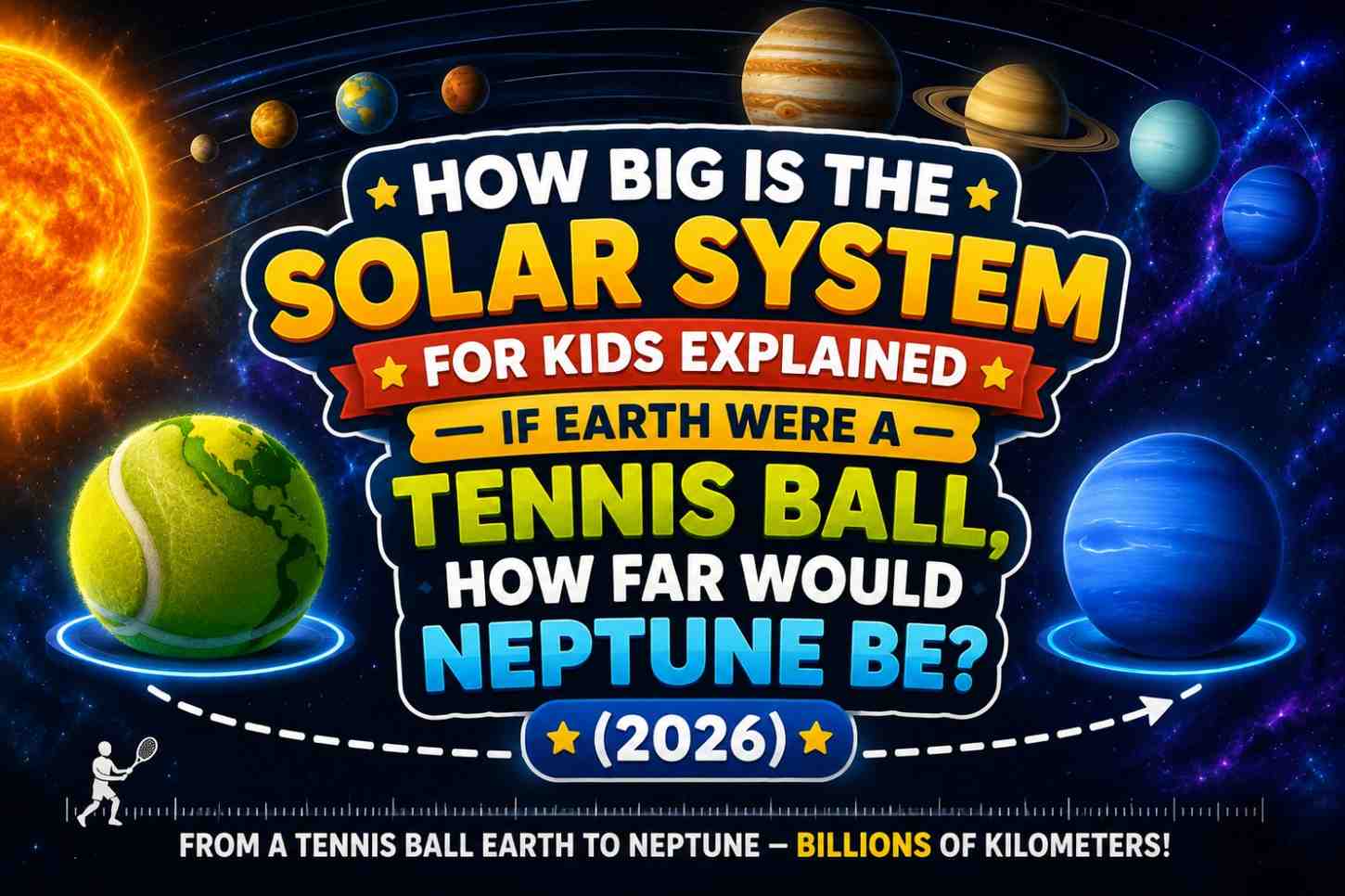
Here is a question that sounds simple but has an answer that will genuinely blow your mind: How big is the solar system? How big the solar system is for kids, explained properly—not with confusing numbers, but with real comparisons you can actually picture—is one of the most fascinating things you can ever learn about space.
The problem with space is that the numbers are so enormous they lose all meaning. “Neptune is 4.5 billion kilometers away” means nothing to most people. But when you hear “If Earth were a tennis ball, Neptune would be over 600 meters away”—suddenly you feel it. That is exactly what “How big is the solar system for kids?” explained in this guide is all about.
Get ready for the most mind-expanding sense of scale you have ever experienced.
Why Understanding Solar System Size Matters
How big is the solar system? For kids, explained properly, it helps children understand several important things:
- Why space travel takes so long — even with incredibly fast rockets
- Why we have not visited the outer planets with humans yet
- Why communication with spacecraft takes hours
- Why finding life on other planets is such a monumental challenge
The size of the solar system is not just a number — it is the key to understanding almost everything about space exploration. Once you understand how big the solar system is for kids explained in real, visual terms, space exploration stories make instant sense.
📍 Image 1 Placement: Place a to-scale diagram illustration of the solar system here—showing the true distances between planets rather than the compressed version seen in most textbooks. ALT Text: How big is the solar system for kids explained—a to-scale diagram showing true distances between the Sun and all 8 planets
The Problem With Most Solar System Diagrams
Before we explore how big the solar system is for kids explained through scale models, we need to address something important.
Almost every diagram of the solar system you have ever seen—in textbooks, on posters, in apps—is completely wrong about distances. The planets are always shown close together with evenly spaced gaps. This is done purely to fit them on a page.
In reality, the solar system is almost entirely empty space. If you drew the solar system to true scale on paper, with Earth the size of a pea, the page would need to be approximately 2.4 km long to fit Neptune at the correct distance. You would barely be able to see the planets at all.
Understanding how big the solar system is for kids, explained with real scale, is a completely different experience from looking at standard diagrams.
The Tennis Ball Scale Model: How Big Is the Solar System?
The easiest way to understand how big the solar system is for kids explained is through a simple scale model. Let us shrink everything down to human-sized distances.
If Earth were the size of a tennis ball (about 6.5 cm), here is where everything would be:
| Object | Real Size / Distance | Scale Model Size / Distance |
|---|---|---|
| Sun | 1.39 million km diameter | 7.1 metres across |
| Mercury | 77 million km from the sun | 30 metres from the sun |
| Venus | 108 million km from the sun | 55 metres from the sun |
| Earth | 150 million km from the sun | 77 metres from the sun |
| Mars | 228 million km from the sun | 117 metres from the sun |
| Jupiter | 778 million km from the sun | 400 metres from the sun |
| Saturn | 1.43 billion km from the sun | 734 metres from the sun |
| Uranus | 2.87 billion km from the sun | 1.47 km from Sun |
| Neptune | 4.5 billion km from the sun | 2.31 km from Sun |
So if Earth is a tennis ball sitting 77 meters from a 7-meter Sun, Neptune is over 2 kilometers away. And the sun itself, at 7 meters across, is larger than a bus. This is how big the solar system is for kids, explained in a way you can actually walk.
Let’s Walk Through the Solar System Together
Imagine you start at the Sun—represented by a ball about 7 meters wide, roughly the size of a large room. You begin walking toward Neptune. Here is what the journey looks like when how big the solar system is for kids is explained through this scale model:
Step away from the Sun:
After walking just 30 meters—about the length of a classroom—you reach Mercury. Mercury in this model is barely the size of a small pebble. You would almost miss it.
55 meters from the Sun—Venus. Slightly larger pebble. About the size of a grape.
77 meters from the Sun—Earth. Your tennis ball. About 55 steps from the Sun.
117 meters from the Sun—Mars. About half the size of Earth in this model — a marble rather than a tennis ball.
Now things start getting interesting. You keep walking. And walking. And walking.
400 meters from the Sun, Jupiter finally appears. On this scale model, Jupiter would be about 7 cm across—similar to… a tennis ball. Despite being the largest planet, at this scale and distance it looks like a small ball in a huge empty field.
734 meters from the Sun—Saturn. Nearly three-quarters of a kilometer from where you started.
1.47 km from the Sun — Uranus. You have been walking for over 1 kilometer and still have not reached the last planet.
2.31 km from the Sun — Neptune. Over 2 kilometers of mostly empty space.
And you have only reached the edge of the known planets. The solar system continues far beyond Neptune, into the Kuiper Belt and the distant Oort Cloud—the home of comets—which in this scale model would be located 1,000–2,000 km away.
This is how big the solar system is for kids, explained in a way that makes the emptiness genuinely felt.
How Far Is Each Planet? Real Numbers Made Simple
Numbers in space are so large they need context. Here is how big the solar system is for kids, explained through simple comparisons for each planet’s distance from Earth:
Mercury—77 to 222 Million km
If you drove a car at 100 km/h non-stop to Mercury, it would take about 88 years. A beam of light gets there in about 5 minutes.
Venus—38 to 261 Million km
Venus is our closest planetary neighbor on average. Even so, the journey by car at 100 km/h would take between 43 and 300 years depending on where both planets are in their orbits.
Mars—56 to 401 Million km
NASA’s fastest Mars missions have taken 6–9 months. Astronauts on a future Mars mission would be in space for over a year for a round trip.
Jupiter—588 to 968 Million km
NASA’s Juno spacecraft took five years to reach Jupiter after launch. Light takes 32–52 minutes to travel from Jupiter to Earth.
Saturn — 1.2 to 1.7 Billion km
The Cassini mission took almost seven years to reach Saturn. When Cassini sent a signal back to Earth, the signal took 68–84 minutes to arrive.
Uranus—2.6 to 3.15 Billion km
The only spacecraft to visit Uranus was Voyager 2 in 1986 — a flyby. Getting a mission back to Uranus is one of NASA’s top planetary-science priorities.
Neptune—4.3 to 4.7 Billion km
Voyager 2 took 12 years to reach Neptune. A radio signal to the Voyager 2 spacecraft (now past Neptune) takes over 4 hours to arrive. This is how big the solar system is for kids, explained through real mission times—distances so large that communication itself becomes a challenge.
Beyond the Planets: How Much Bigger Does It Get?
The 8 planets give us how big the solar system is for kids, explained at a basic level—but the solar system extends much further.
The Kuiper Belt: Beyond Neptune lies the Kuiper Belt — a region of icy objects, dwarf planets (including Pluto), and comets. It extends from about 4.5 billion km to 7.5 billion km from the Sun.
The Heliopause: This is where the Sun’s solar wind stops—the official “edge” of the Sun’s direct influence. Voyager 1 crossed this boundary in 2012 at about 18 billion km from the Sun. It took 35 years of travel to get there.
The Oort Cloud: The outermost theoretical boundary of our solar system is the Oort Cloud—a vast shell of icy objects that may extend up to 15 trillion kilometers from the Sun. In our tennis ball scale model, this would be over 7,500 km away — roughly the distance from India to Europe in real life.
The full solar system, including the Oort Cloud, is so enormous that even light—traveling at 300,000 km per second—takes over a year to cross from one side to the other.
Why Does the Solar System Have So Much Empty Space?
This is a great question, and it is central to truly understanding how big the solar system is for kids.
Our solar system formed from a rotating disk of gas and dust about 4.6 billion years ago. As gravity pulled material together into planets, the vast distances between them were simply never filled. The laws of orbital mechanics keep planets in stable, widely spaced orbits. Gravity needs space to work—if planets were too close, their gravitational interactions would be chaotic and unstable.
The emptiness is not an accident — it is the architecture of a stable, long-lasting planetary system.
How Long Would It Take to Travel Across the Solar System?
Here is how big the solar system is for kids, explained through travel times at different speeds:
| Speed | Time to Reach Neptune |
|---|---|
| Walking (5 km/h) | 102 million years |
| Car (100 km/h) | 5.1 million years |
| Bullet (1,800 km/h) | 285,000 years |
| Space Shuttle (28,000 km/h) | 18,300 years |
| Voyager 1 speed (61,000 km/h) | 8,400 years |
| Speed of Light (1.08 billion km/h) | 4.16 hours |
Even at the speed of light, it takes over 4 hours to cross from the Sun to Neptune. And the speed of light is the absolute maximum speed anything can travel in the universe.
Fun Solar System Scale Activities for Kids
Here are some hands-on ways to experience how big the solar system is for kids, explained in real life:
Activity 1 — The Toilet Paper Solar System Use a roll of toilet paper where each sheet equals 15 million km. Mercury = 5 sheets from the Sun. Neptune = 300 sheets. Unroll it across a field or playground and feel the scale physically.
Activity 2 — Walk Your Own Scale Model Use a basketball for the Sun. Place it at one end of a football field. Using the scale in the table above, place small objects at the correct distances. Walk between them and feel the emptiness.
Activity 3—Use the NASA Eyes on the Solar System App: NASA’s free “Eyes on the Solar System” app shows a real-time 3D model of every spacecraft, planet, and moon in the solar system. One of the best free tools for understanding how big the solar system is for kids is an interactive experience.
📍 Image 2 Placement: Place here a photograph of a child doing a solar system scale model walk activity outdoors, placing small objects to represent planets at correct distances. ALT Text: How big is the solar system for kids explained—a child doing scale model activity, placing planet objects at correct distances on a field
FAQ: How Big Is the Solar System for Kids Explained
Q1. What is the easiest way to explain how big the solar system is to a child? The tennis ball Earth model is the most effective approach to explaining how big the solar system is for kids. If Earth is a tennis ball, Neptune is over 2 kilometers away, and the Sun is a 7-meter ball—bigger than a room. Walking the scale makes the emptiness genuinely felt.
Q2. How long would it take to fly to Neptune in a rocket? NASA’s Voyager 2 spacecraft took approximately 12 years to reach Neptune. Modern spacecraft could potentially make the journey in 8–10 years. No human has ever traveled beyond the Moon—so how big is the solar system? Explained through mission times, it shows how truly vast it is.
Q3. Is Pluto still a planet? Pluto was reclassified as a “dwarf planet” by the International Astronomical Union in 2006. It is located in the Kuiper Belt beyond Neptune, about 5.9 billion km from the Sun. Many people still have strong feelings about this—Pluto remains one of the most beloved objects in our solar system regardless of its official classification.
Q4. What is at the very edge of the solar system? The theoretical outer boundary is the Oort Cloud — a vast shell of icy objects stretching up to 15 trillion km from the Sun. This is a key part of how big the solar system is for kids, explained at full scale—the Oort Cloud boundary is roughly 1 light-year from the Sun, and no spacecraft has ever reached it.
Q5. Which planet is farthest from Earth right now? It depends on where all the planets are in their orbits, as everything is constantly moving. Neptune is generally the farthest planet from Earth—between 4.3 and 4.7 billion km away. The exact current distance can be checked on NASA’s “Eyes on the Solar System” app or website.
Conclusion
Now you truly understand how big the solar system is for kids, explained in a way that most adults never fully grasp. The solar system is not a cosy neighbourhood of planets—it is an almost incomprehensibly vast expanse of mostly empty space, with tiny worlds scattered at enormous distances from each other and from the Sun.
The next time you see a diagram of the solar system in a textbook, you will know it is showing you the planets but hiding the truth about the distances. The real solar system is mostly empty — and that emptiness is one of the most profound things about the universe we live in.
Want to go deeper? Download the NASA Eyes on the Solar System app, try the toilet paper scale model with friends, and look up the night sky with new eyes. The solar system is right above you — vast, beautiful, and waiting to be explored.