
 creator@scienceexplore.site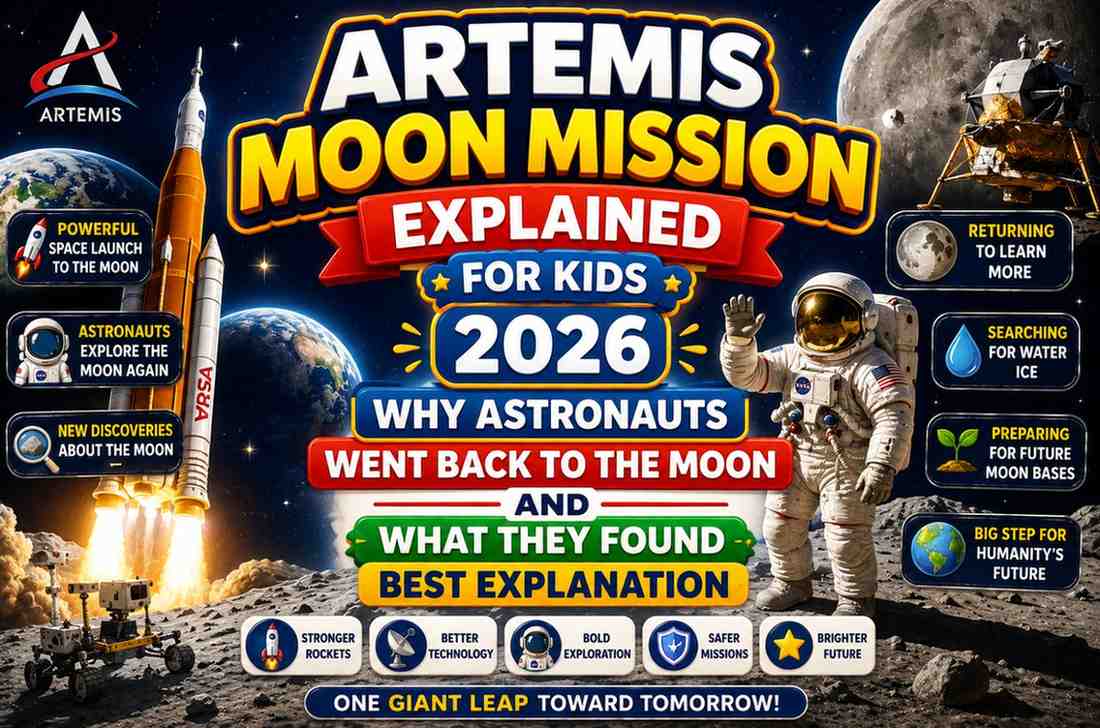
Humans last walked on the Moon in December 1972. That was over 50 years ago. For most people alive today, landing on the Moon is something that happened in history books—not real life. But that has changed. The Artemis Moon mission explained for kids: 2026 is the story of humanity going back—and this time, staying.
The Artemis Moon mission explained for kids: 2026 is not just a repeat of the old Apollo missions. It is bigger, more ambitious, and more international than anything NASA has ever done. It involves the first woman and first person of color to walk on the Moon. It plans to build a permanent lunar base. And it is designed as the first step toward sending humans to Mars.
This complete Artemis Moon mission explained for kids 2026 guide covers everything—why we went back, how the rocket works, who the astronauts are, what has been discovered, and what happens next.
Why Did We Stop Going to the Moon?
Before diving into the Artemis Moon mission explained for kids in 2026, it helps to understand why there was a 50-year gap.
After the Apollo program ended in 1972, NASA turned its attention to other missions—space stations, the Space Shuttle, Mars rovers, and deep space probes. Going to the Moon is extraordinarily expensive and technically challenging. Without the Cold War race against the Soviet Union driving urgency, political support and funding for lunar missions dried up.
But in the early 2020s, things changed. Several factors reignited interest in the Moon:
Water ice was discovered in permanently shadowed craters near the Moon’s south pole. Water on the Moon means drinking water, oxygen to breathe, and hydrogen for rocket fuel—making a permanent Moon base far more practical.
China’s space program accelerated dramatically, announcing plans to land on the Moon. This rekindled political motivation in the United States.
New rocket technology — particularly NASA’s Space Launch System (SLS) and SpaceX’s Starship — made returning to the Moon more technically feasible than ever before.
The Artemis Moon mission explained for kids: 2026 is the result of all these factors coming together.
What Is the Artemis Program?
The Artemis program is NASA’s effort to return humans to the Moon and establish a sustainable, long-term presence there. The name comes from Greek mythology—Artemis was the twin sister of Apollo, the god that gave the original Moon missions their name.
The Artemis Moon mission explained for kids in 2026 involves several phases:
Artemis I (2022): Uncrewed test flight. NASA launched the Space Launch System rocket and the Orion spacecraft around the Moon and back to Earth. No astronauts on board — just a test to make sure everything worked.
Artemis II (planned 2025–2026): The first crewed Artemis flight — four astronauts aboard Orion flying around the Moon (without landing) and returning to Earth. A crucial test of life support systems with humans on board.
Artemis III (planned 2026): The first Moon landing since 1972. Two astronauts descend to the lunar surface near the South Pole. One of them will be the first woman to walk on the Moon.
Artemis IV and beyond: Building the Lunar Gateway space station in orbit around the Moon. Establishing longer-duration surface stays. Eventually building a permanent base called the Artemis Base Camp near the South Pole.
The Artemis Rocket: How Does It Work?
A key part of the Artemis Moon mission explained for kids in 2026 is understanding the incredible engineering involved.
The Space Launch System (SLS)
The SLS is the most powerful rocket NASA has ever built — even more powerful than the Saturn V rockets that took Apollo astronauts to the Moon. It stands 98 meters tall—as tall as a 32-story building. During launch, it produces approximately 8.8 million pounds of thrust — more power than any rocket in history.
The SLS burns through its fuel in just 8 minutes, reaching a speed high enough to break free of Earth’s gravity and head toward the Moon.
The Orion Spacecraft
Sitting on top of the SLS is the Orion spacecraft—the capsule that carries the astronauts. Orion is designed for long-duration deep space missions. It has a crew module (where the astronauts live and work) and a service module (which provides power, propulsion, and life support during the journey).
The journey from Earth to the Moon takes approximately 3–4 days. Orion then enters lunar orbit, where it meets up with the human landing system.
The Human Landing System (SpaceX Starship)
For Artemis III, SpaceX’s Starship will serve as the human landing system—the vehicle that actually descends from lunar orbit to the Moon’s surface. Two astronauts will transfer from Orion into Starship in lunar orbit, descend to the surface, explore, and then return to Orion for the journey home.
Starship is an enormous, fully reusable spacecraft—the largest and most powerful spacecraft ever built by a private company. Using Starship for the Artemis Moon mission explained for kids: 2026 lunar landing is one of the most ambitious partnerships in the history of space exploration.
Who Are the Artemis Astronauts?
One of the most exciting parts of the Artemis Moon mission explained for kids in 2026 is the people involved.
For Artemis II — the first crewed flight around the Moon:
- Reid Wiseman — NASA Commander
- Victor Glover—NASA Pilot and Mission Specialist. He will be the first Black astronaut to travel to the Moon.
- Christina Koch—NASA Mission Specialist. She will be the first woman to travel to the Moon’s vicinity.
- Jeremy Hansen—Canadian Space Agency Mission Specialist. The first non-American to travel to the Moon.
For Artemis III—the Moon landing—specific crew assignments were still being finalized as of early 2026. However, NASA has committed that one of the landing crew members will be the first woman to walk on the lunar surface.
The inclusion of diverse astronaut crews in the Artemis Moon mission, explained for kids, 2026 is a deliberate and historic departure from the all-white, all-male Apollo crews of the 1960s and 70s.
Where on the Moon Are They Going?
The Apollo missions landed near the Moon’s equator—relatively flat areas that were easy to reach and had good sunlight for solar power.
The Artemis Moon mission, explained for kids, 2026 targets a completely different destination: the Moon’s south pole.
Why the South Pole?
Water ice: Permanently shadowed craters near the South Pole contain deposits of water ice—confirmed by multiple spacecraft and rovers. This water can be converted into drinking water, oxygen to breathe, and hydrogen rocket fuel.
Permanent sunlight: Certain ridges and peaks near the South Pole receive almost constant sunlight—perfect for solar panels to generate continuous power for a lunar base.
Scientific interest: The ancient, permanently shadowed craters near the south pole have not been disturbed for billions of years—they preserve a record of the early solar system in their ice and rock.
The specific landing site for Artemis III is near the Shackleton Crater—a large impact crater approximately 21 km wide and 4 km deep at the South Pole.
What Will Astronauts Do on the Moon?
The Artemis Moon mission explained for kids: 2026 surface activities go far beyond planting a flag and collecting rock samples—though those happen too.
Collecting lunar samples: Astronauts will collect rock and soil samples from near the South Pole—ancient material that has never been studied before. These samples will be returned to Earth and analyzed by scientists worldwide.
Testing for water ice: Instruments will directly study the ice deposits in permanently shadowed areas. Understanding how much water is available, how accessible it is, and how clean it is will be critical for planning permanent lunar habitation.
Deploying science experiments: Various sensors, seismometers, and environmental monitors will be left on the surface to continue collecting data long after the astronauts return home.
Testing spacesuits: NASA designed new spacesuits—called the Exploration Extravehicular Mobility Unit (xEMU)—specifically for the Artemis missions. These are more flexible, comfortable, and capable than the Apollo-era suits.
Testing equipment for future bases: Some equipment that would be used in a permanent lunar base—like resource extraction tools—will be tested during early Artemis surface stays.
What Has Been Discovered So Far?
The Artemis Moon mission explained for kids 2026 builds on significant discoveries already made:
Artemis I (2022) confirmed: The Orion spacecraft performed exactly as designed. Radiation measurements taken during the uncrewed flight will help protect future astronaut crews. The spacecraft re-entered Earth’s atmosphere at 40,000 km/h—the fastest re-entry of any crewed-rated spacecraft—and survived perfectly.
LCROSS and LRO missions (before Artemis): NASA’s earlier missions confirmed the presence of water ice in permanently shadowed lunar craters—the scientific foundation that makes Artemis’s south pole landing site so important.
Chandrayaan-3 (India, 2023): ISRO’s lunar rover discovered sulfur, oxygen, iron, calcium, titanium, and chromium in the lunar soil near the south pole. These chemical discoveries are directly relevant to plans for using lunar resources in the Artemis Moon mission explained for kids in 2026 and beyond.
The Lunar Gateway: A Space Station Around the Moon
A major component of the long-term Artemis Moon mission explained for kids’ 2026 vision is the Lunar Gateway—a small space station that will orbit the Moon.
The Lunar Gateway will:
- Serve as a staging point for lunar surface missions
- Provide a place for astronauts to live and work in lunar orbit
- Act as a communications hub between Earth and the lunar surface
- Enable missions to different parts of the Moon’s surface from a central orbital base
The Gateway will be built and operated by an international partnership including NASA, ESA, JAXA (Japan), CSA (Canada), and other partner agencies. Modules are being built and launched in stages beginning in the mid-2020s.
For the Artemis Moon mission explained for kids in 2026, the Gateway represents the transition from short visits to permanent lunar presence.
Artemis and the Path to Mars
The ultimate goal behind the Artemis Moon mission, explained for kids in the 2026 program, is Mars.
The Moon is being used as a proving ground — a place to test every technology, system, and procedure that will be needed for a crewed mission to Mars. Living on the Moon teaches us the following:
- How to produce water, oxygen, and fuel from local resources (in-situ resource utilization—ISRU)
- How to protect astronauts from deep space radiation over long durations
- How to maintain equipment in harsh, airless environments far from Earth
- How to live and work in a habitat on another world
A round trip to Mars takes approximately 2–3 years. Every lesson learned on the Moon makes that future Mars mission safer and more likely to succeed.
📍 Image 1 Placement: Place NASA’s official Artemis program image here—the SLS rocket launching or an astronaut in a spacesuit on the Moon’s south pole (NASA public domain). ALT Text: Artemis Moon mission explained for kids 2026—NASA SLS rocket launching with Orion spacecraft on top
Countries Involved in the Artemis Programme
The Artemis Moon mission explained for kids: 2026 is the most international space exploration effort in history. Countries and agencies participating include:
- United States (NASA) — Lead agency
- European Space Agency (ESA) — Building the Orion service module
- Canada (CSA)—Providing the Canadarm3 robotic arm for the Gateway
- Japan (JAXA) — Providing lunar rovers and Gateway modules
- Australia — Contributing semi-autonomous rover technology
- India (ISRO) — Exploring collaboration on lunar science
Under the Artemis Accords—a set of principles for peaceful, transparent space exploration—over 40 countries have signed agreements to cooperate under the Artemis framework as of 2026.
📍 Image 2 Placement: Place an artist’s illustration of the Lunar Gateway space station in orbit around the Moon here (NASA public domain). ALT Text: Artemis Moon mission explained for kids 2026—artist illustration of the Lunar Gateway space station orbiting the Moon
Artemis Timeline at a Glance
| Mission | Date | What Happens |
|---|---|---|
| Artemis I | November 2022 | Uncrewed test flight around the Moon — SUCCESS |
| Artemis II | 2025–2026 | First crewed flight around the Moon — no landing |
| Artemis III | 2026 | First Moon landing since 1972—South Pole |
| Artemis IV | 2028 | First docking with Lunar Gateway |
| Artemis Base Camp | 2030s | Permanent surface habitat near the South Pole |
| Mars Mission (goal) | 2030s–2040s | First humans on Mars |
FAQ: Artemis Moon Mission Explained for Kids 2026
Q1. Why is the mission called Artemis? In Greek mythology, Artemis was the twin sister of Apollo, the god whose name was given to the original Moon missions. The name honors that legacy while also symbolizing a new era. The Artemis Moon mission explained for kids, 2026 is particularly fitting since one of Artemis’s goals is landing the first woman on the Moon.
Q2. How long will astronauts stay on the Moon during Artemis III? The initial Artemis III surface stay is expected to last approximately 6.5 days on the lunar surface. Future missions will gradually extend these stays toward weeks and eventually months as permanent infrastructure is established.
Q3. What do astronauts eat and drink on the Moon? Astronauts carry food from Earth for initial missions—specially packaged meals similar to those on the International Space Station. Long-term, the Artemis Moon mission, explained for kids, 2026 program plans to extract water from lunar ice deposits and potentially grow food in pressurized habitats.
Q4. Can kids today become part of future Moon or Mars missions? Absolutely. NASA and other space agencies are actively recruiting the next generation of astronauts, engineers, and scientists. Children interested in the Artemis Moon mission, explained for kids, and future Mars missions should focus on STEM education, staying physically fit, and developing curiosity and problem-solving skills. The first humans to walk on Mars are very likely studying today.
Q5. How is Artemis different from the Apollo missions? The Apollo missions (1969–1972) were primarily about demonstrating capability and winning the Space Race during the Cold War. The Artemis Moon mission explained for kids, the 2026 program, is about sustainable, long-term presence—building infrastructure, extracting resources, conducting science, and preparing for Mars. Artemis includes international partners, more diverse crews, newer technology, and far more ambitious long-term goals.
Conclusion
The Artemis Moon mission explained for kids 2026 is more than a space program—it is the opening chapter of humanity’s future as a multi-world species. After 50 years away, we are going back to the Moon — and this time, we are going to stay.
The first woman to walk on the Moon. The first permanent lunar base. The first human steps on Mars are taken. These milestones are not distant dreams — they are plans, missions, and rockets being built right now. The children who read this guide today may live to see all of them happen. Some of them may be part of making them happen.
Stay curious. Follow NASA’s official website, watch Artemis mission livestreams, and look up at the Moon on a clear night with fresh wonder. The next chapter of human exploration is beginning, and it is going to be extraordinary.