 creator@scienceexplore.site
Space is the most amazing, mysterious, and mind-bending place that exists — and the best part? You do not need to be a scientist to understand it. These space facts for kids 2026, easy to understand, will take you on a journey through planets, stars, black holes, galaxies, and the very edges of the universe—explained in simple, fun language anyone can enjoy.
Whether you are 8 years old or 14, a curious student or a parent looking for something exciting to share—these space facts for kids 2026, easy to understand, are packed with the latest discoveries, the weirdest science, and the most jaw-dropping numbers in the known universe.
Ready? Buckle up. Space is about to blow your mind.
Why Space Facts Matter for Kids in 2026
Before we dive in, here is something worth knowing. The space facts for kids 2026 easy to understand in this guide are not just cool trivia—they connect to real science happening right now.
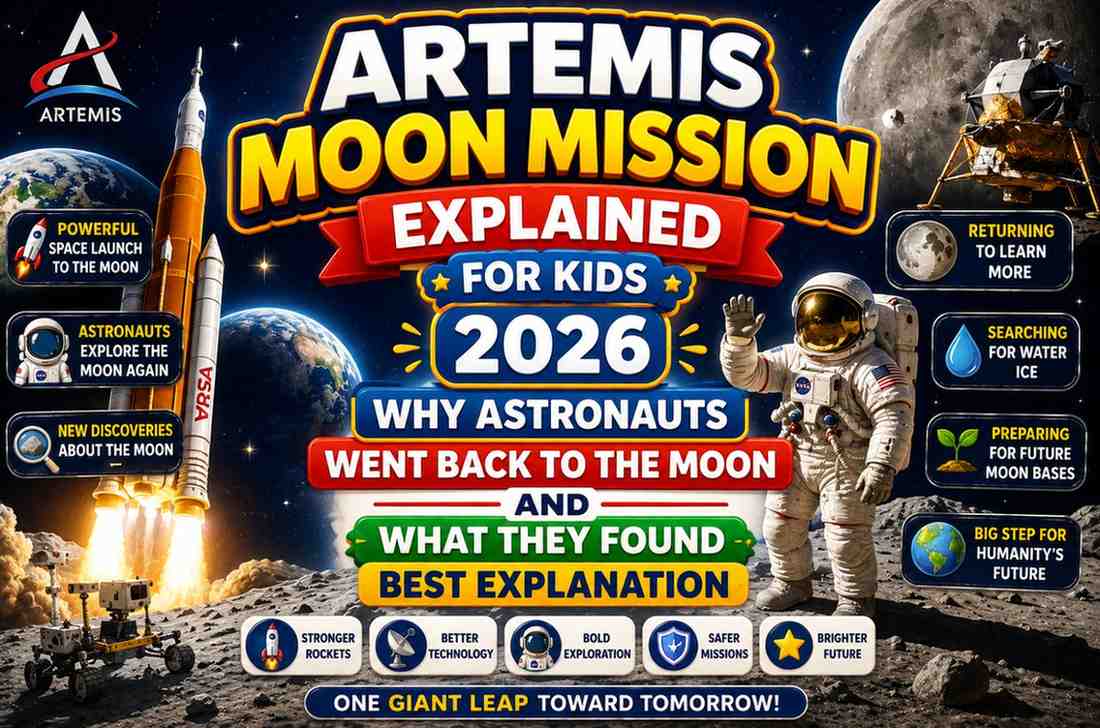
In 2026, humans are actively exploring the Moon again through NASA’s Artemis program. The James Webb Space Telescope is photographing galaxies from 13 billion years ago. Private companies are planning Mars missions. The universe is not something to read about only in textbooks — it is being explored and discovered right now, in real time.
Understanding space facts for kids 2026, easy to understand, helps young people connect to one of the most exciting scientific adventures in all of human history.
📍 Image 1 Placement: Place a colorful, child-friendly illustration of the solar system here—all 8 planets with the Sun at the center, vibrant and clearly labeled. ALT Text: Space facts for kids 2026 easy to understand—colorful illustrated solar system showing all 8 planets and the Sun
Section 1: Amazing Facts About Our Solar System
These space facts for kids 2026 easy to understand start close to home — with our own solar neighbourhood.
Fact 1: The Sun Could Swallow 1.3 Million Earths
The Sun is so enormous that approximately 1.3 million planet Earths could fit inside it. If the Sun were a hollow ball, you could fill it over a million times with Earth-sized objects. The Sun contains 99.86% of all the mass in our entire solar system.
Fact 2: The Solar System Is Mostly Empty Space
If you shrank the Sun to the size of a basketball and placed it at one end of a football field, Neptune—the farthest planet—would be a tiny pea sitting over 600 meters away. Everything in between is essentially empty. Our solar system is a vast, mostly empty place.
Fact 3: Sunlight Takes 8 Minutes to Reach Earth
Light travels at 300,000 km per second — the fastest speed possible. And yet it still takes about 8 minutes and 20 seconds for sunlight to travel from the Sun to Earth. When you look at the sun (never directly—it damages your eyes!), you are seeing it as it was 8 minutes ago.
Fact 4: A Day on Venus Is Longer Than Its Year
Venus rotates so slowly that one full spin takes 243 Earth days. But Venus orbits the Sun in just 225 Earth days. This means a day on Venus is longer than a year on Venus—one of the most delightfully confusing space facts for kids in the entire solar system.
Fact 5: Saturn’s Rings Are Mostly Ice
Saturn’s rings look solid in pictures but are actually made of billions of pieces of ice and rock — from tiny grains to chunks as big as a house. The rings stretch hundreds of thousands of kilometers wide but are only 10–100 meters thick. Incredibly thin for something so spectacular.
Fact 6: Jupiter Is a Failed Star
Jupiter is more than twice the mass of all other planets combined. If it had been about 80 times more massive, gravitational pressure at its core would have triggered nuclear fusion and turned it into a small star. Our solar system very nearly had two suns.
Fact 7: Mars Has the Tallest Volcano Ever Found
Olympus Mons on Mars stands approximately 22 km high — nearly three times the height of Mount Everest. It is also 600 km wide — so enormous that if you stood at its base, the peak would be completely hidden beyond the horizon.
Fact 8: Uranus Spins on Its Side
While most planets spin upright, Uranus is tilted at 98 degrees — it essentially rolls around the Sun like a bowling ball on its side. This gives each pole 42 years of continuous sunlight followed by 42 years of total darkness. One of the strangest space facts for kids in 2026 is easy to understand in the solar system.
Fact 9: Mercury Has the Most Extreme Temperature Swings
Although Venus is hotter overall, Mercury — with no atmosphere to trap heat — experiences the most extreme daily temperature swings. Daytime temperatures reach 430°C. Night-time temperatures plunge to -180°C. A swing of over 600°C between day and night on the same planet.
Fact 10: Neptune Has the Fastest Winds in the Solar System
Neptune is the farthest planet from the Sun and one of the coldest—yet it generates the fastest winds in the entire solar system. Wind speeds on Neptune reach up to 2,100 km/h — fast enough to cross India in under 2 minutes.
Section 2: Mind-Blowing Star Facts
Fact 11: Stars Are Born in Gas Clouds
Stars form inside enormous clouds of gas and dust called nebulae. Over millions of years, gravity pulls the gas inward. When pressure and temperature at the center become extreme enough, nuclear fusion ignites—and a new star is born. Our Sun formed this way about 4.6 billion years ago.
Fact 12: The Nearest Star Is 70,000 Years Away by Spacecraft
Proxima Centauri—the nearest star beyond our Sun—is 4.24 light-years away. Even in the fastest spacecraft ever built, reaching it would take approximately 70,000 years. Space is genuinely, almost incomprehensibly large.
Fact 13: Some Stars Are Bigger Than Our Entire Solar System
The hypergiant star UY Scuti is so enormous that if placed at the center of our solar system, its surface would extend beyond the orbit of Jupiter. Our Earth, Mars, the asteroid belt, and much of the inner solar system would be inside this single star.
Fact 14: Stars Come in Different Colours Based on Temperature
Red stars are the coolest (still thousands of degrees). Yellow stars like our Sun are medium temperature at about 5,500°C. Blue-white stars are the hottest — up to 30,000°C or more. The night sky is full of different colors if you look carefully.
Fact 15: Our Sun Will Become a Red Giant in 5 Billion Years
When the Sun runs out of hydrogen fuel, it will expand into a red giant large enough to engulf Mercury, Venus, and possibly Earth. Then it will shed its outer layers and collapse into a small, dense white dwarf—slowly cooling for billions of years.
Section 3: Galaxy and Universe Facts
Fact 16: The Milky Way Has Up to 400 Billion Stars
Our galaxy contains between 200 and 400 billion stars. Our Sun is just one of them. And the observable universe contains approximately 2 trillion galaxies. The estimated total number of stars in the universe is roughly 1 septillion—written as 1 followed by 24 zeros.
Fact 17: The Universe Is 13.8 Billion Years Old
The Big Bang created all space, time, matter, and energy approximately 13.8 billion years ago. Before the Big Bang, there was no space and no time — so asking “what came before the Big Bang?” is a question that physics cannot yet answer. One of the deepest space facts for kids 2026 easy to understand.
Fact 18: The Universe Is Expanding Faster and Faster
The universe has been expanding since the Big Bang — and the expansion is actually accelerating. Galaxies are moving apart faster over time, driven by a mysterious force called dark energy. Dark energy makes up about 68% of everything in the universe—yet nobody knows exactly what it is.
Fact 19: Deep Space Telescopes See Back in Time
When the James Webb Space Telescope photographs distant galaxies, it sees light that left those galaxies billions of years ago. Looking at the most distant galaxies means seeing the universe as it was when it was just a few hundred million years old — billions of years before Earth even existed.
Section 4: Space Exploration Facts
Fact 20: Only 12 Humans Have Walked on the Moon
Between 1969 and 1972, NASA’s Apollo program landed astronauts on the Moon six times. Only 12 people in all of human history have walked on the lunar surface. The last was Gene Cernan in December 1972. NASA’s Artemis program is working to return astronauts to the Moon in the mid-2020s.
Fact 21: The ISS Orbits Earth Every 90 Minutes
The International Space Station travels at 28,000 km/h, completing one full orbit of Earth every 90 minutes. Astronauts on the ISS see 16 sunrises and 16 sunsets every single day. The ISS has been continuously inhabited since November 2000—over 25 years of humans in space.
Fact 22: Voyager 1 Is Now in Interstellar Space
Launched in 1977, NASA’s Voyager 1 is now over 23 billion km from Earth — beyond our solar system entirely. Radio signals from Voyager 1 take over 22 hours to reach Earth even at the speed of light. It is the most distant human-made object in existence, and it is still sending data home in 2026.
Fact 23: India Landed on the Moon’s South Pole
In August 2023, ISRO’s Chandrayaan-3 mission made India the first country to land a spacecraft near the Moon’s south pole. The Pragyan rover discovered sulfur, iron, oxygen, and other elements in the lunar soil. A historic moment of national and scientific pride.
Fact 24: Moon Footprints Will Last Millions of Years
With no wind or rain in the airless Moon, the footprints left by Apollo astronauts remain perfectly preserved. They will last for millions of years unless disturbed by a meteorite. They are the longest-lasting physical marks ever made by humans.
Section 5: Weird Space Facts That Sound Impossible
Fact 25: Space Is Completely Silent
Sound needs a medium to travel—air, water, or solid material. Space is a near-perfect vacuum. This means the explosions of supernovae, the roaring fires of stars, and the collision of galaxies all produce zero sound. The entire universe is completely silent.
Fact 26: There Is a Planet Where It Rains Glass Sideways
Exoplanet HD 189733b has winds of 8,700 km/h and surface temperatures of 1,000°C. Silicate particles in the atmosphere condense into glass and rain sideways at supersonic speeds. It is one of the most hostile and nightmarish places ever discovered.
Fact 27: Neutron Stars Spin 700 Times Per Second
When massive stars explode, their cores collapse into neutron stars—about 20 km wide but containing more mass than our Sun. Some spin 700 times per second. The centrifugal force at the surface of such a star would be unimaginably powerful.
Fact 28: You Are Made of Stardust
Every atom in your body — carbon, oxygen, iron, calcium — was forged inside ancient stars billions of years ago. Those stars exploded as supernovae, scattering their elements through space. Those elements eventually formed our solar system, our planet, and you. You are literally made of the universe itself.
Fact 29: A Teaspoon of Neutron Star Would Weigh a Billion Tonnes
Neutron stars are so incredibly dense that a teaspoon of their material would weigh approximately one billion tonnes on Earth. The entire mass of a star is compressed into a ball about 20 km across—creating the densest objects in the universe short of black holes.
Fact 30: The Andromeda Galaxy Is Heading Toward Us
The Andromeda Galaxy—our nearest large galactic neighbor—is moving toward the Milky Way at about 110 km per second. In about 4.5 billion years, the two galaxies will collide and merge. Fortunately, galaxies are so empty that the collision will be a slow, graceful merger rather than a catastrophic smash.
10 Quick-Fire Space Facts for Kids
Here are 10 rapid bonus entries from this collection of space facts for kids 2026, easy to understand:
- The Moon is moving away from Earth at about 3.8 cm per year.
- Venus spins backwards compared to most planets — on Venus, the Sun rises in the west.
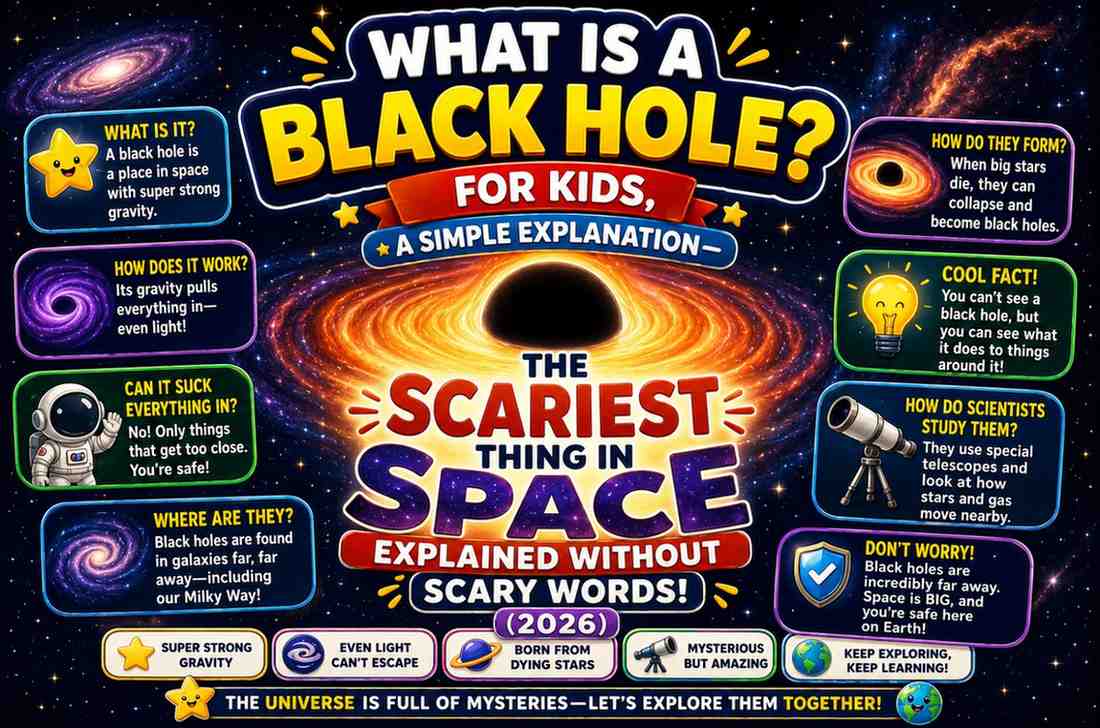
- A black hole the size of a coin would contain the same mass as Earth.
- Halley’s Comet will next visit the inner solar system in 2061.
- Astronauts on the ISS grow about 2 cm taller in space—gravity no longer compresses their spines.
- The Great Red Spot on Jupiter is a storm that has lasted for over 350 years.
- Saturn would float in water—it is less dense than water overall.
- There are more possible chess games than atoms in the observable universe.
- The coldest known place in the universe is the Boomerang Nebula — colder than the background temperature of space.
- Mars has two moons—Phobos and Deimos—both potato-shaped and thought to be captured asteroids.
📍 Image 2 Placement: Place a stunning James Webb Space Telescope deep field image here (NASA public domain) showing thousands of galaxies. ALT Text: Space facts for kids, 2026 easy to understand — James Webb Space Telescope’s deep field photograph showing thousands of distant galaxies
Planet Size Comparison Table
| Planet | Size vs Earth | Moons | Year Length | Fun Fact |
|---|---|---|---|---|
| Mercury | 0.38x | 0 | 88 days | Extreme temperature swings |
| Venus | 0.95x | 0 | 225 days | Hottest planet overall |
| Earth | 1x | 1 | 365 days | Only known life |
| Mars | 0.53x | 2 | 687 days | The tallest volcano |
| Jupiter | 11x | 95 | 12 years | Great Red Spot storm |
| Saturn | 9x | 146 | 29 years | Rings of ice |
| Uranus | 4x | 27 | 84 years | Spins on its side |
| Neptune | 3.9x | 16 | 165 years | Fastest winds |
FAQ: Space Facts for Kids 2026 Easy to Understand
Q1. What is the most amazing space fact for kids? One of the most powerful among all space facts for kids in 2026 easy to understand is that every atom in your body was made inside an ancient star. You are literally made of stardust from stars that exploded billions of years before Earth existed. The universe did not just create you — it is you.
Q2. How big is the universe? The observable universe stretches about 93 billion light years across. But the full universe — beyond what we can see — may be much larger or even infinite. This is one of the most mind-bending space facts for kids in 2026, easy to understand because human brains simply were not built to visualize infinite distances.
Q3. Is there life anywhere else in space? Scientists have not yet found confirmed extraterrestrial life. But with trillions of planets in the universe and water discovered on the Moon and Mars, many scientists believe life elsewhere is very likely. The search is actively ongoing in 2026 — and the answer may come within our lifetimes.
Q4. How do astronauts sleep in space? Astronauts sleep in sleeping bags attached to walls or their bunks to stop themselves floating around the spacecraft. Without gravity, everything floats — including astronauts themselves. Many describe sleeping in space as deeply peaceful, with an incredible view of Earth below them.
Q5. Can kids today become astronauts? Absolutely — and the opportunities are growing in 2026. Multiple space agencies and private companies are planning missions to the Moon and Mars. The best preparation is studying STEM subjects, staying healthy, and developing problem-solving skills. The children reading these space facts for kids 2026 easy to understand today could be the astronauts of tomorrow.
Conclusion
Space is not just something “out there.” It is everything — the atoms in your body, the light in the sky, the ground beneath your feet. The universe is 13.8 billion years old, contains trillions of galaxies, and is expanding at this very moment.
These space facts for kids 2026 easy to understand are just the beginning of the greatest story ever told — the story of a universe discovering itself through the curiosity of beings like you.
Keep exploring. Download a stargazing app. Watch NASA livestreams. Look up at the night sky tonight and remember: every star you see is a sun, and many of them have planets. The universe is enormous beyond imagination, and it is full of wonders waiting to be discovered.