 creator@scienceexplore.site
Stars and galaxies facts for kids easily help us understand the beautiful night sky. Stars are giant balls of burning gas that shine in the darkness of space. Galaxies are collections of billions of stars held together by gravity. Learning star and galaxies facts for kids opens our eyes to the incredible universe we live in.
The universe is vast and mysterious, filled with countless stars and galaxies. Some stars are so far away that their light takes millions of years to reach Earth. When you look at the night sky, you’re actually looking back in time! Let’s explore these amazing stars and galaxies facts for kids easily.
H2: What Are Stars? Basic Stars and Galaxies Facts for Kids Easy
A star is a massive ball of extremely hot gas and plasma. The most famous star is our Sun. Stars produce light and heat through nuclear fusion, a process where atoms combine to create energy. Understanding star and galaxy facts for kids easily starts with understanding what stars really are.
Stars are born in clouds of gas and dust called nebulae. Gravity pulls the gas together, compressing and heating it until nuclear fusion begins. This fusion creates the light and heat we see. Stars shine for billions of years before eventually running out of fuel. Some stars are much bigger than our Sun, while others are smaller.
Basic star facts:
- Balls of hot gas and plasma
- Create light through fusion
- Born in nebulae
- Shine for billions of years
- Come in different sizes and colors
- Most distant stars are very old
H2: Why Do Stars Twinkle? The Most Common Question About Stars and Galaxies: Facts for Kids Easy
One of the most popular stars and galaxies facts for kids’ easy questions is “Why do stars twinkle?” Stars don’t actually twinkle. The twinkling we see is caused by Earth’s atmosphere. Our air moves and shifts, bending the light from distant stars.
When light from a star enters our atmosphere, it travels through layers of air with different temperatures and densities. This causes the light to bend slightly, making the star appear to flicker and twinkle. Astronauts in space see stars as steady, constant lights without any twinkling. This proves that stars and galaxies facts for kids easily include this atmospheric explanation.
Why stars twinkle:
- Earth’s atmosphere bends starlight
- Air layers have different temperatures
- Light bends through these layers
- Creates the twinkling effect
- Stars don’t actually twinkle in space
- Thicker atmosphere = more twinkling
H2: How Many Stars Are There? Big Numbers About Stars and Galaxies: Facts for Kids Easy
Trying to count stars is nearly impossible! Star and galaxy facts for kids easily include big numbers that are hard to imagine. Astronomers estimate there are about 24 sextillion stars in the observable universe. That’s 24 followed by 21 zeros!
Our galaxy, the Milky Way, contains about 100-200 billion stars. Most of these stars are too far away to see without a telescope. The number of stars is so large that new stars are being born while others die. This constant change makes the universe dynamic and ever-changing.
Star count facts:
- Observable universe: 24 sextillion stars (24,000,000,000,000,000,000,000)
- Milky Way galaxy: 100-200 billion stars
- Most stars invisible without telescope
- New stars born constantly
- Numbers too large to fully understand
- Estimates change as technology improves
H2: What Is a Galaxy? Understanding Galaxies: Stars and Galaxies Facts for Kids Easy
A galaxy is a massive collection of stars, gas, and dust held together by gravity. Galaxies come in different shapes and sizes. Some are spiral-shaped like our Milky Way, while others are elliptical or irregular. Learning star and galaxy facts for kids easily includes understanding galaxies.
Galaxies are islands of stars separated by vast empty spaces. The distances between galaxies are enormous—millions of light-years apart. Each galaxy contains billions or even trillions of stars. The universe contains billions of galaxies, making it incomprehensibly large.
Galaxy facts:
- Collections of billions of stars
- Held together by gravity
- Come in different shapes
- Separated by vast distances
- Billions of galaxies exist
- Still being discovered today
H2: Types of Galaxies: Different Shapes of Stars and Galaxies Facts for Kids Easy
Star and galaxy facts for kids easily include information about different galaxy types. Astronomers classify galaxies into main categories based on shape. The three main types are spiral, elliptical, and irregular galaxies.
Spiral galaxies have elegant spinning arms, like our Milky Way. Elliptical galaxies range from nearly round to stretched out. Irregular galaxies have no clear shape, often because they collided with other galaxies. Each type tells us something different about how galaxies form and change.
Galaxy types:
- Spiral galaxies—Arms spinning around center (like Milky Way)
- Elliptical galaxies – Oval or round-shaped
- Irregular galaxies – No clear shape, often from collisions
- Lenticular galaxies—Disk with prominent center
H2: The Milky Way: Our Home Galaxy in Stars and Galaxies Facts for Kids Easy
The Milky Way is our galaxy, and it’s one of the largest galaxies we know. It contains about 100-200 billion stars, including our Sun. Stars and galaxies facts for kids easily must include information about our home galaxy.
The Milky Way is a spiral galaxy with elegant curved arms. At its center is a massive black hole. The name “Milky Way” comes from its appearance—a milky band of light stretching across the night sky. Our entire solar system is just a tiny part of this vast galaxy.
Milky Way facts:
- Spiral galaxy with curved arms
- 100-200 billion stars
- Our Sun is one of these stars
- Black hole at center
- About 100,000 light-years across
- Earth is 26,000 light-years from center
H2: The Andromeda Galaxy: Our Nearest Galaxy Neighbor
The Andromeda Galaxy is the closest large galaxy to our Milky Way. It’s about 2.5 million light-years away. Stars and galaxies facts for kids often mention Andromeda because it’s the most distant object visible to the naked eye from Earth.
Andromeda is a spiral galaxy similar to the Milky Way but even larger. It contains about 1 trillion stars! In the distant future (4-5 billion years), Andromeda and the Milky Way will collide and merge into one giant galaxy. This will be a cosmic event of incredible proportions.
Andromeda facts:
- Nearest large galaxy to us
- 2.5 million light-years away
- Contains 1 trillion stars
- Visible to naked eye
- Similar spiral shape to Milky Way
- Will collide with us in future
H2: Stars and Galaxies Facts for Kids Easy: Different Types of Stars
Not all stars are the same. Stars come in different sizes and colors. Star and galaxy facts for kids easily include information about stellar variety. The color and size of a star depend on its temperature and age.
Red dwarf stars are small and cool, burning slowly and lasting billions of years. Blue giant stars are hot and massive, burning quickly and dying young. Red giant stars are older stars that have expanded. White dwarfs are remnants of dead stars. Neutron stars are incredibly dense. Understanding these types is important for stars and galaxies facts for kids easily.
Types of stars:
- Red dwarfs – Small, cool, long-lived
- Blue giants – Hot, massive, short-lived
- Red giants – Old, expanded stars
- White dwarfs – Dead star remnants
- Neutron stars—Extremely dense
- Supergiants – Enormous stars
H2: The Life Cycle of Stars: Birth to Death
Stars have a life cycle, just like living things. Star and galaxy facts for kids easily include understanding how stars are born, live, and die. This cycle takes billions of years and shapes the universe.
Stars are born when gravity pulls gas and dust together in nebulae. The star grows hotter and brighter as more material collects. For billions of years, the star shines steadily, like our sun. Eventually, it runs out of fuel, swells into a giant, and dies. The star’s death can create a spectacular explosion called a supernova.
Star life cycle:
- Birth – Nebula collapses
- Growth – Fusion begins
- Stable years—billions of years shining
- Red giant phase—Star expands
- Death – Supernova explosion
- Remnant – White dwarf, neutron star, or black hole
H2: Black Holes: The Universe’s Most Mysterious Objects
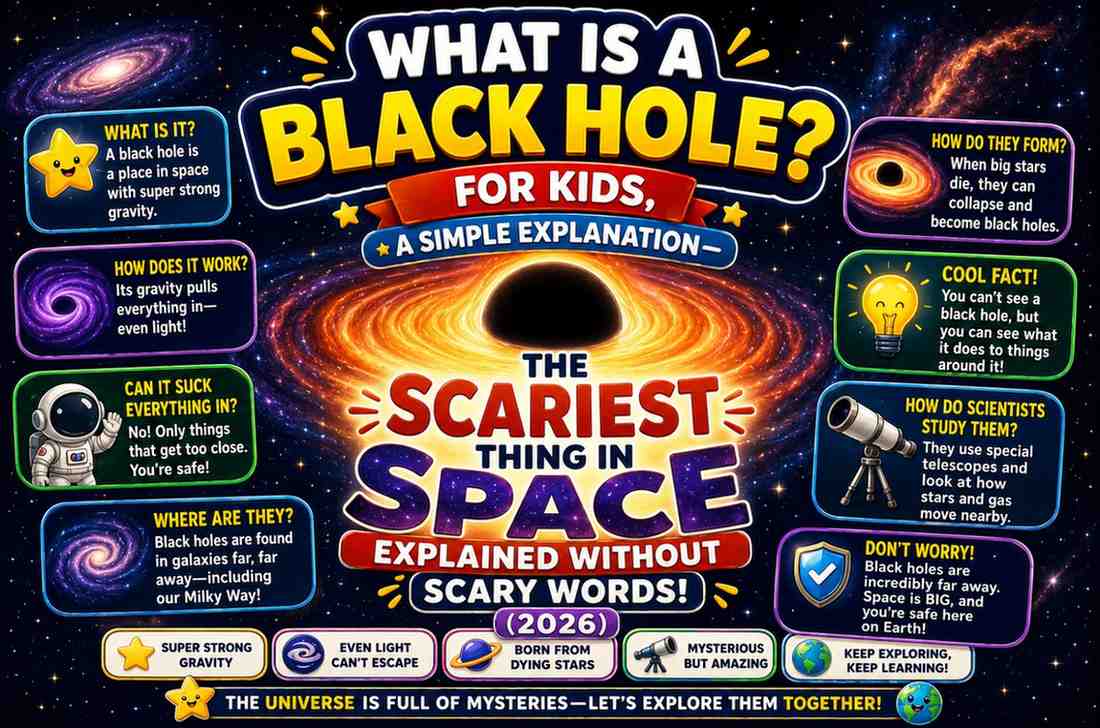
Black holes are among the most fascinating aspects of stars and galaxies. Facts for kids easy. A black hole forms when a massive star dies and collapses. The gravity becomes so strong that nothing, not even light, can escape once it crosses the event horizon (the point of no return).
Black holes are invisible because light can’t escape them. Scientists detect black holes by observing how they affect nearby stars and gas. The center of most galaxies, including our Milky Way, contains a supermassive black hole. These black holes help galaxies form and evolve.
Black hole facts:
- Form from dead massive stars
- Gravity so strong light can’t escape
- Invisible to direct observation
- Detected by effects on nearby objects
- Supermassive black holes center galaxies
- Still mysterious and being studied
H2: Nebulae: Cosmic Clouds Where Stars Are Born
Nebulae are clouds of gas and dust in space. Stars and galaxies facts for kids easily include learning about nebulae because they’re where stars are born. Some nebulae glow with beautiful colors when lit by nearby stars. Others are dark and visible only in infrared light.
Nebulae are massive, spanning light-years across. The Orion Nebula is visible to the naked eye and is a famous birthplace of stars. The Crab Nebula is a remnant of a supernova explosion. Nebulae are among the most beautiful objects in space and are often photographed by telescopes like Hubble.
Nebula facts:
- Clouds of gas and dust
- Star nurseries where stars form
- Come in various colors
- Some visible to naked eye
- Can be light-years across
- Often stunningly beautiful
H2: Light-Years: Measuring the Universe
When discussing stars and galaxies facts for kids easily, we use a special measurement called a light-year. A light-year is the distance light travels in one year: about 6 trillion miles. This helps us understand the vast distances between stars and galaxies.
The star Sirius is about 8.6 light-years away. This means light from Sirius takes 8.6 years to reach Earth. The Andromeda Galaxy is 2.5 million light-years away, meaning we see it as it was 2.5 million years ago. These enormous distances show how vast the universe truly is.
Light-year facts:
- Distance light travels in one year
- About 6 trillion miles
- Used to measure cosmic distances
- The nearest star is 4.37 light-years away
- Most stars are hundreds of light-years away
- Farthest galaxies are billions of light-years away
H2: The Universe Is Expanding: Big Bang and Cosmic Expansion
One of the most important stars and galaxies facts for kids easily is that the universe is expanding. Scientists discovered that galaxies are moving away from each other. This led to the Big Bang theory—the universe started from a single point and has been expanding ever since.
The Big Bang occurred about 13.8 billion years ago. It wasn’t an explosion in space but an expansion of space itself. Everything in the universe came from this single moment. The universe continues expanding, and galaxies continue moving apart. This discovery revolutionized our understanding of stars and galaxies. Facts for kids easy.
Universe expansion facts:
- The universe began with Big Bang
- Happened 13.8 billion years ago
- Space itself is expanding
- All galaxies moving apart
- The universe continues expanding
- Dark energy drives expansion
FAQ SECTION (Schema Friendly)
1. What are star and galaxy facts for kids easy to understand?
Stars are giant balls of burning gas in space that produce light and heat. Galaxies are huge collections of billions of stars held together by gravity. Learning about them helps us understand our place in the vast universe.
2. Why do stars twinkle when they don’t actually twinkle?
Stars twinkle because Earth’s atmosphere bends their light as it passes through different layers of air. The bending makes stars appear to flicker. In space, stars shine as steady, constant lights without twinkling.
3. How can we see stars if they’re so far away?
Stars are so bright that their light reaches Earth even across vast distances. The farthest stars visible to the naked eye are still incredibly bright. Telescopes help us see even more distant and dimmer stars.
4. What is a light-year in simple terms?
A light-year is how far light travels in one year—about 6 trillion miles. Scientists use this measurement to describe distances between stars and galaxies because regular miles would be too big to be useful.
5. Will the Andromeda Galaxy really collide with our Milky Way?
Yes, in about 4-5 billion years, Andromeda and the Milky Way will merge into one giant galaxy. This will be spectacular but won’t happen for a very long time. Our solar system will probably survive the collision.
IMAGE SUGGESTIONS
Image 1: Types of Galaxies Comparison
- Placement: After “Types of Galaxies” section
- Description: Side-by-side images of spiral, elliptical, and irregular galaxies
- ALT Text: “Stars and galaxies facts for kids, easily showing examples of spiral, elliptical, and irregular galaxy types.”
- Purpose: Visual comparison of galaxy shapes
Image 2: Star Life Cycle Diagram
- Placement: After “The Life Cycle of Stars” section
- Description: Illustrated diagram showing star birth from nebula through supernova
- ALT Text: “Stars and galaxies facts for kids: easy diagram showing the complete life cycle of stars from birth to death”
- Purpose: Visual representation of stellar evolution
CONCLUSION WITH CTA
Stars and galaxies: facts for kids easily reveal a universe of extraordinary beauty and mystery. The universe contains countless stars arranged in billions of galaxies, spreading across unimaginable distances. Stars twinkle in our night sky because Earth’s atmosphere bends their light, while the universe itself continues expanding from the Big Bang that occurred 13.8 billion years ago.
Understanding star and galaxy facts for kids easily helps us appreciate our tiny place in this vast cosmos. We live on a small planet orbiting an ordinary star in an average galaxy. Yet we’re able to understand and explore this magnificent universe through science and observation. The night sky holds infinite wonders waiting to be discovered.
Want to learn more about space? Explore our articles about how rockets work, the International Space Station, and how to become an astronaut. Stars and galaxies facts for kids easily are just the beginning of your journey into understanding the universe. Keep looking up!
EXTERNAL LINKS (Authority Sources)
- NASA Galaxies and Stars Education – dofollow
- Space Telescope Science Institute – Hubble – dofollow
- ESA Hubble Space Telescope Images—dofollow
- Stellarium – Free Planetarium Software – dofollow
- Cosmos: Exploring Space and Science – Carl Sagan Foundation – dofollow