 creator@scienceexplore.site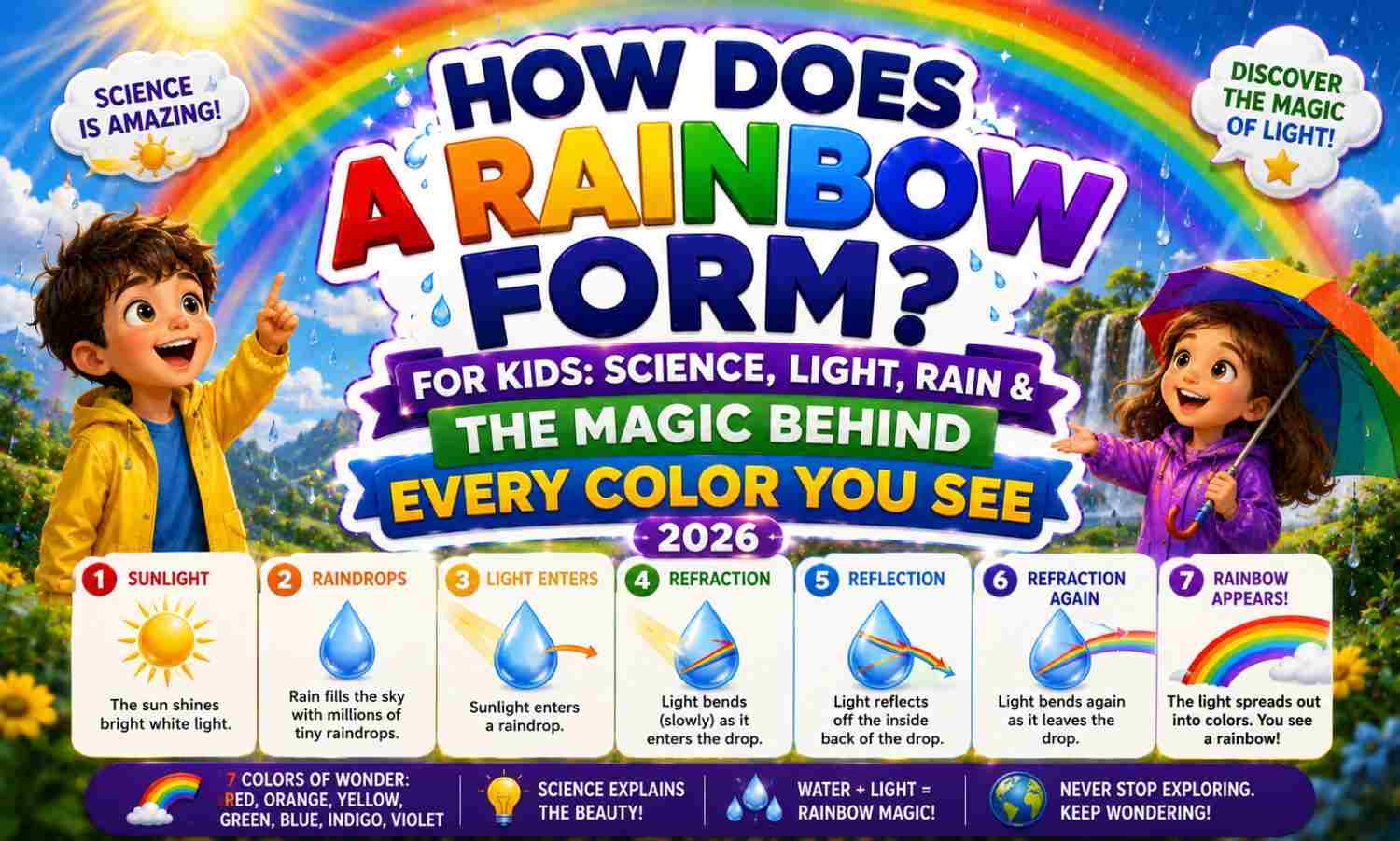
A rainbow after a rainstorm is one of the most beautiful sights in nature. But it isn’t magic—it’s science! “How does a rainbow form?” For kids, science is a question that unlocks the secrets of light, color, and water droplets working together in perfect harmony.
How does a rainbow form? For kids, science begins with a simple fact: sunlight looks white or yellow, but it’s actually made up of ALL the colors you can see blended together. When sunlight passes through a raindrop, those colors get separated, and a rainbow appears.
In this complete guide, you’ll discover everything you need to know about how a rainbow forms for kids‘ science—from the physics of light bending to why you can never reach the end of a rainbow. Let’s explore!
What Is a Rainbow?
The first step in how a rainbow forms for kids’ science is understanding what a rainbow actually is.
A rainbow is an optical phenomenon — a visual effect — caused by sunlight interacting with water droplets in the atmosphere. The sunlight enters each droplet, bends, bounces off the back, and exits again—splitting into a spectrum of colors in the process.
Rainbows are not physical objects floating in the sky. They are an optical illusion created from a specific viewing angle. This is why you can never walk to the end of a rainbow. As you move, the rainbow moves too — it’s always at the same angle relative to your eyes and the sun.
From an airplane flying above rain, passengers sometimes see a full circular rainbow—because the ground isn’t there to cut the bottom half off. On the ground, we usually see only the top half of the circle as an arc.
What Is Light Made Of?
To fully understand how a rainbow forms for kids’ science, we need to understand the nature of light.
Sunlight is called “white light.” It looks white or pale yellow, but it’s actually a mixture of all the colors of the visible spectrum blended together. These colors are red, orange, yellow, green, blue, indigo, and violet—commonly remembered using the name ROY G BIV.
Each color of light travels as an electromagnetic wave. Each color has a different wavelength—the distance between the peaks of its waves:
- Red has the longest wavelength (about 700 nanometers)
- Violet has the shortest wavelength (about 400 nanometers)
- All other colors fall between these extremes
Normally, all these colors travel together at the same speed through empty space and through air, making light appear white. But when light enters a denser material—like water—something very important happens.
This is where how does a rainbow form for kids science really begins.
What Is Refraction?
Refraction is one of the most important physics concepts in how a rainbow forms for kids’ science.
Refraction is the bending of light when it travels from one material (medium) into another. It happens because light travels at different speeds in different materials.
Light travels at about 300,000 km/s in a vacuum. It slows down when it enters water to about 225,000 km/s. When light enters a raindrop, it slows down and bends. When it exits back into air, it speeds up and bends again.
Here’s the crucial detail for how a rainbow forms for kids‘ science: Different colors of light bend by different amounts when they refract:
- Red light bends the least (it slows down a little)
- Violet light bends the most (it slows down more)
- All other colors fall in between
This difference in bending is called dispersion. It’s why white light gets separated into a spectrum of colors when it passes through a raindrop — and it’s why we see a rainbow.
[IMAGE 1 — Place after refraction section]
Suggested Image: A detailed diagram showing a single raindrop with sunlight entering, refracting into colors, reflecting off the back wall, and exiting at different angles to show red at top and violet at bottom. ALT Text: “How does a rainbow form? Kids’ science—diagram of light refracting and reflecting inside a single raindrop creating rainbow colors.”
How a Raindrop Creates a Rainbow — Step by Step
This is the central mechanism of how does a rainbow form for kids science. Let’s follow a single ray of sunlight through a raindrop:
Step 1 — Light Enters the Raindrop A ray of white sunlight hits the curved surface of a spherical raindrop. As it enters the water, it slows down and refracts. Because different colors bend by different amounts, the colors begin to spread apart (dispersion begins).
Step 2 — Light Reflects Off the Back Wall The refracted light travels through the raindrop and hits the curved back surface. At this angle, most of the light undergoes total internal reflection — bouncing off the back wall like a mirror, instead of passing through it.
Step 3 — Light Exits and Refracts Again The reflected light travels back toward the front surface of the raindrop and exits. As it speeds up back into air, it refracts a second time. This second refraction spreads the colors even further apart.
Step 4 — Colors Exit at Different Angles Here is the most important number in how does a rainbow form for kids science:
- Red light exits at about 42 degrees from the original incoming ray
- Violet light exits at about 40 degrees
- Other colors exit at angles between 40 and 42 degrees
Step 5 — Millions of Drops Create the arc. A single raindrop only sends one color to your eye at any given moment. But there are millions of raindrops in the sky. Each drop sends a different color to your eye based on its position. All the drops at 42 degrees appear red. All the drops at 40 degrees send violet light. Together, they create the continuous colorful arc you see as a rainbow.
The 7 Colors of the Rainbow
The color order is one of the most well-known parts of how a rainbow forms for kids’ science.
The rainbow always displays its colors in the same order, from the outside (top) of the arc to the inside (bottom):
- Red — outermost, exits at 42°, longest wavelength
- Orange
- Yellow
- Green
- Blue
- Indigo
- Violet — innermost, exits at 40°, shortest wavelength
Use the name ROY G. BIV to remember the order!
Sir Isaac Newton was the first to demonstrate that white light contains all these colors in the 1660s. He used a glass prism to separate light—the same physics at work in every raindrop. Interestingly, Newton chose to identify 7 colors in part because 7 was considered a special number (7 musical notes, 7 days of the week).
Why Is a Rainbow Arc-Shaped?
Shape is another key element of how does a rainbow form for kids science.
The rainbow’s arc shape arises directly from the geometry of refraction and reflection. Since each color exits its raindrop at a specific fixed angle (between 40° and 42° from the incoming sunlight), all the raindrops that can send that color to your eye must be at exactly that angle from the imaginary line running from the sun through your eyes to the antisolar point (the point directly opposite the sun from your perspective).
All the raindrops at that fixed angle form a circle around the antisolar point. The ground cuts off the bottom half of this circle—giving us the familiar rainbow arc.
From an airplane above the rain, with no ground interference, the full circle of the rainbow becomes visible.
What Is a Double Rainbow?
Double rainbows are an exciting addition to how a rainbow forms for kids’ science knowledge.
A double rainbow forms when light reflects twice inside the raindrop instead of once before exiting.
- The primary rainbow (lower, brighter) has red on top, violet on bottom—exiting at 40°–42°
- The secondary rainbow (upper, dimmer) has colors reversed—violet on top, red on bottom—exiting at approximately 50°–53°
The secondary rainbow is dimmer because more light escapes the drop on the first reflection, leaving less light for the second reflection.
Between the two rainbows is a noticeably darker band called Alexander’s Dark Band. This region appears dark because light reflected once exits below 42° and light reflected twice exits above 50° — leaving the sky between those angles without extra illumination.
[IMAGE 2 — Place after double rainbow section]
Suggested Image: A illustrated comparison of a primary and secondary rainbow showing reversed color orders, with Alexander’s Dark Band labeled between them and the angle measurements shown. ALT Text: “How does a rainbow form for kids science — diagram showing double rainbow with primary and secondary arcs, reversed colors, and Alexander’s Dark Band”
Can You Make Your Own Rainbow?
Hands-on experiments are a great companion to understanding how does a rainbow form for kids science.
Method 1 — Garden Hose Stand with the sun behind you. Set a hose to the finest mist setting. The tiny water droplets refract and split sunlight exactly like raindrops — creating a real rainbow right in front of you!
Method 2 — Glass of Water and Paper Fill a clear glass with water and set it on a sunny windowsill. Hold a white sheet of paper on the other side of the glass. A rainbow spectrum will project onto the paper as sunlight passes through the water.
Method 3 — Glass Prism A prism uses refraction to split white light into a full color spectrum. This is exactly the same physics as how does a rainbow form for kids science — just with glass instead of a water droplet.
When and Where to See a Rainbow
Practical knowledge adds great value to how does a rainbow form for kids science.
For a natural rainbow to appear, you need all three of these:
- Bright sunlight — Direct, unobstructed sunlight
- Water droplets — Rain, mist, spray, waterfalls, or fog
- Correct angle — The sun must be relatively low in the sky (below about 42°) and behind you
This is why rainbows appear in the late afternoon (sun low in the west) or morning (sun low in the east) and always in the part of the sky opposite the sun.
Rainbows are most vivid when:
- The rain cloud behind them is dark (good contrast)
- The sun is bright and unobstructed
- You’re close to the rain (larger drops make brighter rainbows)
Different Types of Rainbows
Expanding knowledge of how does a rainbow form for kids science includes knowing that rainbows aren’t just one type.
| Type | Cause | Appearance |
|---|---|---|
| Primary Rainbow | Single reflection inside raindrops | Bright arc, red on top |
| Secondary Rainbow | Double reflection, colors reversed | Dimmer arc above primary |
| Moonbow (Lunar Rainbow) | Moonlight instead of sunlight | Very faint, often appears white |
| Fogbow | Very tiny fog droplets | Broad, white or pale arc |
| Circumzenithal Arc | Ice crystals, not water droplets | Upside-down arc near the sun |
| Supernumerary Rainbow | Wave interference inside drops | Extra pink and green bands just inside primary rainbow |
The Science of Color Perception
A deeper connection to how a rainbow forms for kids’ science involves understanding how our eyes detect color.
Human eyes contain three types of cone cells sensitive to red, green, and blue light, respectively. Our brains combine signals from these three cone types to perceive all the millions of colors we see.
When rainbow colors hit our eyes, each wavelength stimulates our cones in different combinations — allowing us to distinguish red, orange, yellow, green, blue, indigo, and violet as separate bands.
Bees can detect ultraviolet light—beyond violet in the spectrum—so their “rainbow” has colors we can’t even imagine!
Amazing Rainbow Facts for Kids
- The longest-lasting rainbow ever recorded lasted 8 hours 58 minutes in Taipei, Taiwan, on November 30, 2017
- A rainbow seen from the ground is always a semicircle—but from above (airplane), it can be a full circle
- The antisolar point—the point directly opposite the sun from your perspective—is always at the center of a rainbow’s circle
- No two people see the exact same rainbow—your eyes occupy a slightly different position from everyone else’s
- Isaac Newton first proved white light is a mixture of all colors in 1666 using a glass prism
FAQs: How Does a Rainbow Form for Kids Science
Q1: How does a rainbow form for kids’ science—in one simple sentence? A: Sunlight enters a raindrop, bends into separate colors, bounces off the back of the drop, and exits at slightly different angles for each color—creating the colorful arc we call a rainbow.
Q2: How does a rainbow form for kids’ science—why are there exactly 7 colors? A: The rainbow is actually a continuous color gradient. The “7 colors” were a classification chosen by Sir Isaac Newton. In reality, there are millions of gradual color transitions between red and violet.
Q3: How does a rainbow form for kids’ science—why is red always on top? A: Red light bends the least when it refracts through water, so it exits the raindrop at a slightly higher angle (42°) than violet (40°). Since the higher-angled drops are higher in the sky, red appears at the top.
Q4: How does a rainbow form for kids’ science—why can’t you touch or reach a rainbow? A: A rainbow is an optical effect created by a specific viewing angle, not a physical object in the sky. As you move toward it, the angle changes and the rainbow moves with you. You can never actually reach it.
Q5: How does a rainbow form for kids’ science? Can rainbows happen at night? A: Yes! A rare moonbow forms when bright moonlight (usually a full moon) shines through rain. Moonbows are much fainter than solar rainbows and often appear white to the human eye, though long-exposure photographs can reveal their colors.
Conclusion
From the physics of refraction to the geometry of arcs, how does a rainbow form? For kids, science is one of the most elegant examples of natural optics in the world. Sunlight — which looks plain and white — is secretly carrying every color simultaneously. A humble raindrop is all it takes to reveal the hidden spectrum.
How does a rainbow form? For kids, science teaches us that even the most beautiful things in nature follow clear, logical rules. And once you understand those rules, you’ll never look at a rainbow the same way again.
The next time you spot that arc of color after a rainstorm, you won’t just see beauty — you’ll see refraction, reflection, dispersion, and the entire visible electromagnetic spectrum laid out before you.
Loved this science guide? Explore our full library of kid-friendly science articles and keep discovering the incredible world of physics, biology, and Earth science!
External Links
- https://scijinks.gov/rainbow — NOAA SciJinks: How Do Rainbows Form? (Official)
- https://www.nationalgeographic.com/science/article/rainbows — National Geographic: Rainbows
- https://www.britannica.com/science/rainbow-optics — Britannica: Rainbow (Optics)
- https://www.nasa.gov/stem-ed-resources/light-and-color — NASA: Light and Color Education
- https://www.physics.org/article-questions.asp?id=65 — Institute of Physics: How Rainbows Work