 creator@scienceexplore.site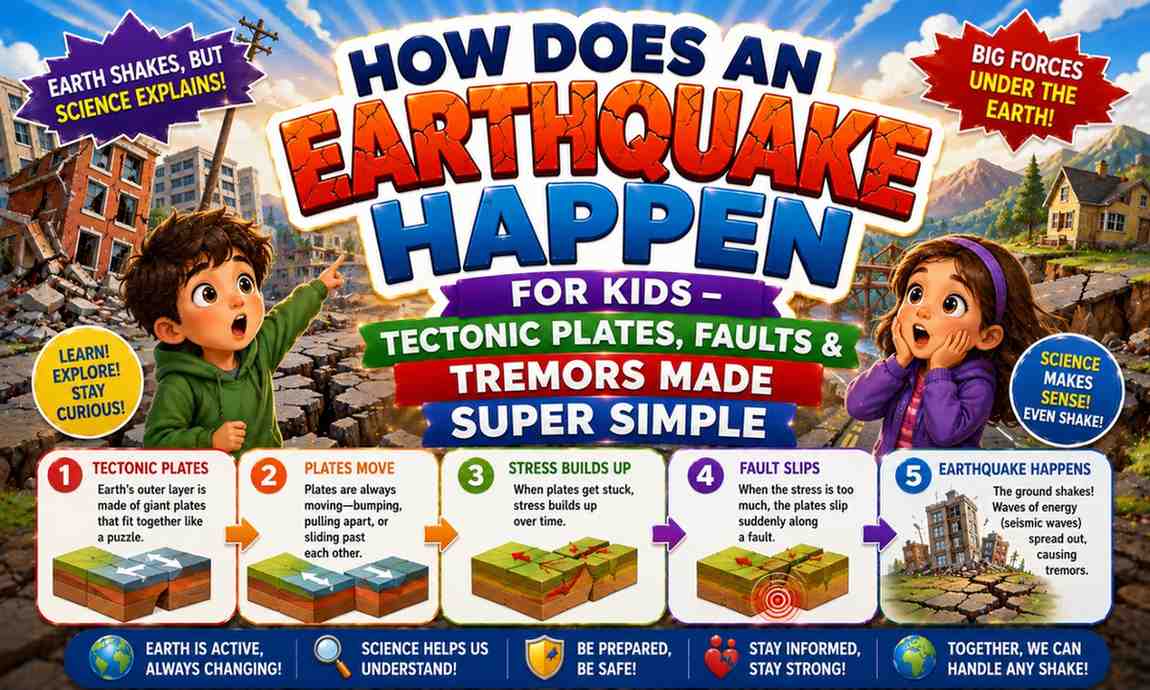
The ground feels solid and still beneath your feet. But every single day, the Earth shakes somewhere. Understanding how does an earthquake happen for kids is one of the most useful and exciting science lessons you can learn. It turns a scary natural event into something you can explain, understand, and even prepare for.
How does an earthquake happen? For kids, it starts deep underground, where giant pieces of the Earth’s crust are constantly—very slowly—moving. When those pieces suddenly slip or grind against each other, energy is released and travels through the ground as shaking waves. That shaking is what we call an earthquake.
In this complete guide, you’ll get the full, clear answer to how an earthquake happen for kids—from the inside of the Earth all the way to the trembling ground beneath your feet. Let’s get started.
What Is an Earthquake?
The starting point for how does an earthquake happen for kids is a simple definition.
An earthquake is a sudden shaking or vibration of the Earth’s surface caused by the release of energy stored deep in the crust. This energy travels outward in all directions as seismic waves—ripples through rock that we feel as shaking.
Earthquakes can be barely noticeable—a tiny vibration only sensitive instruments can measure—or catastrophically powerful, capable of destroying entire cities. Every year, approximately 500,000 earthquakes occur on Earth. About 100,000 of those are strong enough for people to feel. Around 100 causes significant damage.
The Earth’s Layers — Why They Matter for Earthquakes
A solid understanding of how does an earthquake happen for kids requires knowing what the Earth is made of.
The Earth has four main layers:
- Crust — The thin, rocky outer shell. It ranges from 5 km (under oceans) to 70 km thick (under mountains). This is where we live.
- Mantle — A thick layer of hot rock beneath the crust. The upper mantle flows very slowly, like extremely thick honey.
- Outer Core — Liquid iron and nickel, at around 4,000–5,000°C.
- Inner Core — Solid iron at the very center, kept solid by crushing pressure.
The crust and the uppermost mantle together form the lithosphere. The lithosphere is broken into large pieces called tectonic plates—and their movement is the direct cause of most earthquakes.
What Are Tectonic Plates?
Tectonic plates are the key actors in answering how does an earthquake happen for kids.
Think of the Earth’s crust as a giant cracked eggshell. The individual pieces of that cracked shell are tectonic plates. There are about 15 major tectonic plates and many smaller ones. They fit together like puzzle pieces and cover the entire surface of the Earth.
These plates are not stationary. They move extremely slowly, typically just 2 to 5 centimeters per year (about the speed your fingernails grow). The heat rising from the Earth’s interior drives movements in the mantle that drag the plates along in a process called convection.
Over millions of years, this movement has shifted whole continents, created mountain ranges, opened oceans, and caused countless earthquakes.
[IMAGE 1 — Place after tectonic plates section]
Suggested Image: A world map showing the major tectonic plates with arrows indicating movement directions and labels for the Ring of Fire. ALT Text: “How does an earthquake happen for kids—world map showing tectonic plates, boundaries, and the Ring of Fire?”
How Do Plates Cause Earthquakes?
This is the core answer to how does an earthquake happen for kids. Tectonic plates are always moving, and they interact at their edges, called plate boundaries. There are three types of plate boundaries, each causing earthquakes in slightly different ways:
1. Convergent Boundaries — Plates Moving Toward Each Other
When two plates push toward each other, one may slide beneath the other in a process called subduction. The descending plate drags down into the mantle while the upper plate is pushed up. Enormous stress builds at the contact zone. When it suddenly releases—earthquake!
Convergent boundaries also build mountains and deep ocean trenches. The Andes mountain range and the Mariana Trench were both formed this way.
2. Divergent Boundaries — Plates Moving Apart
Here, two plates pull away from each other. New molten rock rises from below to fill the gap, creating new crust. The tension and cracking of the crust as it splits apart generates earthquakes, though these are usually less powerful.
The Mid-Atlantic Ridge is a famous divergent boundary.
3. Transform Boundaries — Plates Sliding Past Each Other
Two plates grind horizontally past each other in opposite directions. There’s no subduction and no new crust created—just two massive slabs of rock scraping against each other. This grinding creates some of the most powerful earthquakes on Earth.
California’s San Andreas Fault is a transform boundary. It’s where the Pacific Plate and the North American Plate slowly slide past each other—and where major earthquakes regularly strike.
What Is a Fault Line?
Fault lines are central to how does an earthquake happen for kids in a practical sense.
A fault is a fracture or crack in the Earth’s crust along which two blocks of rock can move. Faults exist at plate boundaries and also within plates where old stress fractures exist.
When rocks on either side of a fault get stuck together due to friction, stress builds up. The rocks bend and strain — storing enormous elastic energy, like a compressed spring. Eventually, the stress exceeds the frictional force holding the rocks together and they suddenly slip. All that stored energy releases instantaneously.
The underground point where the slip begins is called the focus (or hypocenter). The point on the surface directly above it is the epicenter. Shaking is generally most severe at the epicenter and decreases with distance.
What Are Seismic Waves?
When an earthquake releases energy, it sends out seismic waves — vibrations that travel through rock in all directions from the focus. Understanding seismic waves is important for a complete answer to how does an earthquake happen for kids.
There are three main types:
P-waves (Primary Waves)
- The fastest type — up to 8 km/s through solid rock
- Push and pull the rock forward and backward (like a slinky toy)
- Can travel through solids, liquids, and gases
- Arrive first at a seismograph station
S-waves (Secondary Waves)
- Slower than P-waves — about 4–5 km/s
- Shake rock side-to-side perpendicular to the direction of travel
- Can only travel through solids (not liquids)
Surface Waves
- Slowest of all, but most destructive
- Travel along the Earth’s surface
- Cause the rolling, swaying motion felt during large earthquakes
- Responsible for most earthquake damage to buildings
How Scientists Measure Earthquakes
Measurement tools are a key practical component of how does an earthquake happen for kids.
Scientists who study earthquakes are called seismologists. They use an instrument called a seismograph to detect and record seismic waves. The recordings, called seismograms, show the amplitude and frequency of the waves.
Earthquake strength is measured using a magnitude scale.
| Magnitude | Effect |
|---|---|
| 1.0–2.9 | Not felt by people |
| 3.0–3.9 | Slight vibration, sometimes felt |
| 4.0–4.9 | Rattles dishes and windows |
| 5.0–5.9 | Minor structural damage possible |
| 6.0–6.9 | Significant damage in populated areas |
| 7.0–7.9 | Major earthquake — widespread destruction |
| 8.0+ | Great earthquake—catastrophic damage |
The 1960 Valdivia earthquake in Chile — magnitude 9.5 — is the most powerful ever recorded.
[IMAGE 2 — Place after the measurement section]
Suggested Image: A labeled diagram showing the earthquake focus (hypocenter) underground, the epicenter on the surface, and seismic waves spreading outward as concentric circles. ALT Text: “How does an earthquake happen for kids—diagram showing earthquake focus, epicenter, and seismic waves spreading through Earth”
What Happens During and After an Earthquake?
When answering how does an earthquake happen for kids, it’s helpful to know what the experience is actually like.
During the earthquake:
- The ground shakes, vibrates, or rolls
- Buildings sway and creak
- Objects fall off shelves
- You may hear a rumbling sound
- The shaking may last from a few seconds to over 3 minutes
Aftershocks: After the main earthquake, smaller aftershocks occur as the crust readjusts. Aftershocks can happen minutes, hours, days, or even weeks after the main event. They decrease in frequency over time.
Foreshocks: Some earthquakes are preceded by smaller foreshocks. Unfortunately, it’s impossible to know in advance whether a small quake is a foreshock or just a minor independent earthquake.
Earthquake Safety for Kids
Safety knowledge is an essential part of how does an earthquake happen for kids—because understanding the science includes knowing how to respond.
During an earthquake:
- Drop, Cover, Hold On — Get under a sturdy table or desk and hold on tight
- Protect your head and neck with your arms
- Stay away from windows, exterior walls, and heavy furniture
- Do NOT run outside during shaking
After an earthquake:
- Expect aftershocks and stay alert
- Check for injuries
- Stay away from damaged buildings
- Listen to emergency broadcasts
Famous Earthquakes in History
Real examples bring how does an earthquake happen for kids to life:
- 1906 San Francisco Earthquake (M 7.9)—Destroyed much of the city; fires caused by broken gas mains created more damage than the shaking
- 1960 Valdivia, Chile (M 9.5) — Most powerful earthquake ever recorded; triggered a Pacific-wide tsunami
- 2004 Indian Ocean Earthquake (M 9.1) — Generated a tsunami that killed over 230,000 people across 14 countries
- 2011 Tōhoku, Japan (M 9.0) — Caused a massive tsunami and the Fukushima nuclear disaster
- 1556 Shaanxi, China — Deadliest earthquake ever, estimated to have killed 830,000 people
Can We Predict Earthquakes?
One of the biggest open questions in the science behind how does an earthquake happen for kids is prediction.
Currently, scientists cannot reliably predict when and where a specific earthquake will occur. However, they can:
- Identify high-risk regions based on plate boundary locations
- Monitor ground movements with GPS
- Detect tiny tremors using sensitive seismographs
- Study historical earthquake patterns
- Issue seismic hazard maps used in building codes
Several countries have developed early warning systems that detect P-waves (which arrive before the destructive S-waves and surface waves) and send alerts seconds before shaking begins. Japan’s earthquake early warning system is one of the world’s most advanced.
FAQs: How Does an Earthquake Happen for Kids
Q1: How does an earthquake happen for kids in one simple sentence? A: An earthquake happens when two tectonic plates suddenly slip or grind against each other, releasing stored energy that travels through the ground as shaking waves.
Q2: How does an earthquake happen for kids? What is the most dangerous type of plate boundary? A: Transform boundaries (like the San Andreas Fault) and convergent subduction zones tend to produce the most powerful and destructive earthquakes.
Q3: How does an earthquake happen for kids? What is the difference between the epicenter and the focus? A: The focus (or hypocenter) is the underground point where the earthquake starts. The epicenter is the point on the Earth’s surface directly above the focus.
Q4: How does an earthquake happen for kids — why do some areas have more earthquakes than others? A: Areas near tectonic plate boundaries experience far more earthquakes. The Pacific Ring of Fire — surrounding the Pacific Ocean — is the most seismically active region on Earth.
Q5: How does an earthquake happen for kids? Can animals sense earthquakes before they strike? A: Some animals may sense very subtle environmental changes (like changes in groundwater, electrical fields, or micro-tremors) before earthquakes. Scientists are actively studying this, but it’s not yet reliable enough for official prediction purposes.
USGS Earthquake Science for Kids (Official)
Conclusion
Now you have a thorough, clear answer to how does an earthquake happen for kids. From the slow dance of tectonic plates to the sudden slip of fault lines to the seismic waves that shake the surface—earthquakes are fascinating, powerful, and understandable.
Knowing how does an earthquake happen for kids isn’t just about science class. It’s knowledge that helps communities build safer buildings, engineers design earthquake-resistant structures, and ordinary people know exactly what to do when the ground begins to shake.
Curious about more natural wonders? Explore our full library of kid-friendly Earth science guides and keep learning about the incredible forces that shape our world!