 creator@scienceexplore.site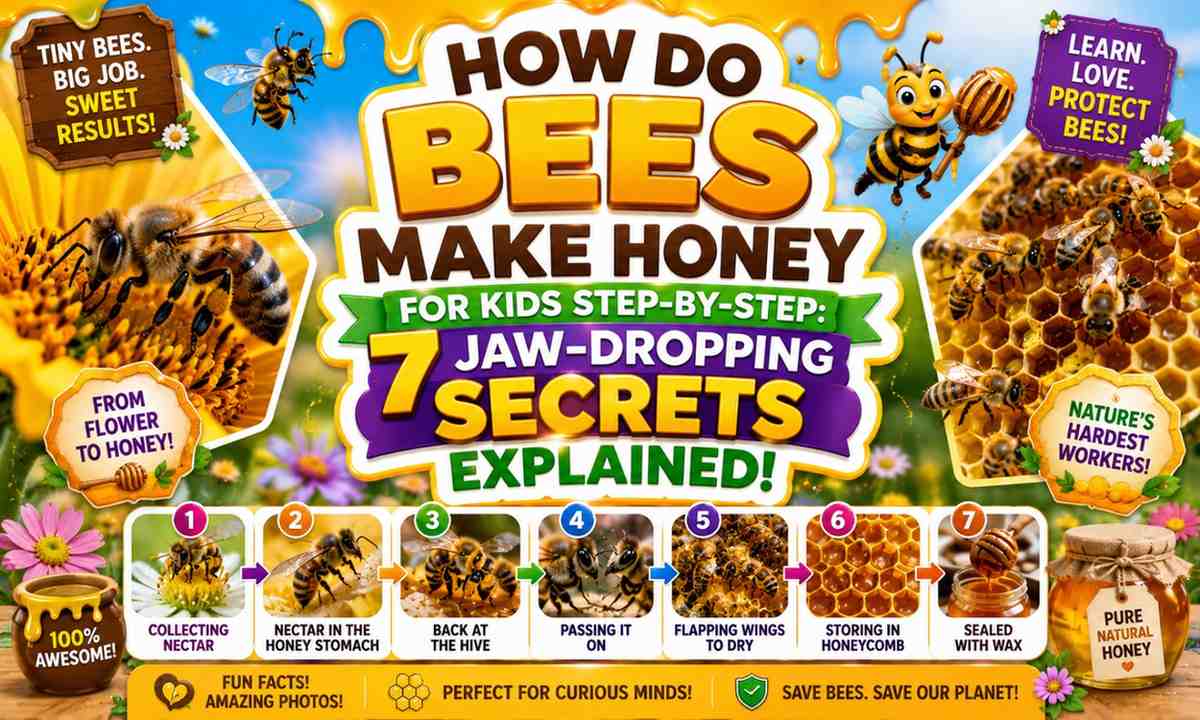
Introduction: The Sweet Science Behind Every Drop of Honey
Next time you drizzle honey on your toast or stir it into your tea, think about this: that golden, sweet syrup was made by one of the hardest-working creatures on Earth—the honeybee.
Understanding how bees make honey for kids step-by-step is not just sweet—it’s one of the most impressive examples of teamwork, chemistry, and natural engineering you’ll ever discover.
A single jar of honey represents millions of flower visits, thousands of kilometers of flight, and the combined effort of tens of thousands of bees working together as a perfectly organized community. Let’s follow that incredible journey from the first flower to your breakfast table! 🍯🐝
Meet the Honeybee Colony—A Community Like No Other
Before we explore how bees make honey for kids step-by-step, it helps to understand the bee community that makes it all possible.
A honeybee hive contains:
- 👑 One Queen Bee — She is the mother of the entire colony. Her only job is to lay eggs—up to 2,000 per day!
- 🐝 Worker Bees (20,000–80,000) — All worker bees are female. They do everything: collect nectar, make honey, guard the hive, care for larvae, and build the honeycomb.
- 🐝 Drone Bees (a few hundred) — All drones are male. Their only job is to mate with a new queen. They don’t make honey and don’t have stingers.
The bees that make honey are the worker bees — and they are extraordinary little creatures.
Step 1: The Worker Bee Sets Out to Find Flowers 🌸
The honey-making journey begins with a worker bee leaving the hive in search of flowers.
Worker bees are foragers — they fly out and look for flowers that contain nectar (a sweet liquid produced by flowers) and pollen (a fine yellow powder).
A forager bee can fly up to 8 kilometers from the hive in search of good flowers. To travel this distance and back, it burns up nearly as much nectar energy as it collects—which is why bees are always so busy!
When a forager finds a good patch of flowers, she doesn’t just tell her friends with a buzz. She performs one of nature’s most extraordinary communications: the waggle dance!
The Waggle Dance 💃
Back at the hive, the forager bee does a figure-of-8 dancing motion on the honeycomb. The direction of the dance indicates which direction to fly relative to the Sun. The duration of the wiggling tells other bees how far to fly.
It’s essentially a GPS navigation system communicated entirely through dance. Scientists Karl von Frisch discovered this and won the Nobel Prize for it!
Step 2: Collecting Nectar From Flowers 🌺
When a worker bee lands on a flower, she uses her long, straw-like tongue called a proboscis to suck up the sweet nectar from inside the flower.
She stores this nectar in a special second stomach called the honey stomach (or honey crop), which is completely separate from her regular digestive stomach.
A bee visits 50–100 flowers on a single trip. By the time she’s ready to return to the hive, her honey stomach is full—holding about 40 milligrams of nectar. That might not sound like much, but multiply it by thousands of forager bees making dozens of trips per day, and it adds up fast!
While collecting nectar, the bee also picks up pollen on her fuzzy body and legs. She transfers this pollen between flowers, helping them reproduce—this is pollination, one of the most vital services bees provide to the entire planet.
Step 3: The Chemistry Begins—Enzymes Are Added 🧪
Here’s where the science gets truly magical, and it’s a key part of how bees make honey for kids step by step.
While the nectar is sitting in the bee’s honey stomach during the flight home, something remarkable begins to happen. The bee’s body adds special proteins called enzymes to the nectar.
The most important enzyme is called invertase (or sucrase). This enzyme begins breaking down the sucrose (a type of complex sugar in nectar) into simpler sugars: glucose and fructose.
This chemical transformation is the very beginning of turning plant nectar into bee honey. The process continues back at the hive.
Step 4: Back at the Hive—Nectar Is Passed On 🏠
When the forager bee returns to the hive, she passes her nectar to a house bee—another worker bee whose job is to process the nectar inside the hive.
The nectar is passed mouth-to-mouth (called trophallaxis) from bee to bee. Each time it’s passed, more enzymes are added, continuing the chemical transformation.
This mouth-to-mouth chain can involve up to 20 different bees before the nectar reaches the honeycomb!
Step 5: Storing Nectar in the Honeycomb 🔶
Eventually, the processed nectar is deposited into the tiny six-sided wax cells of the honeycomb.
The honeycomb itself is a marvel of engineering! Bees build it from beeswax, which they produce from special glands on their abdomen. The six-sided (hexagonal) shape of each cell is mathematically perfect — it uses the least amount of wax possible while providing the strongest possible structure.
However, at this stage, the nectar is still too wet to be honey. Fresh nectar contains about 80% water. Proper honey only contains about 17–20% water.
All that extra water needs to be removed before the nectar can become honey — and bees have a brilliantly simple way to do it.
Step 6: Evaporating the Water — Making Honey Thicker 💨
To remove water from the nectar, bees become tiny fans!
Thousands of worker bees beat their wings rapidly over the honeycomb cells, creating a powerful air current through the hive. This airflow causes water to evaporate from the nectar, gradually thickening it.
Simultaneously, the bees’ enzyme activity continues, further breaking down the sugars and changing the chemistry of the nectar into honey.
This fanning process takes about 1–3 days. The bees also spread the nectar thinly across honeycomb cells to increase the surface area exposed to air, speeding up evaporation — just like how a shallow dish of water dries faster than a deep cup!
As the water evaporates, the nectar thickens and transforms into honey.
Step 7: Sealing the Honey—The Wax Cap 🍯
When the honey has reached the perfect moisture level (below 20%), the bees know it’s ready. They seal the filled honeycomb cell with a thin layer of fresh beeswax, creating what’s called a wax cap or wax seal.
This sealed honey can last for an extraordinarily long time. Honey has been found in ancient Egyptian tombs that was 3,000 years old and was still perfectly edible! Honey is naturally resistant to bacteria and mold because of its low water content and natural antimicrobial properties.
🏆 And there it is—a perfectly made jar’s worth of golden honey, stored in a beautiful honeycomb, ready for the bees to eat during winter—or for us to enjoy on our toast!
How Much Honey Does One Bee Make?
Here’s a number that will blow your mind:
A single honeybee produces about 1/12 of a teaspoon of honey in her entire lifetime—about 40 days of hard work!
A standard jar of honey (450 g) requires:
- About 1 million flower visits
- Around 800 bees
- Flying a combined distance of roughly 90,000 kilometres — more than twice around the world!
That’s why honey is sometimes called “liquid gold.” Every drop represents enormous effort.
You can learn more about bees and their crucial role in our ecosystem at Bee Informed Partnership—a DoFollow resource dedicated to honeybee health and research.
Why Is Honey Good for You?
Honey contains:
- Natural sugars (glucose and fructose) for quick energy 🔋
- Antioxidants that protect your cells from damage 🛡️
- Antibacterial compounds that can help heal wounds 🩹
- Trace minerals like potassium, calcium, and magnesium 💊
In traditional medicine around the world, honey has been used for thousands of years to soothe sore throats, heal burns, and boost immunity. Modern science confirms many of these benefits!
Note: Honey should never be given to babies under 12 months old, as it can contain spores that are harmful to very young infants.
Bees: Heroes of the Planet 🌍
Understanding how bees make honey for kids step-by-step also means understanding just how vital bees are to all life on Earth.
Bees don’t just make honey — they pollinate approximately one-third of all the food humans eat. Without bees:
- We’d lose apples, strawberries, blueberries, almonds, cucumbers, and hundreds of other foods.
- Many wild plants that animals rely on for food would disappear.
- Entire ecosystems would collapse.
Sadly, bee populations worldwide are declining due to pesticides, habitat loss, disease, and climate change. Learning about bees and appreciating their work is the first step toward protecting them.
Frequently Asked Questions (FAQ)
❓ Q1: Do all bees make honey?
No! Only honeybees make honey in large quantities. Bumblebees make tiny amounts of honey (just enough to feed their small colonies). Most of the world’s 20,000+ bee species are solitary and make no honey at all.
❓ Q2: Why is honey so sweet?
Honey is sweet because it’s made mostly of glucose and fructose—two natural sugars. These sugars come from the original nectar and are concentrated as bees remove water during the honey-making process.
❓ Q3: Does honey ever go bad?
Pure, properly stored honey essentially never expires! Archaeologists have found 3,000-year-old honey in Egyptian tombs that was still edible. Its low water content and natural antimicrobial compounds prevent bacteria and mold from growing.
❓ Q4: Why do bees make more honey than they need?
Bees can’t control the weather or predict exactly how long and harsh winter will be. So they produce and store as much honey as possible as a survival buffer. Beekeepers carefully harvest only the surplus honey — leaving enough for the bees to eat through winter.
❓ Q5: What is royal jelly and how is it different from honey?
Royal jelly is a special substance produced by worker bees and fed exclusively to the queen bee and developing queens. It’s creamy white, slightly sour-tasting, and packed with proteins. Unlike honey (which is for energy storage), royal jelly is a premium nutrition source that causes a larva to develop into a queen rather than a worker bee.
Conclusion
The answer to how bees make honey for kids, step by step, is a beautiful story of chemistry, teamwork, incredible instinct, and natural engineering that has been perfected over 100 million years of evolution.
From a bee’s waggle dance to the wax-sealed honeycomb cell, every single drop of honey represents a symphony of effort and intelligence from thousands of tiny creatures working together for the good of their colony.
So the next time you reach for that honey jar, take a moment of appreciation for the remarkable little bees who made it. They deserve it!