
 creator@scienceexplore.site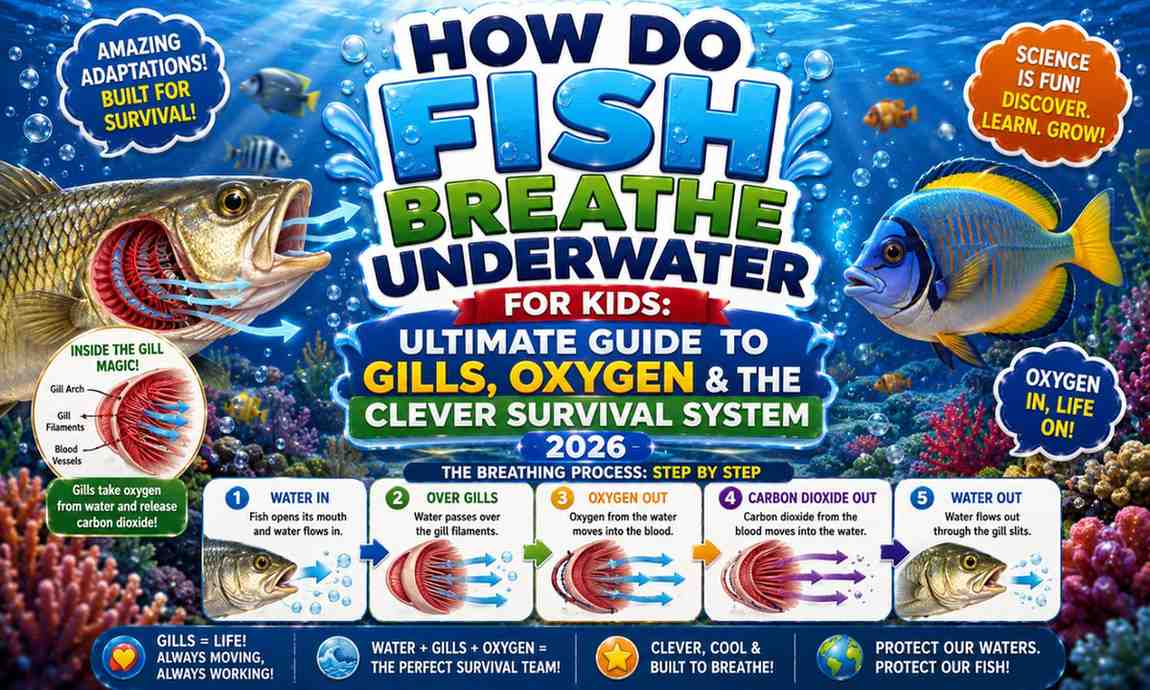
You breathe air. Fish breathe underwater. But here’s the secret—both you and a fish are doing the exact same thing. You’re both trying to get oxygen into your blood and release carbon dioxide out of it. The difference is the equipment and the environment.
How do fish breathe underwater, for kids, is a question that opens up one of the most brilliantly designed systems in all of biology. Fish use organs called gills that are so efficient they can extract up to 80% of the dissolved oxygen from water — far more than your lungs extract from the air you breathe.
In this complete guide, you’ll get a full, step-by-step answer to how fish breathe underwater for kids—from the structure of gill filaments to the genius countercurrent exchange system. Let’s dive in!
Do Fish Breathe Like We Do?
To start with, how do fish breathe underwater? Let’s understand what breathing really means.
Breathing has one goal: move oxygen (O₂) into the bloodstream and remove carbon dioxide (CO₂). In humans, lungs do this by exposing blood to air across a massive network of tiny air sacs called alveoli.
Fish need to do exactly the same thing. The key difference is that fish live surrounded by water—not air. So instead of lungs and air, fish use gills and water.
Water contains dissolved oxygen — not the oxygen in H₂O, but tiny amounts of oxygen gas (O₂) that dissolves into water from the atmosphere and is produced by aquatic plants and algae. The amount is small — water holds far less oxygen than air — but it’s enough for fish, thanks to the incredible efficiency of their gills.
Smithsonian Ocean: How Do Fish Breathe?
What Are Gills?
Gills are the dedicated breathing organs of fish and are central to understanding how do fish breathe underwater for kids.
Gills are located on both sides of a fish’s head, just behind the mouth. In bony fish (the most common type), they are protected by a hard bony flap called the operculum. In sharks and rays, the gill slits are open and visible on the outside of the body — usually 5 to 7 slits on each side.
Each gill is made up of several structures:
- Gill Arch — The curved bony or cartilaginous support structure that holds everything together
- Gill Rakers — Comb-like projections on the front of the arch that strain food particles from the water and protect the gill filaments
- Gill Filaments — Long, thin, finger-like projections extending from the arch. There can be hundreds of thousands of these.
- Lamellae — Microscopic plate-like folds covering each gill filament. These are where gas exchange actually occurs.
- Blood Capillaries — Tiny blood vessels that run through the lamellae walls, bringing blood into very close contact with the passing water.
The lamellae are so thin — just one or two cell layers thick — that oxygen and carbon dioxide can pass directly through their walls. This is the magic of how fish breathe underwater for kids: gas exchange across a membrane so thin it’s almost invisible.
How Do Gills Work? A Step-by-Step Guide
Here is the complete process of how do fish breathe underwater for kids, broken into simple steps:
Step 1 — The Mouth Opens The fish opens its mouth wide, creating a negative pressure that draws water inward. The buccal cavity (mouth space) expands.
Step 2 — Water Flows Over the Gills The water moves from the mouth backward through the gill arches, washing over the thousands of gill filaments and their microscopic lamellae.
Step 3 — Oxygen Diffuses Into the Blood The blood inside the lamellae capillaries is low in oxygen (it’s just returned from delivering oxygen to the body’s muscles and organs). The water flowing over the lamellae has a much higher concentration of dissolved oxygen.
Because of diffusion — the natural movement of molecules from high concentration to low concentration — oxygen moves out of the water and into the blood.
Step 4—Carbon Dioxide Diffuses Out: At the same time, the blood carries a high concentration of carbon dioxide (a waste product from cellular respiration). Carbon dioxide naturally diffuses from the blood (high concentration) into the water (lower concentration) and is carried away.
Step 5 — Water Exits Through the Operculum The now oxygen-depleted water exits through the operculum (gill cover) and back into the surrounding water.
Step 6 — Oxygenated Blood Circulates The now oxygen-rich blood is pumped by the fish’s two-chambered heart throughout its body—to muscles, organs, and tissues.
This cycle is continuous and rapid. It’s the core engine of how fish breathe underwater for kids.
The Countercurrent Exchange System — Nature’s Genius
The most impressive part of how do fish breathe underwater for kids is the clever engineering trick called countercurrent exchange.
In fish gills, the blood in the lamellae capillaries flows in the opposite direction to the water flowing over them. This creates a countercurrent—two flows going in opposite directions alongside each other.
Here’s why this is brilliant: Because the blood is always flowing toward “fresher” water (water that hasn’t yet given up all its oxygen), there is always a concentration gradient that drives oxygen diffusion along the full length of every single gill filament. Not just at the beginning — along the entire length.
This allows fish gills to extract up to 80% of the dissolved oxygen in the water that passes over them. By comparison, human lungs only extract about 25% of the available oxygen from each breath we take.
Underwater, scientists and engineers study countercurrent exchange to improve designs in medical devices, industrial heat exchangers, and water treatment systems. When students learn how fish breathe underwater, kids are learning about one of nature’s most efficient designs.
Why Can’t Fish Breathe Out of Water?
This is a key part of how do fish breathe underwater that surprises many people.
If fish gills are so efficient, why can’t fish breathe air?
The problem is structural. The gill filaments and lamellae are extremely delicate structures that must be kept wet and buoyed up by water to function. When a fish is removed from water:
- The lamellae collapse and stick together like wet pages in a closed book
- The available surface area for gas exchange drops dramatically—from thousands of square centimeters to almost nothing
- Even though the fish is surrounded by oxygen-rich air, its collapsed gills cannot extract it
- The fish essentially suffocates, despite being surrounded by more oxygen than water ever contains
Some specially adapted fish can breathe air as a supplement to their gills. The mudskipper can absorb oxygen through its damp skin. Lungfish have actual primitive lungs and can survive droughts buried in mud for years. Betta fish and gouramis have a labyrinth organ that lets them gulp air at the surface. But these are fascinating exceptions to the general rule of how fish breathe underwater for kids.
How Do Fish Get Enough Oxygen?
Another practical dimension of how do fish breathe underwater for kids is understanding oxygen availability.
Water contains far less dissolved oxygen than air. Air is roughly 21% oxygen by volume. Water contains only about 4–8 mg of dissolved oxygen per liter—a tiny fraction. This is why fish need to pump enormous volumes of water over their gills constantly.
Factors that affect dissolved oxygen in water:
- Temperature — Cold water holds more dissolved oxygen than warm water
- Movement—Turbulent, fast-moving water (like rapids) is better oxygenated than still water
- Aquatic plants—Produce oxygen through photosynthesis during daytime
- Depth—Surface water is usually more oxygenated than deep, still water
This is why fish sometimes gasp at the water’s surface on hot summer days — warm water has less dissolved oxygen, and they’re struggling to breathe.
Comparing Fish Gills to Human Lungs
| Feature | Fish Gills | Human Lungs |
|---|---|---|
| Breathing Medium | Water | Air |
| Gas Exchange Organ | Gills (lamellae) | Lungs (alveoli) |
| Flow Direction | Countercurrent (continuous) | Tidal (in-out) |
| Oxygen Extraction Rate | Up to 80% | About 25% |
| Protective Structure | Operculum or gill slits | Ribcage |
| Heart Chambers | 2 | 4 |
Fascinating Fish Breathing Facts for Kids
Learning how fish breathe underwater for kids comes with some spectacular bonus facts:
- Goldfish can survive in dangerously low-oxygen water by switching to a fermentation process that produces ethanol (alcohol) as a byproduct—they essentially brew alcohol to survive!
- Sharks must keep swimming to push water over their gills — if they stop, they suffocate. This is called obligate ram ventilation.
- Tuna are so active that their regular gill pumping can’t supply enough oxygen—they also rely on ram ventilation at high swimming speeds.
- Electric eels get up to 80% of their oxygen by surfacing and gulping air, because their gills are too small for their large bodies.
- Some Antarctic fish have clear, colorless blood with no hemoglobin — their blood is so efficient in cold, oxygen-rich water that red blood cells aren’t needed.
FAQs: How Do Fish Breathe Underwater for Kids
Q1: How do fish breathe underwater, for kids in the simplest terms? A: Fish use organs called gills to pull dissolved oxygen out of water. Water flows over the gills, oxygen passes into the blood, carbon dioxide passes out, and the water exits through the gill covers.
Q2: How do fish breathe underwater? (For kids) Do fish breathe the same oxygen we breathe? A: Yes! Fish breathe oxygen (O₂) just like we do. The only difference is that their oxygen is dissolved in water rather than floating freely in air.
Q3: How do fish breathe underwater? (For kids) Why are gills so much more efficient than lungs? A: Fish gills use a countercurrent exchange system — blood and water flow in opposite directions — which allows continuous oxygen diffusion along the entire gill surface. This extracts up to 80% of available oxygen, compared to about 25% for human lungs.
Q4: How do fish breathe underwater? (For kids) What happens if water’s oxygen levels drop? A: Fish may swim to the surface to gulp air (if they have a labyrinth organ), show signs of stress, slow down, or, in severe cases, suffocate. This is why aquarium owners use air pumps and why wild fish are sensitive to water pollution that depletes oxygen.
Q5: How do fish breathe underwater? (For kids) Can any fish survive completely out of water? A: Some fish have special adaptations. Mudskippers breathe through skin. Lungfish use primitive lungs. Walking catfish use modified gill chambers to breathe air. But for most fish, being out of water for more than a few minutes is fatal.
Conclusion
You now have a complete, science-backed answer to how do fish breathe underwater for kids. From the microscopic lamellae that perform gas exchange to the brilliant countercurrent system that maximizes oxygen extraction, fish gills are one of the most efficient biological structures ever evolved.
Understanding how do fish breathe underwater for kids shows us that nature has solved engineering problems that humans are still studying and learning from. The next time you watch a fish open and close its mouth in a tank or stream, you’re watching one of nature’s finest respiratory systems in action.
Want to discover more incredible science about animals and nature? Browse our full collection of kid-friendly biology guides and keep your curiosity swimming strong!
External Links
- https://ocean.si.edu/ocean-life/fish/how-do-fish-breathe — Smithsonian Ocean: How Do Fish Breathe?
- https://www.nationalgeographic.com/animals/fish — National Geographic: Fish
- https://www.noaa.gov/education/resource-collections/marine-life — NOAA Marine Life Education
- https://www.britannica.com/animal/fish — Britannica: Fish Biology
- https://kids.nationalgeographic.com/animals/fish — National Geographic Kids: Fish