
 creator@scienceexplore.site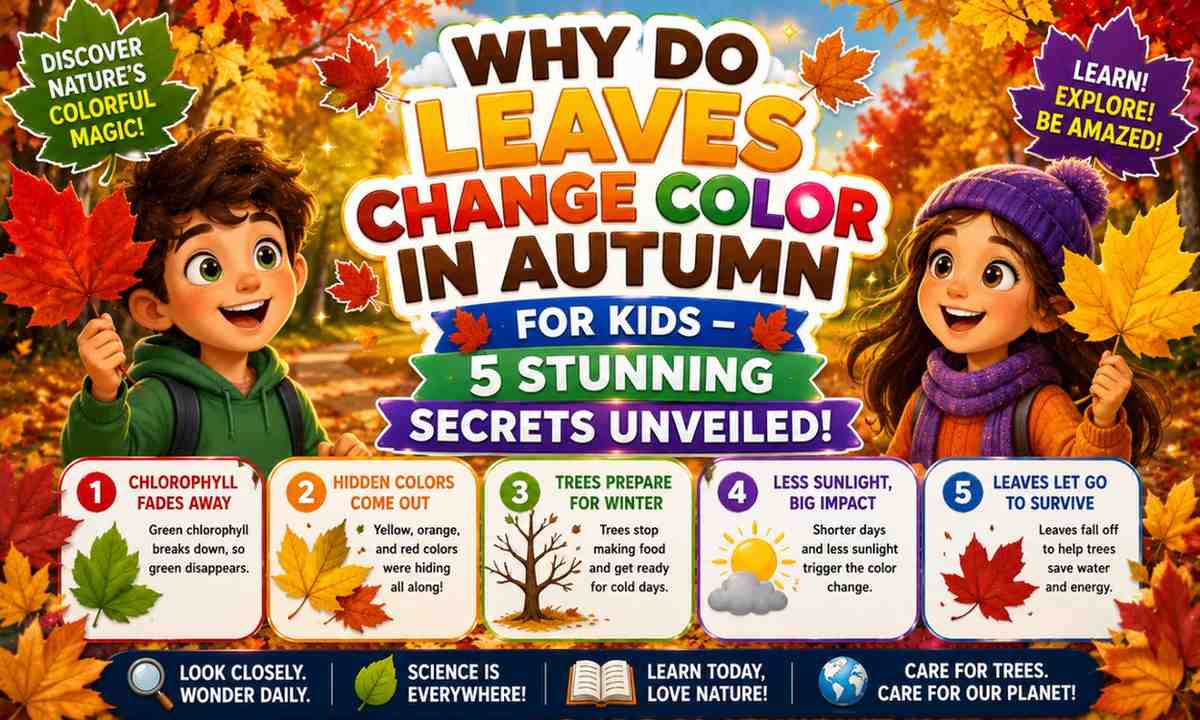
Introduction: The Most Beautiful Season Has a Secret
Every autumn, something breathtaking happens. Green trees slowly transform into explosions of red, orange, yellow, and gold. It looks like the forest is on fire—in the most beautiful way possible!
But have you ever stopped and asked, “Why do leaves change color in autumn for kids—what’s actually happening inside those leaves?” Why does it only happen in autumn? And why are some trees red while others turn yellow or orange?
The answers are all wrapped up in some wonderful science — and by the end of this article, you’ll be able to explain fall colors better than most grown-ups! Let’s dive into the most colorful science lesson of the year. 🍁
First: Why Are Leaves Green in the First Place?
To understand why do leaves change color in autumn for kids, we first need to know why leaves are green the rest of the year.
Leaves are green because of a special chemical called chlorophyll (say it: KLOR-oh-fill). Chlorophyll is found inside tiny structures in leaf cells called chloroplasts.
Chlorophyll has a very important job: it captures energy from sunlight and uses it to make food for the tree. This food-making process is called photosynthesis.
Chlorophyll absorbs red and blue light from the Sun — but it reflects green light. That’s why leaves look green to our eyes! Green is the colour that bounces back.
So the question of why do leaves change color in autumn for kids is really a question of: what happens to the chlorophyll?
The Hidden Colors Already in the Leaves 🎨
Here’s one of the most mind-blowing facts in all of leaf science: the orange and yellow colors in autumn leaves were there all along!
You just couldn’t see them.
Inside every green leaf, there are other pigments — colour-making chemicals — called:
- Carotenoids — these make yellow and orange colours
- Xanthophylls — these also make yellow colours
These pigments exist in the leaf throughout spring and summer. But during those months, the leaf has so much green chlorophyll that it completely hides the yellow and orange underneath. It’s like painting over a yellow wall with a thick coat of green paint — the yellow is still there, you just can’t see it!
Only when the green chlorophyll goes away do those hidden colours finally shine through.
Why Do Leaves Change Color in Autumn for Kids — The Main Reason
The real trigger for the spectacular autumn colour show is one simple thing: less sunlight.
As summer ends and autumn begins, the days get shorter. The nights get longer. The temperature starts to drop.
Trees are incredibly sensitive to these changes. They detect the shortening days and prepare for winter by doing something brilliant: they shut down leaf production and go into rest mode.
Here’s exactly what happens, step by step:
🍃 Step 1: The Tree Detects Shorter Days
The tree uses special cells that are sensitive to light. When it detects fewer hours of sunlight, it begins to prepare for winter dormancy (a kind of deep rest, like sleep).
🍃 Step 2: The Tree Builds a Seal
At the base of each leaf stem, the tree grows a special layer of cells called the abscission layer. This layer acts like a tiny door closing between the leaf and the branch. It slowly cuts off the flow of water and nutrients to the leaf.
🍃 Step 3: Chlorophyll Breaks Down
Without water and nutrients flowing in, the leaf can no longer make chlorophyll. The existing chlorophyll breaks down and disappears. As the green fades away, the hidden yellow and orange pigments are finally revealed!
🍃 Step 4: Red Colours Are Made Freshly
Here’s something special: the red and purple colours are NOT hidden inside the leaf all year. They are made freshly in autumn!
As the abscission layer forms, sugars get trapped inside the leaf (they can’t flow back down to the tree anymore). These trapped sugars, in the presence of bright sunlight and cool temperatures, produce a pigment called anthocyanin — which makes the brilliant red, crimson, and purple colours!
Why Are Some Trees Red and Others Yellow or Orange?
This explains why do leaves change color in autumn for kids — but why are some trees red while others are yellow?
It comes down to how much sugar gets trapped in the leaf and how much anthocyanin is produced.
- Maples produce lots of anthocyanin → brilliant RED leaves 🍁
- Birches and Ginkgos have lots of xanthophyll → beautiful YELLOW leaves 🌕
- Oaks produce a mix → warm BROWN and RUSSET tones 🍂
- Aspens show their carotenoids → glowing ORANGE-GOLD 🟠
The weather also plays a huge role:
- Warm sunny days + cold (but not freezing) nights = the most spectacular colours
- Warm sunny days help produce more anthocyanin (red pigment)
- Cool nights slow the breakdown of colour pigments, keeping the colours vivid longer
That’s why some autumns are more spectacular than others!
What Happens After the Leaves Change Colour?
After the beautiful color show, something equally fascinating happens — the leaves fall off.
Once the abscission layer is complete, the leaf can no longer hold on to the branch. Wind, rain, or even just gravity pulls it free. The tree lets go.
This is not sad — it’s brilliant survival strategy! Here’s why:
Why Trees Drop Their Leaves 🌲
- Water conservation — Leaves constantly lose water through transpiration. In winter, when the ground is frozen, trees can’t absorb water. Dropping leaves prevents the tree from drying out.
- Energy saving — Keeping leaves alive through cold winter would cost the tree too much energy. Better to drop them and rest.
- Avoiding damage — Heavy snow and ice can break branches. Without leaves, snow falls through the branches instead of piling on them.
Trees that drop their leaves in autumn are called deciduous trees. Trees that keep their leaves all year (like pine trees) are called evergreen trees.
What Happens to the Fallen Leaves? ♻️
Fallen leaves don’t go to waste — they become part of nature’s own recycling system!
- 🍂 Leaves pile up on the forest floor.
- 🪱 Worms, beetles, and tiny microbes break them down.
- 🌿 They decompose into humus — rich, dark, fertile soil.
- 🌱 This nourishes the ground, feeding next year’s plants and trees.
So even a dead, brown leaf is still doing important work for the planet. Nothing in nature goes to waste!
You can learn more about the amazing science of forests and leaves at BBC Bitesize — Science for Kids — an excellent DoFollow resource for young learners.
Best Places in the World to See Autumn Colours 🌍
Now that you understand why do leaves change color in autumn for kids, here are some of the most spectacular places to witness this natural art show:
- 🍁 New England, USA — Vermont, New Hampshire, and Maine are world-famous for breathtaking fall foliage.
- 🌲 Kyoto, Japan — Japanese maples turn brilliant shades of red and orange in November.
- 🍂 Bavaria, Germany — Alpine forests blaze with autumn colour against mountain backdrops.
- 🌳 Canadian Rockies — The mix of aspen and larch trees creates a golden wonderland.
- 🍁 The Lake District, England — Rolling hills covered in golden, russet, and amber leaves.
Fun Activity: Leaf Rubbings and Nature Journal 📒
The best way to celebrate why do leaves change color in autumn for kids is to go outside and collect some!
Try this fun activity:
Leaf Rubbing Art:
- Collect 5–10 different shaped autumn leaves.
- Place a leaf under a piece of white paper.
- Rub a crayon gently over the paper above the leaf.
- The shape and veins of the leaf appear on the paper!
- Label each one with the tree name and the date.
You’ll start noticing that different trees have completely different shaped leaves — just as unique as fingerprints!
Seasonal Science: Why Only Deciduous Trees Change Colour?
A great follow-up question to why do leaves change color in autumn for kids is: why don’t pine trees change colour?
Pine trees and other evergreens (like spruce and fir) have needle-shaped leaves with a thick, waxy coating. This coating prevents water from escaping in winter — so they don’t need to drop their leaves to survive!
Their leaves (needles) do eventually fall — but not all at once and not seasonally. They stay green throughout autumn while their deciduous neighbours put on a magnificent colour show.
Also, evergreen needles contain far less chlorophyll and different pigment combinations that don’t produce the dramatic colour changes we see in deciduous trees.
Frequently Asked Questions (FAQ)
❓ Q1: Do leaves change color in countries near the equator?
In tropical countries near the equator, there isn’t much difference between seasons. Trees there don’t experience the shortening days that trigger autumn color changes — so their leaves stay green all year round.
❓ Q2: Do the same trees turn the same colors every year?
Generally yes! The type of colour a tree produces depends on its species. Maples tend to turn red, birches turn yellow, and oaks turn brown. However, the intensity of the colours can vary depending on that year’s weather.
❓ Q3: Is it true that leaves make red colour to protect themselves?
Some scientists believe anthocyanin (the red pigment) may also act as a sunscreen for leaves, protecting them from bright autumn sunlight while they break down their nutrients before falling. It may also signal to insects that the tree is not a good place to lay eggs.
❓ Q4: Can you make leaves change color faster?
You can simulate the effect at home! If you leave a leaf in a dark cupboard, it will start to lose its green chlorophyll (no light = no photosynthesis), and the hidden yellow pigments may start to appear. Try it and see!
❓ Q5: Do animals know autumn is coming from the colour of leaves?
Many animals use environmental cues — including shortening days and cooling temperatures — to prepare for winter. While they likely don’t “read” leaf colors, they respond to the same triggers that cause leaves to change, using the season as a signal to hibernate, migrate, or stockpile food.
Conclusion
The answer to why do leaves change color in autumn for kids is a stunning combination of chemistry, biology, and the Earth’s journey around the Sun.
When days get shorter, trees stop making green chlorophyll, allowing hidden yellow and orange pigments to emerge. At the same time, trapped sugars create brilliant new red and purple pigments. Then, the leaves fall — not as a sign of death, but as an act of brilliant survival.
Autumn is not an ending. It’s a preparation. A rest. A promise that spring will come again.
So the next time you crunch through a pile of red and golden leaves, you’re walking through one of nature’s most beautiful scientific performances. Enjoy every colourful step!