 creator@scienceexplore.site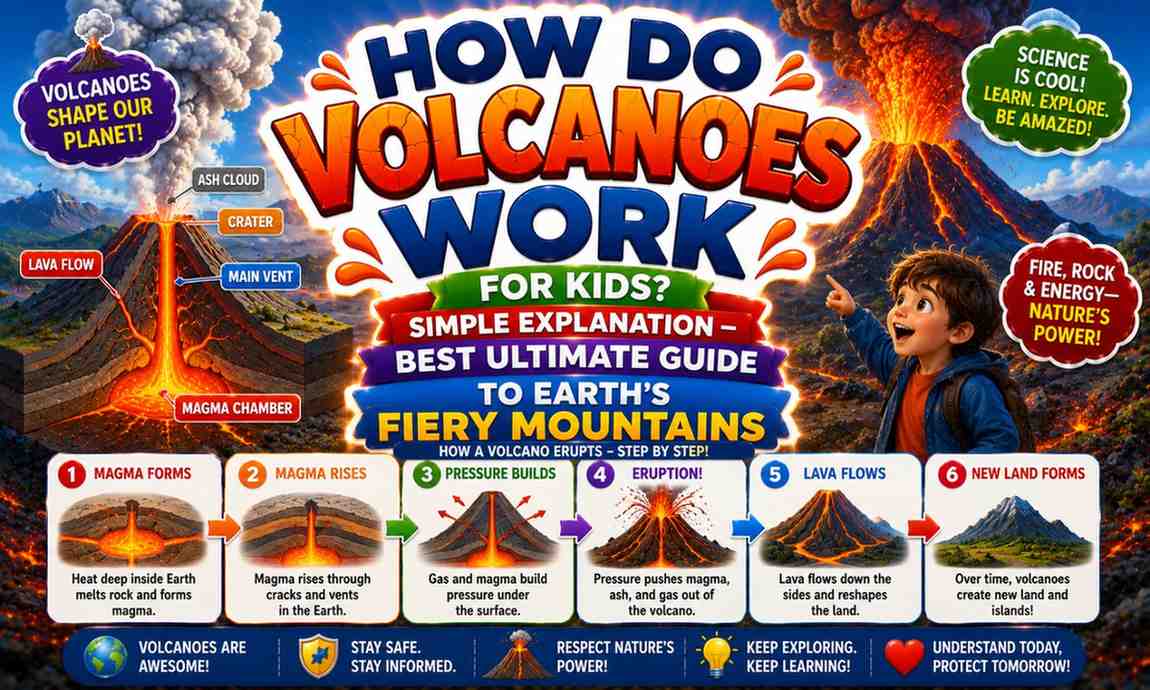
If you’ve ever asked, “How do volcanoes work?” for kids in a simple explanation style, you’re in exactly the right place. Volcanoes are one of the most dramatic and powerful natural forces on our planet. They shoot fire into the sky, pour rivers of glowing rock down mountainsides, and reshape entire landscapes over time.
How do volcanoes work for kids simple explanation starts with a single idea: deep inside the Earth, it is incredibly hot. So hot, in fact, that rock melts into liquid. This liquid rock — called magma — is what drives every volcanic eruption on our planet.
In this complete guide, we’ll explore every part of the volcano story. By the end, you’ll have a full how do volcanoes work for kids simple explanation that you can share with friends, use in school projects, and apply to real-world science.
What Is a Volcano? — How Do Volcanoes Work for Kids Simple Explanation Basics
The first step in answering how do volcanoes work for kids simple explanation is understanding what a volcano actually is.
A volcano is an opening or vent in the Earth’s crust. Through this vent, hot melted rock, ash, gas, and steam can escape from deep underground. Think of the Earth like a pressure cooker. When the pressure inside builds too high, it needs a release valve. That release valve is a volcano.
Volcanoes come in many forms — tall, steep mountains, wide gentle slopes, flat underwater ridges, and even small cinder cones. They appear on every continent and under every ocean. There are even volcanoes on other planets and moons in our solar system.
One key piece of how do volcanoes work for kids simple explanation is knowing the difference between an active, dormant, and extinct volcano:
- Active — Currently erupting or has erupted recently
- Dormant — “Sleeping,” hasn’t erupted in a long time but could again
- Extinct — Has not erupted in recorded history and is unlikely to again
What’s Inside the Earth?
A huge part of how do volcanoes work for kids simple explanation involves understanding the inside of our planet. The Earth has four layers:
- Crust — The thin, rocky outer shell where we live. It ranges from about 5 km thick under oceans to 70 km thick under mountain ranges.
- Mantle — A thick layer of hot rock beneath the crust. The upper mantle can partially melt, creating magma.
- Outer Core — A liquid layer of iron and nickel at roughly 4,000–5,000°C.
- Inner Core — Solid iron at the center, kept solid by enormous pressure despite extreme heat.
The mantle is the engine behind everything in how do volcanoes work for kids simple explanation. Heat from the Earth’s core causes slow circular movements in the mantle — called convection currents. These movements drag the crust around and create the conditions for volcanic eruptions.
What Is Magma?
No guide on how do volcanoes work for kids simple explanation would be complete without explaining magma.
Magma is molten (melted) rock that exists below the Earth’s surface. It forms when the temperature and pressure in the mantle cause solid rock to melt. Magma is lighter than the solid rock around it — just like oil floats on water — so it slowly rises through cracks and weak zones in the crust.
As it rises, it collects in a large underground pool called a magma chamber. Here, pressure continues to build. Gases dissolved in the magma — including water vapor, carbon dioxide, and sulfur dioxide — expand and push against the walls of the chamber.
When the pressure becomes greater than the strength of the rock above it, the magma forces its way upward through a channel called the vent. Once it reaches the surface and erupts, we give it a new name: lava.
This is the key moment in how do volcanoes work for kids simple explanation — when underground magma becomes surface lava.
[IMAGE 1 — Place after magma section]
Suggested Image: A cross-section illustration of the Earth showing the mantle, magma chamber, vent, and crater with lava erupting at the top. ALT Text: “How do volcanoes work for kids simple explanation — Earth’s cross-section showing magma chamber and volcanic vent”
How Does a Volcano Erupt? — Step-by-Step
Here is the full eruption process for how do volcanoes work for kids simple explanation made as simple as possible:
Step 1 — Heat Builds The mantle generates enormous heat. Rock melts into magma over thousands of years.
Step 2 — Magma Rises Because magma is less dense than solid rock, it floats upward. It travels through fissures (cracks) in the crust toward the surface.
Step 3 — Magma Collects Magma pools in a magma chamber beneath the volcano. Gas bubbles begin forming inside the magma — much like bubbles in a soda bottle.
Step 4 — Pressure Peaks The gas pressure inside the magma chamber keeps building. The weight of the rock above it is the only thing holding it back.
Step 5 — Eruption The pressure exceeds the strength of the rock above. Magma blasts up through the vent and erupts out of the crater. Magma is now called lava. It can be as hot as 1,200°C (2,200°F).
Step 6 — Material Escapes Alongside lava, the eruption shoots ash, rock fragments, and gas into the air. These can travel thousands of kilometers.
This six-step chain of events is the heart of how do volcanoes work for kids simple explanation.
Types of Volcanic Eruptions
Another dimension of how do volcanoes work for kids simple explanation is recognizing that not all eruptions look alike.
Explosive Eruptions
Thick, gas-rich magma traps enormous pressure. When it finally erupts, it blasts rock, ash, and pyroclastic material high into the atmosphere. Mount St. Helens (USA, 1980) and Krakatoa (Indonesia, 1883) are famous examples.
Effusive Eruptions
Thin, runny magma flows gently out of the volcano. There’s less gas and less pressure. Lava flows slowly down the sides of the volcano like a glowing river. Hawaiian volcanoes often erupt this way.
Phreatomagmatic Eruptions
These occur when magma contacts underground water. The sudden steam explosion can be extremely violent, even if the lava volume is small.
Types of Volcanoes — Comparison Table
| Volcano Type | Shape | Eruption Style | Famous Example |
|---|---|---|---|
| Shield Volcano | Wide, flat, gently sloping | Effusive, slow lava flows | Mauna Loa, Hawaii |
| Stratovolcano (Composite) | Tall, steep, symmetrical | Explosive | Mount Fuji, Japan |
| Cinder Cone | Small, steep, bowl-shaped | Short, explosive bursts | Paricutín, Mexico |
| Caldera | Wide bowl or depression | Super-explosive | Yellowstone, USA |
| Submarine Volcano | Underwater | Varies | Lō’ihi, Hawaii |
Where Are Volcanoes Found?
Understanding geography adds important context to how do volcanoes work for kids simple explanation.
Most volcanoes sit at the boundaries of tectonic plates — the giant puzzle pieces that make up the Earth’s crust. The Pacific Ocean is surrounded by so many plate boundaries and volcanoes that the region is called the Ring of Fire. It contains about 75% of all active volcanoes on Earth.
Some volcanoes form over hot spots — places where an unusually hot plume of mantle rock rises through the middle of a plate. The Hawaiian Islands chain was formed over millions of years as the Pacific Plate moved over a stationary hot spot.
There are approximately 1,500 active volcanoes on Earth, with 40–50 erupting every single year.
What Comes Out of a Volcano?
When understanding how do volcanoes work for kids simple explanation, it helps to know exactly what eruptions produce:
- Lava — Molten rock that flows across the surface. Can form tubes, rivers, or vast lava fields.
- Volcanic Ash — Fine particles of broken rock and glass. Can travel thousands of miles in the atmosphere.
- Pyroclastic Flows — Superheated clouds of gas, ash, and rock moving at 700 km/h. Extremely deadly.
- Tephra — Chunks of rock ejected into the air, ranging from tiny pebbles (lapilli) to large boulders (volcanic bombs).
- Volcanic Gases — Water vapor, CO₂, SO₂, hydrogen sulfide, and others.
Are Volcanoes Dangerous?
Safety is a key aspect of how do volcanoes work for kids simple explanation that kids should understand.
Yes, volcanoes can be highly dangerous. They can:
- Destroy towns and forests with lava flows
- Bury communities in meters of ash
- Trigger tsunamis if they erupt near or under the ocean
- Temporarily cool global temperatures by injecting sulfur into the upper atmosphere
- Send toxic gases across large areas
However, scientists called volcanologists monitor active volcanoes constantly. Modern monitoring tools — seismographs, GPS sensors, gas detectors, satellite imagery — can often detect signs of an imminent eruption weeks or even months in advance, giving populations time to evacuate safely.
Can Volcanoes Be Beneficial?
A surprising but true part of how do volcanoes work for kids simple explanation is that volcanoes provide many benefits:
- Rich Soil — Volcanic ash breaks down into some of the world’s most fertile farmland. The slopes of Vesuvius in Italy have supported vineyards for centuries.
- New Land — The entire island of Hawaii and the nation of Iceland were built entirely by volcanic activity.
- Geothermal Energy — Iceland generates over 25% of its electricity from geothermal heat.
- Minerals & Gemstones — Volcanic processes concentrate gold, silver, copper, and even diamonds.
- Building Materials — Pumice and basalt from volcanoes are widely used in construction.
Famous Volcanoes Around the World
Every great how do volcanoes work for kids simple explanation should include real-world examples:
- Mount Vesuvius (Italy) — Buried Pompeii in 79 AD under meters of ash
- Krakatoa (Indonesia) — 1883 eruption heard 4,800 km away; triggered global temperature drop
- Mauna Loa (Hawaii) — Largest active volcano on Earth by volume
- Mount Pinatubo (Philippines) — 1991 eruption temporarily lowered global temperature by 0.5°C
- Eyjafjallajökull (Iceland) — 2010 eruption shut down European air travel for weeks
[IMAGE 2 — Place after famous volcanoes section]
Suggested Image: A vibrant labeled diagram of an erupting stratovolcano showing lava flows, ash cloud, pyroclastic flow, vent, crater, magma chamber, and tectonic plate. ALT Text: “How do volcanoes work for kids simple explanation — labeled erupting volcano diagram showing all major features”
Fun Volcano Facts for Kids
- The word “volcano” comes from Vulcan, the Roman god of fire and metalworking
- Jupiter’s moon Io has the most active volcanoes in our solar system — hundreds of them!
- The tallest volcano in our solar system is Olympus Mons on Mars — nearly 3 times the height of Mount Everest
- Diamonds reach the Earth’s surface through a rare type of volcanic eruption called a kimberlite eruption
- The deepest volcano on Earth is the West Mata volcano in the Pacific Ocean, erupting at over 1,100 meters below sea level
FAQs: How Do Volcanoes Work for Kids Simple Explanation
Q1: How do volcanoes work for kids simple explanation in one sentence? A: A volcano erupts when hot melted rock (magma) deep underground builds up pressure and forces its way through a crack in the Earth’s crust, erupting as lava, ash, and gas.
Q2: When asking how do volcanoes work for kids simple explanation, what is the most important layer of the Earth? A: The mantle is the most important layer. It generates the heat that melts rock into magma, which eventually rises and causes eruptions.
Q3: What is the difference between magma and lava? A: This comes up in every how do volcanoes work for kids simple explanation — magma is melted rock underground; once it erupts to the surface, it’s called lava.
Q4: How do volcanoes work for kids simple explanation — why are some eruptions explosive and others not? A: It depends on how thick the magma is and how much gas is trapped inside. Thick, gas-rich magma produces explosive eruptions. Thin, gas-poor magma flows out more gently.
Q5: How do volcanoes work for kids simple explanation — can scientists predict eruptions? A: Scientists can’t predict eruptions with perfect accuracy, but they monitor ground movement, gas emissions, and small earthquakes near volcanoes. These signs often warn of an eruption days or weeks ahead.
Conclusion
From the molten interior of our planet to the dramatic explosion of lava and ash into the sky, how do volcanoes work for kids simple explanation comes down to pressure, heat, and the relentless movement of the Earth beneath our feet. Every volcano on Earth tells a story about our planet’s incredible energy and power.
Understanding how do volcanoes work for kids simple explanation helps us appreciate both the danger and the incredible creative power of these natural giants. They destroy — but they also build new land, nourish soil, and power entire nations with geothermal energy.
The next time you see an image of an erupting volcano, you won’t just see fire and chaos. You’ll see science in action.
Want to keep exploring amazing science topics? Browse our full collection of kid-friendly guides and satisfy your curiosity about the incredible world around you!
External Links
- https://www.nationalgeographic.com/science/article/volcanoes — National Geographic: Volcanoes
- https://volcanoes.usgs.gov — USGS Volcano Hazards Program (Official)
- https://www.smithsonianmag.com/science-nature/volcanoes — Smithsonian Magazine: Volcano Science
- https://www.britannica.com/science/volcano — Britannica: Volcano
- https://www.nasa.gov/solar-system — NASA Solar System Exploration: Volcanic Worlds