 creator@scienceexplore.site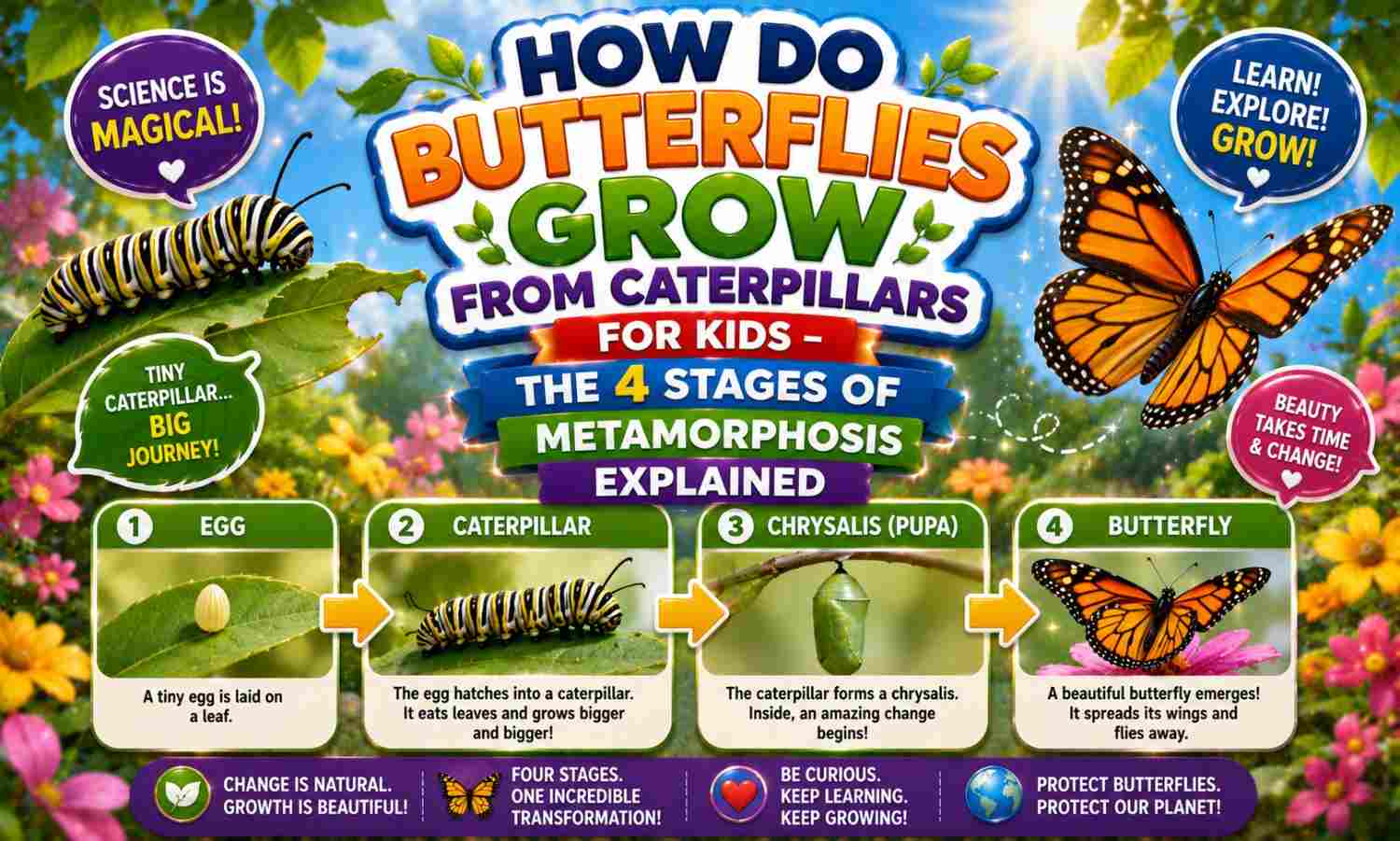
If you’ve ever watched a caterpillar crawl slowly across a leaf and wondered what it’s doing, this guide is for you. How do butterflies grow from caterpillars for kids is one of the most magical science questions in all of nature. The answer involves one of biology’s most remarkable transformations—a complete body makeover called metamorphosis.
How do butterflies grow from caterpillars for kids begins with a tiny egg laid on a leaf and ends with a beautiful, winged butterfly soaring through the air. Along the way, the creature’s body dissolves and completely rebuilds itself — something that sounds impossible but happens millions of times every day in gardens, forests, and meadows around the world.
In this guide, we’ll walk through every stage of the process. By the end, you’ll have a complete, clear answer to how do butterflies grow from caterpillars for kids—packed with fascinating science facts.
What Is Metamorphosis?
Before answering how do butterflies grow from caterpillars for kids, we need to understand the word metamorphosis.
Metamorphosis comes from the Greek words for “change” (meta) and “form” (morphe). It describes the biological process by which some animals dramatically change their body form as they grow up.
Butterflies go through complete metamorphosis (also called holometabolism), which means they pass through four completely different life stages—each looking almost nothing like the others. This is different from incomplete metamorphosis, where young animals simply look like smaller versions of adults (like grasshoppers).
The four stages of complete metamorphosis—the answer to how do butterflies grow from caterpillars for kids—are:
- Egg
- Larva (Caterpillar)
- Pupa (Chrysalis)
- Adult Butterfly
Let’s explore each one in wonderful detail.
Stage 1 — The Egg
Every answer to how do butterflies grow from caterpillars for kids begins with a tiny, often beautiful, egg.
A female butterfly lays her eggs on specific host plants—and she’s extremely choosy. She uses sensors in her feet to taste the plant before lying. She only picks plants her caterpillars will be able to eat when they hatch.
For example:
- Monarch butterflies only lay eggs on milkweed
- Swallowtail butterflies prefer citrus, parsley, and dill plants
- Painted Lady butterflies like thistles
Butterfly eggs are tiny — often smaller than a pinhead. But if you look closely, they’re surprisingly beautiful. They can be round, oval, ribbed, spiky, or flattened, depending on the species. The outer shell (the chorion) protects the developing embryo inside. A thin wax layer keeps the egg from drying out.
Inside the egg, a tiny caterpillar (embryo) develops over the course of 3–7 days. One of the most fascinating parts of how do butterflies grow from caterpillars for kids is what happens when the egg finally hatches—the first meal of the newborn caterpillar is often its own eggshell!
[IMAGE 1 — Place after Stage 1]
Suggested Image: A magnified illustration of butterfly eggs on a leaf in different shapes — round, ribbed, spiky — with labels. ALT Text: “How do butterflies grow from caterpillars for kids—close-up illustration of butterfly eggs on a leaf showing different shapes”
Stage 2 — The Larva (Caterpillar)
The second stage in how do butterflies grow from caterpillars for kids is the caterpillar stage—also called the larval stage.
When the egg hatches, a tiny larva—the caterpillar—emerges. This stage has one primary purpose: eat and grow. The caterpillar is essentially a tiny eating machine, designed by evolution to consume as many leaves as possible in a short time.
Caterpillars can eat many times their own body weight in leaves every single day. A monarch caterpillar, for example, increases its body mass by about 2,700 times during its caterpillar stage!
How Caterpillars Grow — Molting
Here’s a fascinating detail in how do butterflies grow from caterpillars for kids: caterpillars can’t grow the way mammals do because their skin doesn’t stretch. Instead, they shed their outer skin entirely when they get too big. This is called molting.
Caterpillars molt 4 to 5 times during their larval stage. The period between two molts is called an instar. After each molt, the caterpillar emerges slightly larger and sometimes looking quite different from before.
Caterpillar Anatomy
- Head—Contains strong chewing mouthparts, simple eyes (ocelli), and small antennae
- Thorax — 3 segments, each with one pair of true jointed legs (6 total)
- Abdomen — 10 segments, with up to 5 pairs of soft prolegs used for gripping
- Silk Glands—Near the mouth; produce silk used for safety lines and the chrysalis
Some caterpillars are brightly colored (warning predators they’re toxic), while others use camouflage to blend into their surroundings. All of this is part of the incredible story of how do butterflies grow from caterpillars for kids.
Stage 3 — The Pupa (Chrysalis)
The third and most mysterious stage in how do butterflies grow from caterpillars for kids is the pupa stage.
When the caterpillar has grown large enough, it instinctively finds a safe location—usually a branch, twig, or the underside of a leaf. It attaches itself firmly using a small silk pad and sometimes a silk girdle, then sheds its skin one final time.
Underneath the old skin is the chrysalis—a hard, smooth, protective shell. This is not a cocoon (which is a silk-wrapped structure made by moths). The butterfly’s chrysalis is actually the skin of the pupa itself, hardened into a protective case.
What Happens Inside the Chrysalis?
This is the most mind-bending part of how do butterflies grow from caterpillars for kids: inside the chrysalis, the caterpillar’s body essentially dissolves.
Scientists call this process histolysis—the breakdown of the larval tissues. Almost everything becomes a cellular soup. The muscles, organs, and body structures of the caterpillar break down into basic building blocks.
Then comes histogenesis—the construction phase. Special cells called imaginal discs, which were hidden inside the caterpillar from the very beginning, use the nutrient-rich cellular soup to build an entirely new body:
- Four wings
- Six slender legs
- A coiled proboscis (feeding tube)
- Compound eyes
- Long antennas
- A completely restructured abdomen and thorax
This incredible rebuilding process takes 10–14 days for most species, though some butterflies spend the entire winter in the chrysalis.
Stage 4 — The Adult Butterfly
The final stage in how do butterflies grow from caterpillars for kids is the emergence of the adult butterfly—called eclosion.
The butterfly pushes and wriggles out of the chrysalis. Its wings are wet, soft, and crumpled at first. The butterfly must pump hemolymph (insect blood) through the veins of its wings to inflate and harden them. This takes about 2–3 hours. During this time, the butterfly hangs quietly and pumps its wings gently.
Once the wings are fully expanded and dry, the butterfly is ready to fly for the first time.
Adult butterflies have three main jobs:
- Finding food—They drink nectar from flowers using their long proboscis
- Finding a mate—Males often display colorful wings and emit pheromones to attract females
- Laying eggs—To start the entire cycle of how do butterflies grow from caterpillars for kids all over again
[IMAGE 2 — Place after Stage 4]
Suggested Image: A circular lifecycle diagram showing all 4 stages of butterfly metamorphosis with arrows and labels: egg → caterpillar → chrysalis → butterfly. ALT Text: “How do butterflies grow from caterpillars for kids—a circular lifecycle diagram showing all 4 metamorphosis stages?”
How Long Does the Full Cycle Take?
One of the most common follow-up questions to how do butterflies grow from caterpillars for kids is about timing.
| Stage | Duration (Average) |
|---|---|
| Egg | 3–7 days |
| Caterpillar (Larva) | 2–4 weeks |
| Chrysalis (Pupa) | 10–14 days |
| Adult Butterfly | 2–4 weeks (lifespan) |
| Complete Lifecycle | About 4–8 weeks |
The monarch butterfly is a special case. Its fall generation can live up to 8–9 months because it migrates south to Mexico for the winter and only lays eggs upon its return.
Butterflies vs. Moths—What’s the Difference?
A great add-on to “How do butterflies grow from caterpillars?” for kids is understanding how butterflies differ from their close relatives, moths.
| Feature | Butterfly | Moth |
|---|---|---|
| Active Time | Day (diurnal) | Night (nocturnal) |
| Antennae | Thin with clubbed tips | Feathery or comb-like |
| Pupa Stage | Chrysalis (no silk wrapping) | Cocoon (silk wrapped) |
| Resting Wing Position | Wings held upright | Wings spread flat |
| Colors | Usually bright and vivid | Often brown, gray, or dull |
Why Does Metamorphosis Matter?
Understanding the deeper purpose behind how do butterflies grow from caterpillars for kids adds real scientific value.
- Different life stages occupy different ecological niches—the caterpillar eats leaves while the butterfly drinks nectar, reducing competition within the species
- The dramatic transformation makes it harder for predators that hunt caterpillars to recognize adult butterflies
- The chrysalis stage protects the vulnerable insect during transformation
- Butterflies are critical pollinators—they transfer pollen between flowers, helping plants reproduce
- Butterfly populations are an important indicator of ecosystem health
Amazing Butterfly Facts for Kids
- There are approximately 20,000 known species of butterflies worldwide
- Butterflies taste with their feet—sensors on their tarsi detect chemical signals in plants
- The Painted Lady butterfly holds the record for the longest migration of any insect—up to 4,200 miles from Europe to Africa
- Some butterflies, like the Blue Morpho, produce color not from pigment but from microscopic structures that reflect light
- Butterflies cannot fly if their body temperature drops below 13°C (55°F)—they must warm up in sunlight first
FAQs: How Do Butterflies Grow from Caterpillars for Kids
Q1: How do butterflies grow from caterpillars for kids in the simplest terms? A: A butterfly starts life as an egg, hatches into a caterpillar that eats and grows, wraps itself in a chrysalis where its body completely rebuilds, and then emerges as a fully formed butterfly.
Q2: How do butterflies grow from caterpillars for kids — does the caterpillar really dissolve? A: Yes! During the chrysalis stage, almost all of the caterpillar’s cells break down into a nutrient-rich liquid. Special cells called imaginal discs then use this material to construct the butterfly’s new body.
Q3: How do butterflies grow from caterpillars for kids—why is a chrysalis not a cocoon? A: A cocoon is a silken covering spun by moths around their pupa. A butterfly’s chrysalis is actually the hardened outer skin of the pupa itself—no silk wrapping involved.
Q4: How do butterflies grow from caterpillars for kids? How long is the full lifecycle? A: For most butterfly species, the full lifecycle from egg to adult takes about 4 to 8 weeks. Some species that migrate or survive winter may live much longer.
Q5: How do butterflies grow from caterpillars for kids? Why don’t all caterpillars become butterflies? A: Not all caterpillars grow into butterflies — some grow into moths. The type of adult the caterpillar becomes is determined entirely by its species and genetic code.
Conclusion
The answer to how do butterflies grow from caterpillars for kids is one of nature’s most extraordinary stories. From a microscopic egg on a leaf, to a hungry caterpillar, to a seemingly lifeless chrysalis, and finally to a colorful, winged butterfly—every step of metamorphosis is packed with purpose, science, and wonder.
How do butterflies grow from caterpillars for kids teaches us that transformation isn’t just possible—in` nature, it’s routine. The next time you spot a caterpillar inching along a branch or a butterfly dancing above a flower, you’ll know the remarkable journey it took to get there.
Enjoyed this guide? Explore more of our kid-friendly nature and science articles — there’s an entire world of incredible biology waiting to be discovered!
External Links
- https://www.nationalgeographic.com/animals/invertebrates/facts/butterflies — National Geographic: Butterflies
- https://kids.nationalgeographic.com/animals/invertebrates/facts/monarch-butterfly — National Geographic Kids: Monarch Butterfly
- https://www.fs.usda.gov/wildflowers/pollinators/Monarch_Butterfly — USDA: Monarch Butterfly Life Cycle
- https://www.smithsonianmag.com/science-nature/the-beautiful-science-of-butterflies — Smithsonian: Butterfly Science
- https://www.britannica.com/animal/butterfly — Britannica: Butterfly