 creator@scienceexplore.site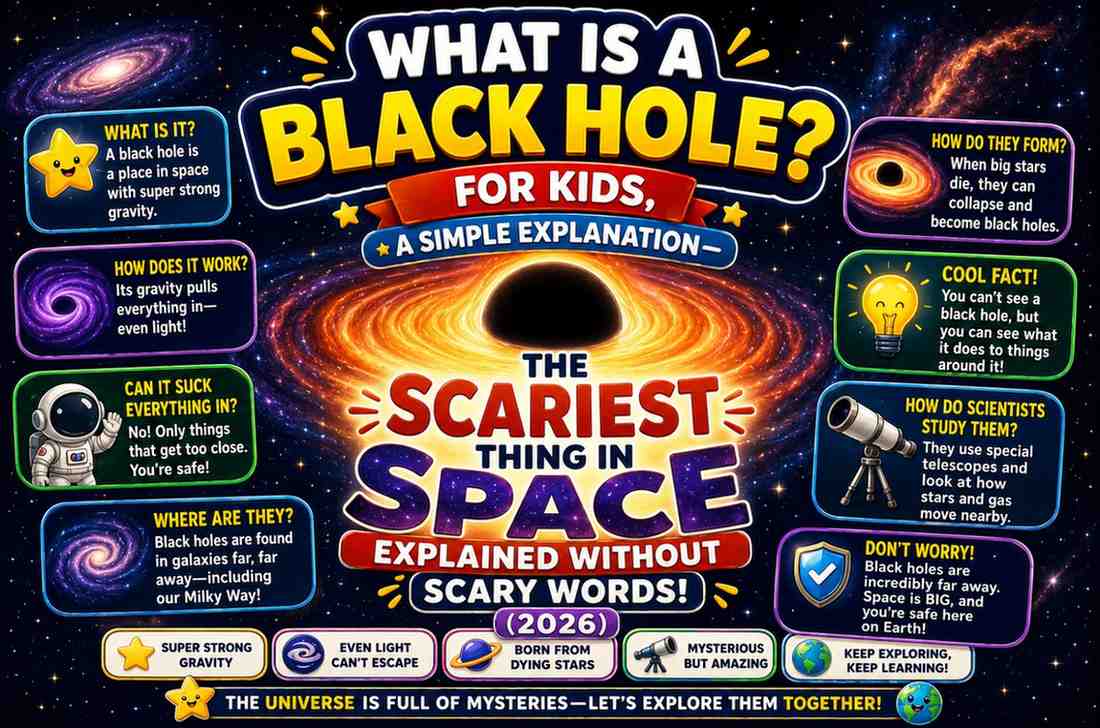
Black holes are the most dramatic, mysterious, and mind-bending objects in the entire universe. They are places where gravity becomes so extreme that nothing — not even light — can escape. But they are also deeply fascinating, and once you understand them, they become one of the most exciting topics in all of science.
This guide is the complete “What is a black hole?” for kids simple explanation—no confusing jargon, no scary descriptions, just clear, fun, genuinely interesting science explained in a way that makes perfect sense to anyone.
By the end of this “What is a black hole for kids?” simple explanation, you will understand what black holes are, how they form, what happens near one, why they are important, and what scientists have actually discovered about them. Ready? Let us go.
What Is a Black Hole? The Simple Version
Let us start with the clearest, simplest version of what a black hole is for kids: a simple explanation.
A black hole is a region in space where gravity is so incredibly strong that nothing can escape from it—not matter, not gas, not even light.
Because light cannot escape, black holes appear completely black — they emit no light of their own and reflect no light either. This is why they are called “black holes.”
The gravity inside and around a black hole is so strong because an enormous amount of mass is packed into an incredibly small space. The more mass is compressed into a smaller space, the stronger the gravity becomes. Black holes take this to the absolute extreme.
That is the core of what a black hole is for kids—a simple explanation: extreme gravity, caused by extreme concentration of mass.
How Do Black Holes Form?
To fully understand what a black hole is for kids (simple explanation), you need to understand where black holes come from. There are several types, but the most common form is this way:
Step 1: A Massive Star Lives Its Life
Stars spend their entire lives in a constant battle between two forces:
- Gravity pulling everything inward toward the centre
- Nuclear fusion (the energy from burning hydrogen) pushing everything outward
For millions or billions of years, these two forces have been balanced. The star shines steadily — like our Sun is doing right now.
Step 2: The Star Runs Out of Fuel
Eventually, a massive star burns through all its hydrogen fuel. The nuclear fusion slows down and stops. The outward pressure disappears.
Step 3: The Star Collapses
With nothing pushing outward, gravity wins—dramatically. The star’s outer layers collapse inward at enormous speed in a fraction of a second.
Step 4: A Supernova Explosion
The collapsing material bounces off the incredibly dense core and explodes outward in a supernova—one of the most powerful explosions in the universe, briefly outshining an entire galaxy.
Step 5: The Core Becomes a Black Hole
What is left behind is the star’s compressed core—now crushed to an unimaginably small, dense point called a singularity. The gravity around this point is so extreme that not even light can escape. A black hole is born.
This is what a black hole is for kids: a simple explanation at the most fundamental level—the death of a massive star creating an object so dense that it warps space itself.
The Parts of a Black Hole
What is a black hole? A simple explanation for kids includes understanding its structure. A black hole has two main parts:
The Singularity
At the very center of a black hole is the singularity—a point where all the mass of the original star is concentrated. At the singularity, density becomes infinite, and the laws of physics as we know them break down completely. Scientists do not yet fully understand what happens at the singularity — it is one of the great unsolved problems in physics.
The Event Horizon
Surrounding the singularity is an invisible boundary called the event horizon. This is the “point of no return.” Once anything — matter, gas, light — crosses the event horizon, it can never get back out.
The event horizon is not a physical surface or wall. It is simply a boundary in space. If you crossed it without knowing, you might not immediately notice anything unusual. But once you are past it, you can never return—you are inside the black hole.
Think of it like a waterfall. The event horizon is the point in the river where the current becomes too strong to swim against. Cross that point, and you go over the waterfall no matter what.
How Big Are Black Holes?
What is a black hole for kids simple explanation of size is genuinely surprising. Black holes come in different sizes:
Stellar Black Holes
These form from collapsing stars and are typically 5 to 100 times the mass of our Sun. Despite containing enormous mass, a stellar black hole might have an event horizon only a few kilometers wide. If our Sun collapsed into a black hole (it won’t — it is not massive enough), it would be about 6 km across.
Supermassive Black Holes
These are giants that sit at the centers of almost every large galaxy—including our own Milky Way. Supermassive black holes contain millions or even billions of times the mass of our Sun. The black hole at the center of the Milky Way—called Sagittarius A*—contains about 4 million solar masses and has an event horizon about 24 million km across.
The Largest Known Black Hole
The largest known black hole, TON 618, contains approximately 66 billion solar masses. Its event horizon is larger than our entire solar system.
Can a Black Hole Suck Up Everything in Space?
This is one of the most common questions in any “What is a black hole for kids?” simple explanation—and the answer is reassuring.
No. Black holes do not “vacuum up” everything around them. A black hole’s gravity follows the same rules as any other object’s gravity. It only pulls strongly on things that come very close.
If our Sun magically turned into a black hole right now (it won’t — it is far too small), Earth would not be sucked in. Earth would simply continue orbiting the black hole sun in exactly the same orbit it follows today—because the mass is the same. Only the Sun’s light and warmth would disappear.
Black holes are dangerous only if you get extremely close to them. From a safe distance, they behave like any other massive object — pulling on nearby things through normal gravity.
Our nearest known black hole is about 1,000 light-years away from Earth. We are perfectly safe.
What Would Happen If You Fell Into a Black Hole?
This is the question everyone asks in a “What is a black hole for kids?” simple explanation—and the answer is genuinely fascinating.
From the Outside
If you watched a friend fall into a black hole (from a safe distance), something strange would appear to happen. As they approached the event horizon, they would appear to slow down—time passes more slowly in strong gravitational fields. Their image would get redder and dimmer. Eventually, they would appear to freeze at the event horizon, slowly fading to nothing. You would never actually see them cross it, though they do.
From the Inside (For the Falling Person)
If you were falling into a very large black hole—like the supermassive one at the center of a galaxy—you might not immediately notice anything unusual as you crossed the event horizon. There is no wall, no alarm, no sensation of crossing.
However, the gravity would be slightly stronger on the side of you closest to the singularity than on the far side. This difference in gravity — called a tidal force — would gradually stretch you in one direction and squeeze you in another. Scientists have a wonderful word for this: spaghettification. Eventually, the tidal forces become so extreme that you would be stretched out like a noodle.
For smaller black holes, this spaghettification would happen before you even reached the event horizon—the tidal forces near the event horizon of a stellar black hole are extreme enough to tear anything apart.
Have We Actually Seen a Black Hole?
Great question for a “What is a black hole?” simple explanation—and in 2019, something historic happened.
Since black holes emit no light, you cannot photograph one directly. But you CAN photograph the glowing gas and dust swirling around the event horizon—heated to millions of degrees as it spirals inward. This glowing material forms a bright ring around the dark shadow of the event horizon.
In April 2019, the Event Horizon Telescope—a network of radio telescopes linked across the planet—captured the first-ever image of a black hole’s shadow. The black hole photographed was in galaxy M87, located 55 million light-years from Earth. It contains 6.5 billion solar masses.
In 2022, the same team released the first image of Sagittarius A*—the black hole at the center of our own Milky Way galaxy. These are among the most important scientific achievements in history.
Types of Black Holes: A Simple Summary
For a complete, simple explanation of what a black hole is for kids, it is worth knowing there are actually four main types:
Stellar black holes: Formed from collapsing stars. 5–100 solar masses. Most common type.
Intermediate black holes: Between 100 and 100,000 solar masses. Relatively rare and less understood.
Supermassive black holes: Millions to billions of solar masses. Found at the centre of most large galaxies.
Primordial black holes (theoretical): Possibly formed in the very early universe, fractions of a second after the Big Bang. Maybe as small as atoms but with enormous mass. Their existence has not yet been confirmed.
Fun Black Hole Facts for Kids
Here are some quick, amazing facts to round out this “What is a black hole for kids?” simple explanation:
- Time passes more slowly near a black hole due to its extreme gravity—a real phenomenon called “gravitational time dilation.”
- Black holes can spin incredibly fast. Some spin at close to the speed of light.
- Stephen Hawking theorized that black holes slowly evaporate over enormous timescales by emitting “Hawking radiation”—though this has never been directly observed.
- The black hole at the center of our galaxy—Sagittarius A*—is about 26,000 light-years away from Earth. Completely safe.
- Despite the name, black holes are not actually “holes” — they are objects with enormous mass.
- A black hole the size of a coin would have the same mass as the entire Earth.
- Black holes were predicted by Albert Einstein’s theory of general relativity in 1915 — over 100 years before one was photographed.
Black Holes and Time: The Coolest Part
One of the most extraordinary aspects of what a black hole is for kids simple explanation is the relationship between black holes and time.
Albert Einstein’s theory of general relativity tells us that gravity slows down time. The stronger the gravity, the slower time passes relative to somewhere with weaker gravity. This is not science fiction — it is a real, measurable effect.
Near a black hole, where gravity is extreme, time slows down dramatically. If you could hover just outside the event horizon of a black hole (without falling in), an hour might pass for you while years pass on Earth.
This means black holes are literally time machines—though only one-way ones. You could travel far into Earth’s future by spending time near a black hole. But you could never use a black hole to travel into the past.
The film Interstellar (2014) depicted this effect accurately—an hour on a planet near a black hole equaled seven years on Earth.
Comparison Table: Types of Black Holes
| Type | Mass | Size of Event Horizon | Where Found |
|---|---|---|---|
| Stellar | 5–100 x Sun | A few km | Throughout galaxies |
| Intermediate | 100–100,000 x Sun | Thousands of km | Globular clusters (suspected) |
| Supermassive | Millions–billions x Sun | Millions of km | Centre of galaxies |
| Primordial (theoretical) | Varies wildly | Possibly microscopic | Early universe (theoretical) |
FAQ: What Is a Black Hole? Simple Explanation for Kids
Q1. Can a black hole destroy Earth? No — at least not any time soon. The nearest known black hole is about 1,000 light-years away. Even if it wanted to “eat” Earth (which is not how gravity works), it would have no effect at that distance. In this “What is a black hole for kids?” simple explanation, the key takeaway is that black holes are only dangerous at very close range.
Q2. How do scientists know black holes exist if they cannot see them? Scientists detect black holes through their effects on surrounding matter and light. Gas swirling around a black hole heats up to millions of degrees and emits powerful X-rays. Stars near the center of our galaxy can be observed orbiting something massive and invisible—only a supermassive black hole fits the data. And in 2019, we actually photographed one.
Q3. Could anything escape from a black hole? According to Einstein’s relativity, nothing that crosses the event horizon can escape—not even light. However, Stephen Hawking theorised that black holes very slowly lose mass through quantum effects called Hawking radiation. Over trillions of years, a black hole would theoretically evaporate completely—though this has never been observed.
Q4. What is inside a black hole? This is one of the great mysteries in all of science. At the center is the singularity—a point of infinite density where our current physics breaks down. What “happens” at the singularity is unknown. Understanding it will likely require a theory that unifies quantum mechanics and general relativity — a goal physicists have been working toward for over a century.
Q5. Are there black holes near our solar system? No black holes are known to exist within immediate danger of our solar system. The nearest known black hole, Gaia BH1, discovered in 2022, is about 1,560 light years away. At that distance, it has zero effect on our solar system. This what is a black hole for kids simple explanation should reassure anyone who was starting to worry.
Conclusion
Black holes are not something to fear — they are something to marvel at. They are the universe’s most extreme objects: places where gravity becomes so powerful that the known laws of physics reach their limits, where time slows, and where space itself curves to a breaking point.
This complete “What is a black hole?” simple explanation for kids has taken you from the death of a massive star all the way to the first photograph of a black hole and the mysteries still waiting to be solved. The more you understand about black holes, the more extraordinary they become.
Want to explore more? Watch NASA’s black hole videos on YouTube, explore the ESA’s space science pages, and look up the first black hole photographs online. Science has never been more exciting than it is right now—and you are right at the beginning of the most fascinating era of space discovery in human history.