 creator@scienceexplore.site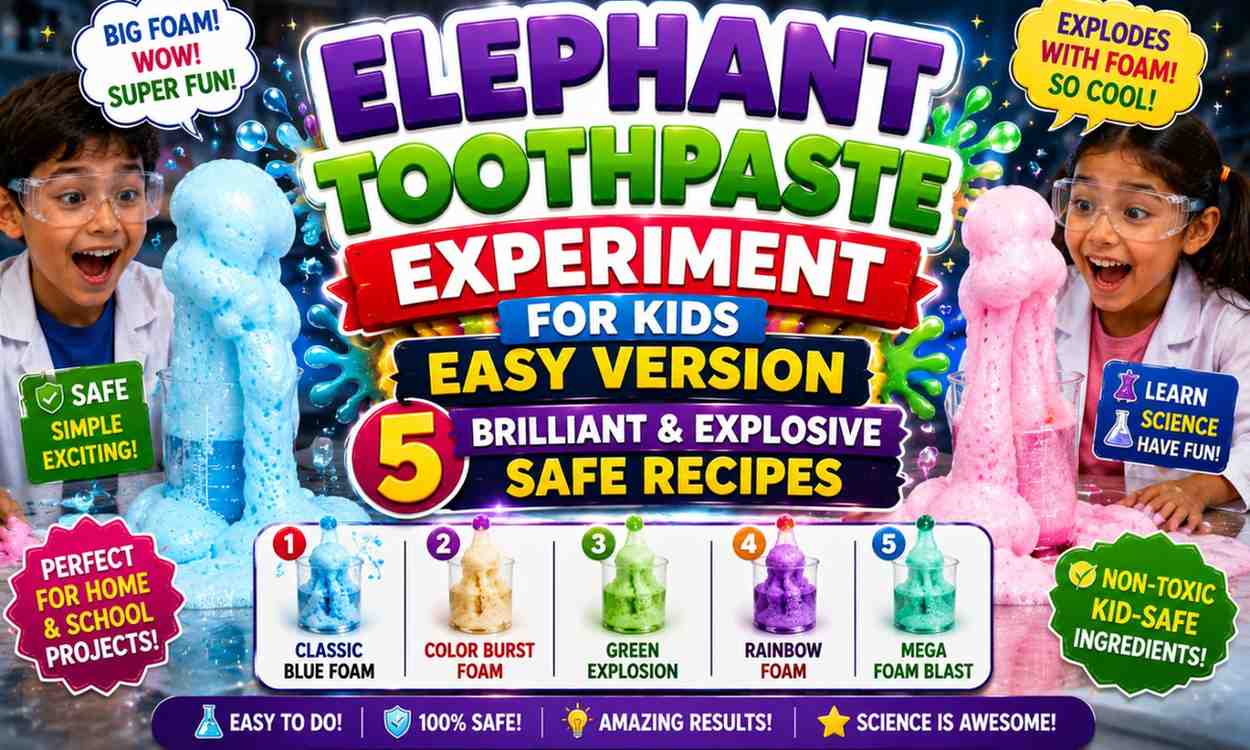
Introduction
If there is one science experiment that makes every child’s jaw drop the moment it begins, it is the elephant toothpaste experiment. A tall column of foam erupts from a bottle in seconds—warm to the touch, surprisingly soft, and so dramatically oversized that it looks like toothpaste squeezed out for an elephant. Hence the name.
The elephant toothpaste experiment for kids, easy version, is the perfect starting point for families and classrooms who want the full spectacular effect without the high-concentration chemicals used in advanced versions. Using nothing more than standard drugstore hydrogen peroxide, dry yeast, dish soap, and warm water, this safe version delivers an eruption that is every bit as impressive as the chemistry-lab original.
In this complete guide, you will find everything you need—the full elephant toothpaste experiment for kids, an easy version with step-by-step instructions, five creative variations, a thorough explanation of the science behind the foam, safety information, troubleshooting tips, and answers to every question parents and teachers ask most frequently.
By the end, your child will not just have witnessed one of the most dramatic reactions in kitchen chemistry. They will understand exactly why it happens — and that understanding is the most valuable part of any science experiment.
What Is the Elephant Toothpaste Experiment?
The elephant toothpaste experiment is a rapid decomposition reaction that produces a large, fast-expanding column of foam from a narrow-necked bottle. The foam erupts upward dramatically, resembling a giant tube of toothpaste being squeezed out at incredible speed.
The reaction involves hydrogen peroxide breaking down into water and oxygen gas. Normally this breakdown happens very slowly over days or weeks. But when a catalyst is added—a substance that dramatically speeds up a chemical reaction without being consumed by it—the breakdown happens in seconds, releasing a massive burst of oxygen gas all at once.
That oxygen gas is trapped by dish soap in the mixture, creating millions of tiny bubbles simultaneously—the foam you see erupting from the bottle. Because the reaction is exothermic (it releases heat), the foam is noticeably warm when you touch it immediately after the eruption.
The elephant toothpaste experiment for kids, easy version, uses dry yeast as the catalyst instead of the potassium iodide used in advanced laboratory versions. This makes it completely safe for children while still producing a genuinely impressive eruption.
The Science Behind the Elephant Toothpaste Experiment for Kids Easy Version
Understanding the science behind the elephant toothpaste experiment for kids easy version involves three interconnected concepts that are foundational to chemistry education.
Hydrogen Peroxide Decomposition
Hydrogen peroxide (H₂O₂) is chemically similar to water (H₂O) but with an extra oxygen atom attached. This extra oxygen makes the molecule unstable — it wants to break apart and release that oxygen atom.
The decomposition reaction looks like this:
2H₂O₂ → 2H₂O + O₂
Two molecules of hydrogen peroxide break down into two molecules of water and one molecule of oxygen gas. In a standard bottle of 3% hydrogen peroxide from a drugstore, this happens slowly over months — which is why it has a shelf life.
Catalysis — The Star of the Show
A catalyst is a substance that speeds up a chemical reaction without being used up in the process. Catalysts work by providing an alternative reaction pathway that requires less energy to complete.
In the elephant toothpaste experiment for kids (easy version), dry yeast contains an enzyme called “catalase”—one of the most efficient biological catalysts known to science. Catalase is found in almost all living organisms, including the human body, where it protects cells by rapidly breaking down hydrogen peroxide (a cellular waste product) before it can cause damage.
When yeast dissolved in warm water is added to hydrogen peroxide, the catalase enzymes go to work immediately, breaking down hydrogen peroxide thousands of times faster than it would decompose on its own. The result is an instantaneous flood of oxygen gas.
The Exothermic Reaction
Because the catalase-driven decomposition releases energy as it converts hydrogen peroxide to water and oxygen, the reaction is exothermic — it produces heat. The foam that erupts from the bottle will feel noticeably warm to the touch immediately after the reaction.
This warmth is direct evidence that a chemical reaction has taken place and that energy has been released. Asking children to feel the foam carefully and describe the temperature is one of the most effective ways to make the concept of exothermic reactions tangible and memorable.
What You Need for the Elephant Toothpaste Experiment for Kids Easy Version
Basic Safe Version — Complete Ingredients List
For the Bottle:
- 1/2 cup (120 ml) hydrogen peroxide — 3% concentration (standard brown bottle from any pharmacy or drugstore — completely safe)
- 1 tablespoon dish soap (standard washing-up liquid)
- Food coloring — any color or multiple colors (optional but visually spectacular)
- A tall, narrow-necked plastic bottle (500 ml or 1 liter works perfectly—taller and narrower produces a more dramatic eruption column)
For the Yeast Activator:
- 1 tablespoon dry active yeast (standard baking yeast from any supermarket)
- 3 tablespoons warm water (not hot — hot water kills the yeast enzymes and ruins the reaction)
Additional Equipment:
- A large tray or baking sheet to catch the foam overflow
- A measuring cup and spoon
- A small cup for mixing the yeast
- Safety goggles (recommended for children — adds to the laboratory atmosphere and is good scientific practice)
Step-by-Step Instructions — Elephant Toothpaste Experiment for Kids Easy Version
Step 1: Prepare Your Space
Place the plastic bottle in the center of a large tray. Cover your work surface with newspaper or a plastic sheet. The foam will overflow significantly—this is part of the fun, but preparation prevents mess on surfaces you care about. Put on aprons and safety goggles if available.
Step 2: Add Hydrogen Peroxide to the Bottle
Carefully pour 1/2 cup of 3% hydrogen peroxide into the plastic bottle. Pour slowly to avoid splashing—though at 3% concentration, this is completely harmless to skin in small amounts.
Step 3: Add Dish Soap
Squirt one generous tablespoon of dish soap directly into the bottle on top of the hydrogen peroxide. The soap is critical — it is what traps the oxygen bubbles and creates the foam. Without soap, the oxygen gas would simply escape, and you would see barely any foam at all.
Step 4: Add Food Coloring
Add 8–10 drops of food coloring to the bottle. For a striped effect, drizzle colors down the inside of the bottle neck using different colors one at a time—the foam will erupt in stripes. For a solid color, add all drops together and swirl gently.
Step 5: Prepare the Yeast Activator
In a separate small cup, combine 1 tablespoon of dry yeast with 3 tablespoons of warm water. Stir well for about 30 seconds until the yeast is fully dissolved and the mixture looks smooth and slightly frothy. Warm water activates the yeast enzymes—cold water slows them down and produces a weaker reaction.
Step 6: The Moment of Truth
Make sure everyone is standing back and watching. Pick up the yeast mixture and pour it quickly and decisively into the bottle in one continuous pour. Do not dribble it in slowly—a fast pour produces a more dramatic, unified eruption.
Step 7: Watch and React
Within 2–5 seconds, the foam will begin rising rapidly up the bottle neck and erupt outward. The eruption typically lasts 15–30 seconds for the main burst, with slower foam production continuing for another minute or two afterward.
Step 8: Feel the Foam
Once the eruption has slowed, invite children to reach in and feel the foam carefully. It will be noticeably warm—this is the exothermic reaction they are feeling firsthand. Ask them: Why is it warm? Where did that heat come from? This question anchors the science concept in a memorable physical experience.
Step 9: Clean Up
The foam is entirely non-toxic and safe. It can be rinsed down the sink or wiped up with paper towels. The bottle can be rinsed and reused. If you want to repeat the experiment, start fresh with new hydrogen peroxide and yeast — the original ingredients have been chemically converted and cannot produce a second reaction.
5 Brilliant Variations of the Elephant Toothpaste Experiment for Kids Easy Version
Once the basic experiment has been completed and the science discussed, these five variations extend the exploration and add new layers of learning.
Variation 1: The Rainbow Eruption
Instead of a single color, use a squeeze bottle or syringe to carefully apply 4–5 different colors in horizontal stripes around the inside of the bottle neck before adding the yeast mixture. When the foam erupts, it will emerge in distinct colored layers—a rainbow of foam that looks extraordinary and photographs beautifully.
Variation 2: The Giant Version
Scale up the entire experiment using a 2-liter bottle, 1 full cup of hydrogen peroxide, 2 tablespoons of dish soap, and double the yeast mixture. The eruption column will be dramatically taller and the foam volume significantly larger. This version is best done outdoors or in a garage—the foam overflow can be surprisingly extensive.
Variation 3: Side-by-Side Catalyst Comparison
Set up three identical bottles with identical amounts of hydrogen peroxide and dish soap. To the first, add the yeast activator. To the second, add a small amount of raw liver or potato (both contain natural catalase enzymes). To the third, add nothing — leave it as a control. Compare the speed and volume of the reaction across all three. This turns the experiment into a proper controlled scientific investigation.
Variation 4: Temperature Investigation
Prepare three identical yeast mixtures using cold water (from the refrigerator), room-temperature water, and warm water. Set up three identical bottles and add each yeast mixture simultaneously. Observe which produces the fastest and largest eruption. This demonstrates how temperature affects enzyme activity—warm conditions accelerate the catalase enzyme, and cold conditions slow it significantly.
Variation 5: Glow in the Dark Version
Add glow-in-the-dark paint or a cracked glow stick’s liquid to the hydrogen peroxide before starting (use gloves when handling glow stick liquid). Conduct the experiment in a darkened room. The foam will erupt, glowing—an effect that produces absolute wonder in children of all ages. This is the most visually spectacular of all elephant toothpaste experiment for kids easy version variations and is particularly effective at science fairs and classroom demonstrations.
Elephant Toothpaste Experiment for Kids Easy Version — Safety Guide
The safe version of this experiment using 3% hydrogen peroxide is genuinely safe for children with basic precautions. Here is everything parents and teachers need to know.
Hydrogen Peroxide at 3%: This is the same concentration sold in pharmacies for wound care. It is safe on skin in small amounts and produces only mild irritation if splashed in the eyes. Rinse eyes with water immediately if contact occurs. Do not use higher concentrations (6%, 12%, or 30%) in the easy version—these are for advanced laboratory use only and can cause skin and eye burns.
Yeast: Completely safe and food-grade. No precautions needed beyond standard hygiene.
Dish Soap: Non-toxic in the quantities used. Avoid getting in eyes.
Food Coloring: Can stain skin and clothing temporarily. Use aprons and cover surfaces.
The Foam: Once produced, the foam is essentially soapy water—completely non-toxic and safe to touch, handle, and clean up without any protective equipment.
Supervision: Always supervise children during the experiment. The eruption is fast and can surprise younger children. Keep faces away from the bottle opening at the moment of reaction.
Troubleshooting — Why Did My Elephant Toothpaste Not Work?
The elephant toothpaste experiment for kids, easy version, is highly reliable, but a few common issues can reduce the effect.
Problem: Very little foam produced. Most likely cause: Old or weak hydrogen peroxide. Hydrogen peroxide degrades over time — check the expiry date and ensure the bottle has been stored correctly (away from heat and light). Also check that yeast is fresh and active.
Problem: Reaction happens very slowly. Most likely cause: Water used to activate the yeast was too cold. Yeast enzymes work much faster at warm temperatures (around 38–40°C / 100–104°F). Use warm tap water, not cold.
Problem: Foam comes out but stays in the bottle. Most likely cause: The bottleneck is too wide. Use a taller, narrower bottle to channel the foam upward rather than letting it spill out sideways.
Problem: No reaction at all. Most likely cause: Yeast was killed by water that was too hot (above 50°C/122°F destroys the enzymes), or the yeast is expired. Also check that dish soap was added—without it, oxygen escapes without forming visible foam.
Problem: Foam is very watery and collapses quickly. Most likely cause: Too much water in the yeast mixture diluting the hydrogen peroxide. Use exactly 3 tablespoons of water for 1 tablespoon of yeast, and pour the entire mixture in at once rather than slowly.
Connecting Elephant Toothpaste to Real-World Science
The elephant toothpaste experiment for kids, easy version, demonstrates principles that appear across numerous real-world scientific applications.
Biology and medicine: The catalase enzyme used in this experiment exists in almost every living cell in the human body. Your blood cells produce hydrogen peroxide as a byproduct of metabolism—catalase breaks it down before it can damage your DNA. Children doing this experiment are essentially watching the same chemistry that keeps their own cells healthy.
Industrial chemistry: Catalysts are used in virtually every major industrial chemical process—from producing fertilizers using the Haber process to refining petroleum to manufacturing plastics and pharmaceuticals. Catalysis is the foundation of the modern chemical industry.
Environmental science: Hydrogen peroxide is used in environmental remediation — cleaning contaminated soil and groundwater. Its controlled decomposition, managed with catalysts, is a key tool in environmental engineering.
Food science: Yeast enzymes, including catalase, are widely used in food production—from baking to brewing to cheese-making. Understanding how enzymes accelerate reactions is fundamental to food science and nutrition.
For more in-depth information about catalysts and enzyme chemistry for young learners, the American Chemical Society’s education resources provide excellent, verified content for parents and teachers.
How to Turn This Into a Science Fair Project
The elephant toothpaste experiment for kids, easy version, makes an outstanding science fair project with some straightforward additions.
Choose a testable question: For example—Does the temperature of the yeast mixture affect the speed of the elephant toothpaste reaction?
Form a hypothesis: Write down your prediction before testing. For example—I predict that a warmer yeast mixture will produce a faster and taller foam column because heat increases enzyme activity.
Design a controlled experiment: Keep all variables the same (same bottle size, same amount of hydrogen peroxide, same amount of soap, and same amount of yeast) except the one you are testing—water temperature.
Measure results: Use a ruler to measure foam column height. Use a stopwatch to time how quickly the foam reaches its peak. Record all results in a table.
Analyze and conclude: Create a bar chart of your results. Did the data support your hypothesis? What would you do differently next time?
Present your findings: A well-documented elephant toothpaste science fair project—with a clear hypothesis, methodology, data table, graph, and conclusion—is consistently one of the most memorable and successful entries at primary school science fairs.
Frequently Asked Questions (FAQ)
Q1: Is the elephant toothpaste experiment for kids’ easy version safe for toddlers? The 3% hydrogen peroxide version is safe with close adult supervision. Keep toddlers away from the bottle opening during the reaction itself. The foam produced is non-toxic and safe to touch. Always store hydrogen peroxide out of reach of young children.
Q2: Can I use higher concentration hydrogen peroxide for a bigger reaction? Only for the safe kids’ version, 3% hydrogen peroxide is recommended. Higher concentrations (6% or above) can cause skin and eye irritation and should only be used by adults with proper safety equipment. The 3% version still produces an impressive eruption that is entirely appropriate for children.
Q3: Why does the foam feel warm? The decomposition of hydrogen peroxide releases energy as heat — this is what chemists call an exothermic reaction. The heat is real and measurable. Feeling the warm foam is one of the most effective ways for children to understand exothermic reactions physically.
Q4: Can the experiment be repeated with the same foam? No — once the reaction is complete, the hydrogen peroxide has been fully converted to water and oxygen. The foam is essentially soapy water at this point. A new reaction requires fresh hydrogen peroxide and fresh yeast. However, a single bottle of hydrogen peroxide contains enough for multiple experiments.
Q5: What size bottle works best for the easy version? A 500ml plastic bottle with a standard narrow neck produces the best column effect for the easy version quantities. Taller is better — a 1-liter bottle creates an even more impressive eruption. Avoid wide-mouthed bottles as the foam spreads outward instead of erupting upward.
Conclusion
The elephant toothpaste experiment for kids, the easy version, is more than a spectacular foam eruption. It is a window into some of the most important concepts in chemistry and biology—catalysis, enzyme activity, exothermic reactions, and gas production—all made visible, tangible, and genuinely thrilling using nothing more than a pharmacy bottle of hydrogen peroxide and a packet of baking yeast.
What makes this experiment truly special is the combination of instant dramatic impact and deep scientific substance. The foam erupts, and children gasp—but then they feel the warmth and begin to ask why. And that question: why is it warm? Why did it foam? What did the yeast actually do? — is the beginning of real scientific thinking.
The best science experiments do not just impress. They inspire curiosity. They make children lean forward, reach in, and want to understand. And the elephant toothpaste experiment for kids, easy version, done well and explained thoroughly, does exactly that every single time.
So measure your hydrogen peroxide, activate your yeast, stand back, and let the foam rise. Science has never looked quite so much like magic—or felt quite so warm.
External Resource (DoFollow): For more educator-approved chemistry experiments, enzyme science explanations, and science fair project guides, visit Science Buddies — the leading free K–12 STEM resource used by teachers and parents worldwide.