
 creator@scienceexplore.site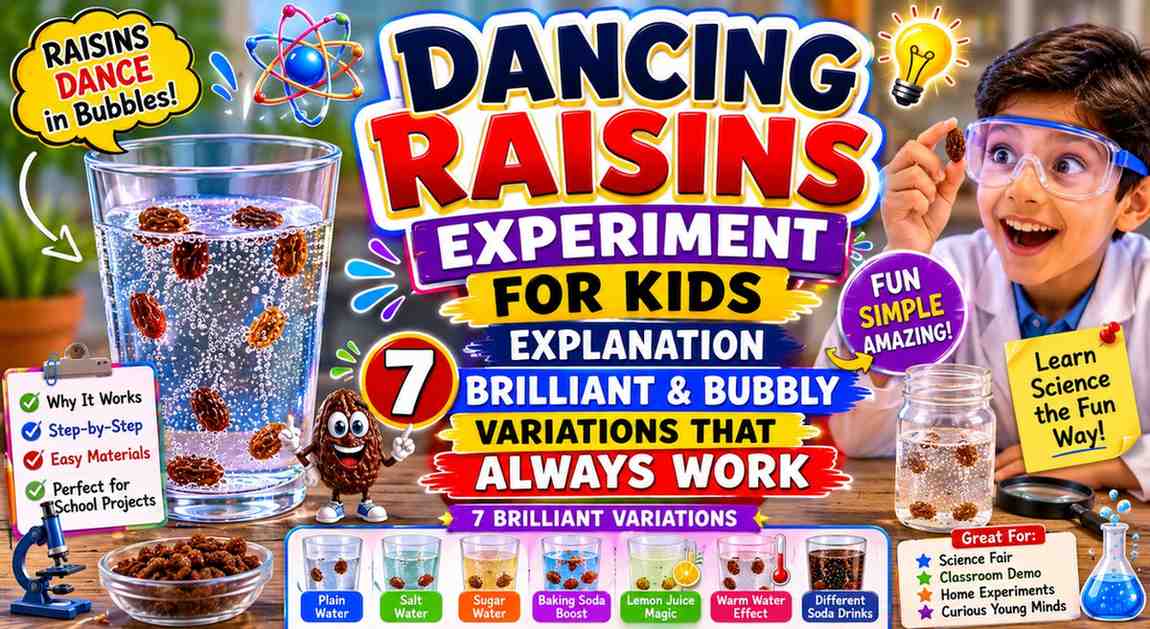
Introduction
Few science experiments deliver as much wonder with as little effort as the dancing raisins experiment. You drop a handful of wrinkled, shriveled raisins into a glass of sparkling water—and something extraordinary happens. The raisins sink, pause at the bottom, and then—one by one—begin to rise. They float to the surface, pause again, then sink back down. Up and down they go, over and over, in a mesmerizing underwater ballet that seems to defy common sense.
How can a raisin—clearly denser than water—float? How does it know when to rise and when to sink? Why does it keep dancing for minutes on end? And what on earth does sparkling water have to do with any of it?
The dancing raisins experiment for kids explanation answers every one of these questions beautifully—and in doing so, teaches three of the most important concepts in physics: density, buoyancy, and gas behavior. Three core curriculum concepts, all demonstrated simultaneously in a glass that costs nothing to set up and produces results within seconds of starting.
In this complete guide, you will find the full dancing raisins experiment for kids explanation—the step-by-step instructions, the deep science explained at multiple levels for different ages, seven creative and educational variations, a complete troubleshooting guide, science fair project ideas, and a thorough FAQ covering every question parents and teachers ask most frequently.
By the end, your child will not just have watched raisins dance. They will understand — genuinely and deeply — exactly why it happens, what force lifts the raisins, what force drops them back down, and how those two forces take turns winning in an endless, elegant cycle. And that understanding, built on a glass of sparkling water and a handful of dried fruit, is the beginning of real physics.
What Is the Dancing Raisins Experiment?
The dancing raisins experiment for kids explanation centers on one of the simplest, most accessible demonstrations of competing physical forces in all of kitchen science.
When raisins are dropped into carbonated water or sparkling soda, they immediately sink — confirming that they are denser than water. But the carbonation in the liquid produces carbon dioxide (CO₂) bubbles that attach to the rough, wrinkled surface of the raisins. As enough bubbles accumulate, the combined density of the raisin-plus-bubbles system drops below the density of the surrounding water, and the raisin rises.
At the surface, the bubbles pop and release their gas into the air. The raisin—now without its bubble cargo—returns to its original density, which is greater than water. It sinks again. At the bottom, new CO₂ bubbles attach. The raisin rises again. This cycle repeats continuously until the carbonation in the liquid is exhausted—typically 5 to 15 minutes depending on the drink used.
The dancing raisins experiment for kids explanation is a perfect demonstration of what happens when buoyancy and gravity take turns winning—and why the outcome depends entirely on the density of the object relative to its surrounding fluid at any given moment.
The Complete Science Behind the Dancing Raisins Experiment for Kids Explanation
To fully appreciate the dancing raisins experiment for kids’ explanation, it helps to understand each scientific concept involved separately—and then see how they work together to create the dancing effect.
Density — The Foundation of Everything
Density is defined as mass per unit volume—how much matter is packed into a given space. It is calculated as:
Density = Mass ÷ Volume
The density of pure water is approximately 1.0 g/ml at room temperature. Objects with a density greater than 1.0 g/ml sink in water. Objects with a density less than 1.0 g/ml float.
A raisin has a density of approximately 1.3–1.4 g/ml—significantly greater than water. This is why raisins sink immediately when dropped into water. They are simply too dense to float.
But density is not fixed — it can change. And this is where the dancing begins.
Buoyancy — Archimedes’ Principle in Action
Buoyancy is the upward force exerted on an object submerged in a fluid. It was first described by the ancient Greek mathematician Archimedes, who stated that the buoyant force on an object equals the weight of the fluid it displaces.
An object floats when its buoyant force (upward) equals or exceeds its weight (downward). An object sinks when its weight exceeds its buoyant force.
In simple terms: an object floats if it is less dense than the fluid it is in. It sinks if it is more dense.
A raisin alone is denser than water—it sinks. But a raisin covered in CO₂ bubbles is a different story. The bubbles are filled with gas — which is far less dense than water (approximately 0.0018 g/ml for CO₂ at room temperature). The combined system of raisins plus attached bubbles has a lower average density than water alone—so the combined system floats.
This is exactly the same principle that makes a submarine rise and dive—by filling or emptying ballast tanks with water or air, a submarine changes its average density relative to the surrounding water, allowing it to ascend or descend at will. The raisin is doing exactly what a submarine does—but powered by CO₂ bubbles rather than mechanical pumps.
Carbon Dioxide — The Engine of the Dance
The carbonation in sparkling water and soda drinks consists of carbon dioxide gas dissolved under pressure in the liquid. When the drink is opened and pressure is released, the CO₂ begins to come out of solution and form bubbles.
Bubble formation does not happen randomly throughout the liquid. CO₂ bubbles form preferentially on nucleation sites — surfaces that provide a place for the gas to begin accumulating. Smooth surfaces provide few nucleation sites. Rough, irregular, porous surfaces provide many.
This is the key to the dancing raisins experiment. The surface of a raisin is extraordinarily rough and irregular—covered in tiny folds, crevices, and pores from the drying process that turned a grape into a raisin. This rough surface is covered in nucleation sites, making raisins exceptionally effective at attracting and holding CO₂ bubbles.
Within seconds of entering a carbonated drink, a raisin’s surface is covered in attached CO₂ bubbles. The bubbles grow as more CO₂ comes out of solution and joins existing bubbles. When enough bubbles have accumulated — when the average density of the raisin-plus-bubble system drops below 1.0 g/ml — buoyancy wins and the raisin rises.
The Surface Moment — Why Bubbles Pop and Raisins Sink Again
When the bubble-covered raisin rises to the surface of the liquid, the bubbles are exposed to air above the liquid. Surface tension at the liquid surface causes the bubbles to pop—releasing their CO₂ into the atmosphere.
Without the bubbles, the raisin returns to its natural density of approximately 1.3–1.4 g/ml—greater than water. Gravity wins. The raisin sinks.
At the bottom, the raisin’s rough surface immediately begins collecting new CO₂ bubbles from the surrounding liquid. The cycle begins again.
Why the Dance Eventually Stops
The dancing raisins experiment for kids’ explanation also teaches something important about limited resources—the dance stops when the carbonation is exhausted. CO₂ dissolved in the liquid is a finite resource. Each rising-and-surface-popping cycle releases some CO₂ into the air. Over 5 to 15 minutes, the CO₂ concentration in the liquid drops too low to produce enough bubbles to lift the raisins—and they sink permanently.
You can restart the dance by pouring fresh sparkling water, confirming that CO₂ is the active ingredient and that the raisins themselves are unchanged.
What You Need for the Dancing Raisins Experiment for Kids Explanation
Basic Ingredients:
- A clear glass or jar (clear is essential — the whole point is to watch the dance)
- Carbonated water, sparkling water, club soda, or clear lemon-lime soda
- A handful of raisins (8–12 raisins is ideal)
Optional Additions:
- A magnifying glass for observing bubbles on the raisin surface
- A timer for measuring how long the dance continues
- A ruler for measuring how high raisins rise
- A notebook for recording observations
- Food coloring added to the water to make the bubbles more visible
Important Notes on Ingredient Selection:
The liquid matters significantly. More carbonated drinks produce more energetic, faster dancing. Club soda and sparkling water tend to be more heavily carbonated than most sodas. Fresh, newly opened bottles produce the best results—flat or partially carbonated drinks produce weak or no dancing.
The raisins matter too. Fresh, soft, plump raisins with deeply wrinkled surfaces work significantly better than old, dried-out, shrunken raisins. The more surface area and crevices, the more nucleation sites for bubbles. Raisins that have been soaking in water (which swells them and smooths their surface) work much worse—an interesting variable to investigate.
Step-by-Step Instructions — Dancing Raisins Experiment for Kids Explanation
Step 1: Prepare Your Observation Setup
Place the clear glass on a stable surface. If using food coloring, add 2–3 drops to the glass first. Have your raisins ready. Open your sparkling water or soda immediately before use—you want maximum carbonation.
Step 2: Pour the Carbonated Liquid
Pour sparkling water or clear soda into the glass until it is about 3/4 full. Pour gently and slowly to preserve as much carbonation as possible — aggressive pouring releases CO₂ prematurely through foam and fizz, reducing the amount available for the experiment.
Step 3: Observe the Liquid First
Before adding raisins, observe the carbonation in the liquid. Watch how bubbles form on the glass surface and rise. Note that the glass surface, like the raisin surface, provides nucleation sites—but the glass is fixed and the bubbles simply float away from it rather than lifting it.
Step 4: Add the Raisins
Drop 6–8 raisins into the glass one at a time. Watch each one carefully as it enters the liquid.
Step 5: Observe the Initial Sinking
Every raisin will sink immediately. This is expected and important — it confirms that raisins are denser than the liquid. Encourage children to note this and explain why. Raisins are denser than water. They sink. This is the starting state.
Step 6: Watch the First Rise
Within 10–30 seconds, the first raisin will begin to rise. Watch it carefully as it ascends—use a magnifying glass if available to see the bubble clusters attached to its surface. The bubbles are clearly visible as a cluster of tiny spheres clinging to the raisin’s wrinkled skin.
Step 7: Watch the Surface Moment
When the raisin reaches the surface, watch closely. The bubbles pop — sometimes visibly, sometimes with tiny sounds. The raisin pauses momentarily at the surface, then begins its descent.
Step 8: Time the Cycle
Use a timer to measure how long it takes for a single raisin to complete one full cycle—from the bottom, to the surface, and back to the bottom. Record this in a notebook. Does the cycle time change as the experiment continues and carbonation decreases?
Step 9: Watch the Dance Wind Down
After 5–15 minutes, observe as the dancing gradually slows. Raisins rise less high, cycle more slowly, and eventually sink permanently as the carbonation is exhausted. This gradual wind-down is itself scientifically interesting—ask children why the dance is getting slower.
Step 10: Restart the Experiment
Pour fresh sparkling water into the same glass over the same raisins. The dance immediately restarts—confirming that the CO₂ in the liquid was the active ingredient and that the raisins themselves are unchanged and reusable.
7 Brilliant Variations of the Dancing Raisins Experiment for Kids Explanation
Once the basic experiment is understood, these seven variations extend the science significantly—each one testing a different variable and producing new insights.
Variation 1: The Carbonation Comparison Test
Set up four identical glasses simultaneously. Fill with:
- Plain still water
- Lightly sparkling mineral water
- Standard sparkling water or club soda
- A fresh, heavily carbonated clear soda
Add the same number of raisins to each glass at the same moment. Observe and compare:
- Which glass shows dancing immediately?
- Which shows the most energetic dancing?
- Which shows the longest-lasting dance?
- Which shows no dancing at all?
The Science: This directly demonstrates the relationship between CO₂ concentration and the buoyancy effect. More carbonation means more bubbles forming faster — more energetic, faster dancing. Still water provides no buoyancy change, and raisins simply sink and stay. This is a classic controlled experiment with a clear, measurable variable (carbonation level) and clear, observable results.
Variation 2: The Object Comparison Test
Replace raisins with different objects of similar size and test which ones dance. Try:
- Raisins (deeply wrinkled — excellent nucleation sites)
- Grapes (smooth skin — poor nucleation sites)
- Small pieces of pasta (dry, rough surface)
- Corn kernels (rough surface)
- Smooth pebbles (very smooth — minimal nucleation sites)
- Rice grains (small, rough)
- Dried cranberries
The Science: This investigation reveals that it is not just density that matters—surface texture is equally important. Smooth objects (grapes, pebbles) dance poorly or not at all because their smooth surfaces provide few nucleation sites for CO₂ bubbles. Rough, wrinkled, porous objects dance energetically. This teaches that the dancing raisins experiment for kids’ explanation depends on two factors working together: density close to 1.0 g/ml AND a rough surface for bubble attachment.
Variation 3: Fresh vs. Soaked Raisins
Prepare two sets of raisins:
- Set 1: Standard dry raisins straight from the packet
- Set 2: Raisins that have been soaking in plain water for 1 hour (they will swell, soften, and have a smoother surface)
Test both sets in identical glasses of fresh sparkling water simultaneously.
The Science: Soaked raisins have absorbed water—increasing their density while also smoothing their wrinkled surface (reducing nucleation sites). They should dance significantly less effectively than dry raisins—possibly not at all. This demonstrates how both density and surface texture simultaneously affect the dancing behavior.
Variation 4: Temperature Investigation
Prepare identical sparkling water at three different temperatures:
- Ice cold (straight from the refrigerator with ice added)
- Room temperature
- Slightly warmed (not hot — just gently warmed to about 30–35°C)
Add identical raisins to each glass simultaneously and compare.
The Science: CO₂ dissolves more readily in cold water than in warm water—cold carbonated water holds more CO₂ in solution. However, cold water also releases CO₂ from solution more slowly, producing fewer bubbles per second. The relationship between temperature and carbonation behavior is complex, and the results may surprise children. Warmer water releases CO₂ faster (more energetic initial dance) but exhausts its carbonation sooner (shorter dance). This is an excellent investigation into gas solubility and temperature.
Variation 5: The Density Investigation — Salt Water vs. Fresh Water
Set up two identical glasses—one with fresh sparkling water and one with sparkling salt water (dissolve 3 tablespoons of salt in sparkling water before adding raisins).
The Science: Salt water is denser than fresh water — approximately 1.025–1.03 g/ml compared to 1.0 g/ml. A raisin that sinks in fresh sparkling water might barely sink—or even float—in salt sparkling water even without bubbles. Adding salt changes the baseline density of the liquid, affecting the amount of CO₂ lift needed to raise the raisin. This investigation connects the dancing raisins experiment for kids explanation to ocean buoyancy—why objects float more easily in the salty ocean than in fresh water.
Variation 6: The Shape Investigation
Cut raisins into different shapes and sizes:
- A whole raisin
- A raisin cut in half (more surface area relative to volume)
- A raisin cut into quarters
- A raisin squashed flat (maximum surface area)
Test each in fresh sparkling water and compare how quickly each dances and how energetically.
The Science: Cutting a raisin increases its surface area relative to its volume—more surface area means more nucleation sites for bubbles, meaning more bubbles can attach simultaneously, meaning less time is needed to accumulate enough buoyancy to rise. Smaller pieces also have less total weight—requiring fewer bubbles to achieve lift. This investigation introduces the concept of surface area to volume ratio—one of the most important concepts in biology and materials science.
Variation 7: The Bubble Counting Challenge
Using a magnifying glass and a smartphone camera (for close-up video), try to count the number of CO₂ bubbles attached to a raisin just before it rises. Then count the bubbles visible after it returns to the bottom.
The Science: The minimum number of bubbles needed to lift a raisin represents the threshold buoyancy—the number of bubbles whose combined buoyant force exactly equals the excess weight of the raisin above the water’s buoyant force. This is a genuine quantitative investigation that connects directly to Archimedes’ principle calculations—the kind of measurement that real fluid dynamics researchers make in laboratory settings.
Connecting the Dancing Raisins Experiment to Real-World Science
The dancing raisins experiment for kids’ explanation connects to a remarkable range of real-world scientific and engineering applications.
Submarine Ballast Systems
The most direct real-world parallel to the dancing raisins experiment is the ballast system of a submarine. A submarine dives by flooding its ballast tanks with seawater—increasing its average density above that of seawater, causing it to sink. It surfaces by pumping compressed air into the ballast tanks, expelling the water and reducing average density below that of seawater—causing it to rise. The raisin uses CO₂ bubbles as its ballast system—filling up with bubbles to rise, losing them to sink.
Fish Swim Bladders
Many fish control their buoyancy using an organ called a “swim bladder“—a gas-filled sac that they can inflate or deflate to adjust their average density. By adding or removing gas from the swim bladder, a fish can hover at any depth without expending energy to swim upward or downward. The raisin’s CO₂ bubble system is a passive, uncontrolled version of the same principle.
Deep Sea Creatures and Pressure
At extreme ocean depths, the immense water pressure compresses gas-filled structures—reducing buoyancy. Deep sea creatures have evolved various strategies to manage their density at different depths. The dancing raisins experiment introduces children to the concept that pressure affects gas volume and therefore buoyancy—a concept that becomes critical in understanding deep-sea biology and diving physics.
Champagne and Carbonated Beverages
The CO₂ bubbles in the dancing raisins experiment are the same bubbles that make champagne, sparkling wine, and carbonated drinks fizzy. The bubbles form on nucleation sites on the glass surface and on any particles in the liquid—which is why a dirty glass produces far more bubbles than a perfectly clean one and why adding a grain of salt to a glass of soda produces an immediate cascade of bubbles. The dancing raisins experiment for kids’ explanation is, at its heart, an exploration of carbonation—one of the most commercially important applications of dissolved gas chemistry.
Geology and Volcanic Activity
CO₂ and other gases dissolved in magma behave similarly to CO₂ in sparkling water. As magma rises toward the surface and pressure decreases, dissolved gases come out of solution and form bubbles — just as CO₂ bubbles form when a soda bottle is opened. The rapid expansion of these bubbles is one of the driving forces of volcanic eruptions. The dancing raisins experiment is, in a very small and safe way, demonstrating the same physics that drives some of the most powerful geological events on Earth.
The Dancing Raisins Experiment as a Science Fair Project
The dancing raisins experiment for kids explanation has excellent potential as a school science fair project because it involves clearly measurable variables and produces quantitative, comparable results.
Excellent Research Questions:
- Which carbonated drink produces the most energetic dancing raisins?
- How does water temperature affect the duration of the dancing raisins’ dance?
- Does raisin surface texture affect dancing behavior?
- How does the density of the liquid (fresh vs. salt water) affect how many bubbles are needed to lift a raisin?
- Does raisin size affect how quickly it rises after sinking?
Measuring Results: Use a stopwatch to time the complete cycle (bottom to surface to bottom). Use a ruler to measure rise height. Count cycles per minute to quantify dance energy. Photograph at regular intervals to document behavior.
Presenting Your Project: A well-documented dancing raisins science fair project should include a clear hypothesis, a controlled experimental design, a data table with multiple trials, a graph showing results, and a conclusion that uses the concepts of density, buoyancy, and CO₂ behavior to explain the findings. Display the actual experiment running at the science fair—few demonstrations attract more judges and fellow students to a table than a glass of dancing raisins.
For additional information about buoyancy, Archimedes’ principle, and fluid dynamics appropriate for young learners, the Khan Academy Physics — Fluids section provides excellent free educational content covering all the concepts demonstrated in this experiment.
Troubleshooting — Why Are My Raisins Not Dancing?
The dancing raisins experiment for kids explanation is one of the most reliable experiments in kitchen science—but a few common issues can reduce or eliminate the dancing effect.
Problem: Raisins sink and stay at the bottom. Most likely cause: The liquid is not carbonated enough. Use a freshly opened bottle of sparkling water or club soda. Old, partially flat drinks contain insufficient CO₂ to produce enough bubbles for life. Also check that raisins are fresh with a deeply wrinkled surface.
Problem: Raisins float at the surface without sinking first. This is rare but can happen with very old, dried-out raisins that have become less dense due to significant moisture loss. Try fresh raisins from a recently opened packet.
Problem: Raisins dance very briefly and then stop quickly. The carbonation is being exhausted too rapidly. This happens with lightly carbonated drinks or in warm conditions. Use heavily carbonated drinks in a cool environment. Reduce the glass size so less drink is used — concentrating the CO₂ available relative to the number of raisins.
Problem: Raisins dance but rise only very slightly. The raisins may be too dense—perhaps they have absorbed moisture previously. Try completely fresh, dry raisins. Also ensure the drink is as fresh and carbonated as possible — more vigorous carbonation produces more and larger bubbles, generating more lift per cycle.
Problem: Only some raisins dance while others stay at the bottom. This is normal and actually scientifically interesting. Different raisins have different densities and different surface textures. Raisins closest to the neutral buoyancy point of 1.0 g/ml need fewer bubbles to achieve lift and dance first. Denser raisins require more bubbles and take longer to begin dancing — or may not dance if they are too dense for the available carbonation. Ask children why some raisins dance and others do not—and what that tells us about density variation within the same type of food.
Extension Activities — Taking the Science Further
The dancing raisins experiment for kids explanation is an excellent foundation for deeper scientific exploration across multiple disciplines.
Mathematics Connection: Estimate the volume of a raisin and its mass using a kitchen scale. Calculate its density. Compare to water density. Calculate approximately how many CO₂ bubbles (estimate bubble diameter at 1 mm, calculate bubble volume using the sphere formula) would be needed to reduce the average density of the raisin-plus-bubbles system to below 1.0 g/ml.
Biology Connection: Research how fish use swim bladders to control buoyancy. Compare the fish’s biological mechanism to the raisin’s CO₂ bubble mechanism. What are the advantages of active (biological) buoyancy control over passive (physical) buoyancy control?
Engineering Connection: Design a simple model submarine using a plastic bottle and ballast — filling and emptying it with water to dive and surface. Connect this to the raisin experiment by identifying the equivalent of the CO₂ bubbles in the submarine system.
History Connection: Research Archimedes and his famous discovery of buoyancy. Read about his principle and its applications throughout history—from ship design to the Plimsoll line to modern submarine engineering.
Frequently Asked Questions (FAQ)
Q1: Why do raisins dance in sparkling water but not plain water? Plain water contains no dissolved CO₂ gas and therefore produces no bubbles. Without bubbles attaching to the raisin’s surface, there is no buoyancy change—the raisin simply sinks and stays at the bottom. The CO₂ bubbles in sparkling water are the entire mechanism of the dance. This is the central point of the dancing raisins experiment for kids‘ explanation—carbonation provides the changing buoyancy that makes the dance possible.
Q2: Which drink produces the best dancing raisins? Club soda and fresh sparkling water typically produce the most energetic and long-lasting dance because they are very heavily carbonated and contain no sugar (which can slightly reduce carbonation). Clear lemon-lime sodas work well too. Avoid colored or dark sodas if visibility is important—the dance is much harder to observe in dark liquid. Flat or partially carbonated drinks produce poor results.
Q3: How long does the dancing raisins experiment last? Typically 5–15 minutes with fresh, heavily carbonated drinks. The dance gradually slows and stops as CO₂ is depleted. Adding fresh sparkling water to the same raisins immediately restarts the dance—the raisins are completely reusable. The raisins themselves are unchanged by the experiment and can be used for multiple trials.
Q4: Can you eat the raisins after the experiment? Yes—all ingredients are completely food-safe. The raisins have simply been sitting in carbonated water, which is harmless. They will be slightly more plump from absorbing some water. Some children enjoy eating the “dancing raisins” at the end of the experiment—a satisfying conclusion to the science.
Q5: Why do some raisins dance more vigorously than others? Individual raisins vary in density and surface texture. Raisins with density closer to 1.0 g/ml (closer to neutral buoyancy) need fewer bubbles to achieve lift and dance more readily. Raisins with more deeply wrinkled surfaces have more nucleation sites and accumulate bubbles faster. These natural variations within the same food make the experiment even more scientifically interesting—demonstrating that real scientific systems always involve natural variation.
Q6: What would happen if you used a liquid denser than the raisin? If the liquid were denser than 1.3–1.4 g/ml (the approximate density of a raisin), the raisin would float without any bubbles at all—buoyancy alone would be sufficient to support it. You can approach this by using very concentrated saltwater—in enough saltwater, a raisin will float passively. This investigation beautifully demonstrates that whether an object sinks or floats depends entirely on the relative density of the object and the liquid—not on the absolute density of either.
Q7: Does the size of the glass affect the experiment? Yes—a narrower, taller glass produces more dramatic-looking dancing because the raisins travel further vertically. A wider, shallower glass produces less impressive vertical movement. The glass size also affects how long the dance lasts — a larger volume of carbonated liquid contains more total CO₂, producing a longer dance. For best visual results, use a tall, narrow glass.
Q8: How does this experiment connect to what children learn in school science? The dancing raisins experiment for kids explanation directly demonstrates curriculum concepts, including density (objects sink or float based on density relative to surrounding fluid), buoyancy and Archimedes’ principle (upward force equals weight of displaced fluid), gas behavior (CO₂ dissolves under pressure and comes out of solution when pressure drops), and scientific investigation skills (forming hypotheses, controlling variables, and measuring results). It is one of the most curriculum-relevant kitchen science experiments available for primary and middle school students.
Conclusion
The dancing raisins experiment for kids’ explanation is proof—as satisfying and complete as any proof in science—that the most profound physical principles can be observed, understood, and genuinely felt through the simplest possible setup.
A glass. Some sparkling water. A handful of raisins. And three of the most important concepts in physics—density, buoyancy, and gas behavior—were made completely visible, completely tangible, and completely unforgettable.
Every time a raisin rises, it is because CO₂ bubbles have changed its effective density enough that Archimedes’ upward buoyant force exceeds the downward pull of gravity. Every time it sinks, it is because those bubbles have popped at the surface and gravity has won again. Every time it rises once more, it is because physics is patient and consistent and absolutely reliable—the same forces, following the same laws, producing the same outcome, over and over, as long as the carbonation lasts.
That reliability — that beautiful, precise, testable reliability — is what science is. Not magic. Not mystery. But forces and laws and densities and pressures operate with perfect consistency in a glass of sparkling water on a kitchen table.
The dancing raisins experiment for kids explanation teaches children something more important than density and buoyancy. It teaches them that the universe is understandable. That the forces governing the dance of a raisin in a glass are the same forces governing the dive of a submarine, the swim of a fish, and the eruption of a volcano. That physics does not change depending on the scale or the setting—only the numbers change.
And a child who understands why a raisin dances has taken the first step toward understanding all of it.
So pour the sparkling water, drop in the raisins, and watch the physics begin. The dance awaits—and now you know every step of it.
External Resource (DoFollow): For comprehensive, curriculum-aligned physics tutorials covering buoyancy, density, fluid dynamics, and Archimedes’ principle, visit Khan Academy Physics — Fluids — a completely free, world-class educational resource for students of all ages.