
 creator@scienceexplore.site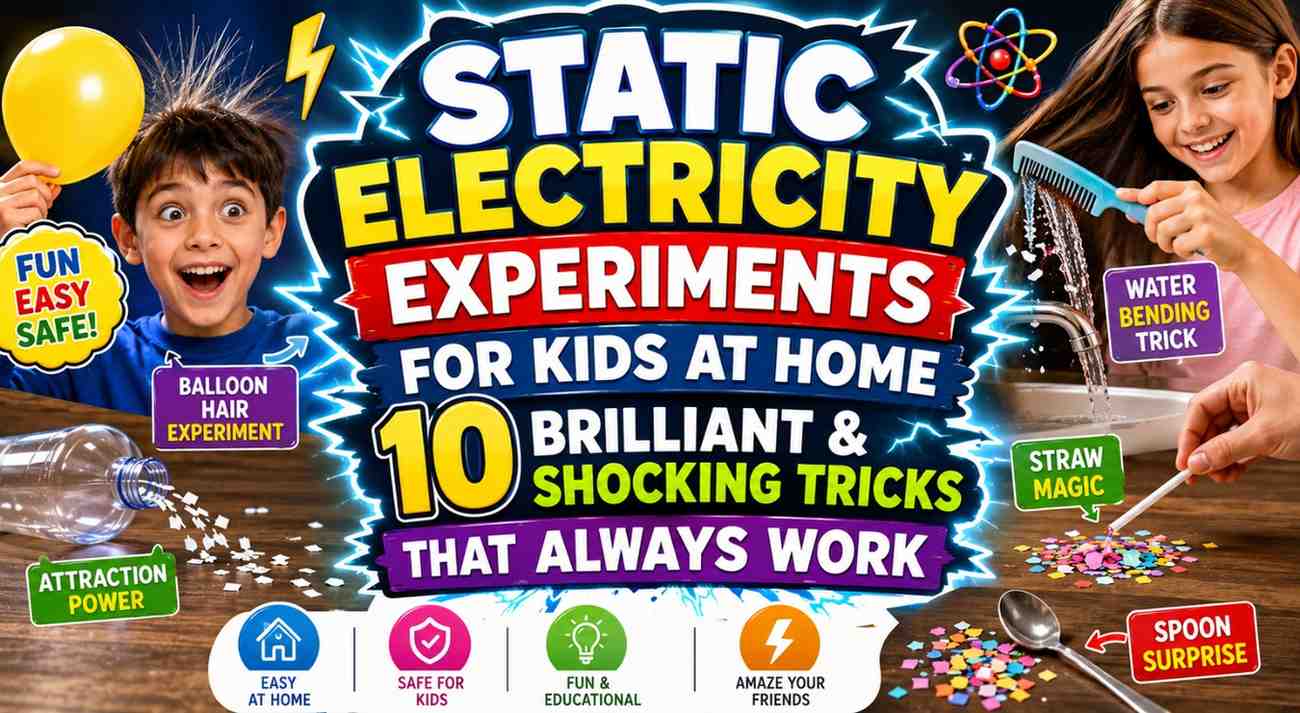
Introduction
Have you ever shuffled across a carpet in socks and then touched a doorknob—only to get a sharp, surprising zap? Have you ever pulled a sweater over your head and watched your hair stand straight up, reaching toward the fabric like tiny fingers? Have you ever peeled apart two sheets of plastic wrap and felt them cling stubbornly to everything—your hands, the counter, your face?
That invisible, crackling, hair-raising force is static electricity—and it is one of the most fascinating, most accessible, and most dramatic branches of physics available to curious children. Unlike many scientific phenomena that require sophisticated equipment to observe, static electricity reveals itself constantly in everyday life. It just needs someone to notice it and to ask why.
Static electricity experiments for kids at home are among the most immediately spectacular science activities available because they produce effects that feel genuinely magical. Water bends. Pepper jumps. Balloons float against walls. Tissue paper dances in midair. Tiny lightning bolts spark between fingers and metal. All of this happens using nothing more than a balloon, a wool sweater, and household items that cost almost nothing.
In this complete guide, you will find 10 thoroughly explained, always-successful static electricity experiments for kids at home — each with full step-by-step instructions, the deep science behind the effect, age recommendations, and creative extensions. You will also find a complete explanation of what static electricity actually is at the atomic level, a thorough troubleshooting guide, science fair project ideas, and a comprehensive FAQ section.
By the end, your child will not just have performed spectacular tricks with static electricity. They will understand — at a genuinely atomic level — exactly what is happening when electrons move, charges build up, and invisible electrical forces reach out across empty space to attract, repel, and occasionally shock everything they encounter.
What Is Static Electricity? The Complete Science Explanation
Before diving into the 10 experiments, understanding static electricity thoroughly transforms every demonstration from a cool trick into a window onto the fundamental structure of matter.
Atoms, Electrons, and Charge
Everything in the universe — every object you can see, touch, or hold — is made of atoms. Each atom consists of a nucleus containing positively charged protons and uncharged neutrons, surrounded by negatively charged electrons orbiting in shells around the nucleus.
In a neutral atom, the number of protons exactly equals the number of electrons — the positive and negative charges cancel each other out perfectly, leaving the atom with zero net charge.
Static electricity arises when electrons — which are in the outer shells of atoms and therefore relatively loosely held — are transferred from one material to another through contact and friction. This transfer leaves one material with more electrons than protons (net negative charge) and the other material with fewer electrons than protons (net positive charge).
The Triboelectric Effect
The specific process of charge transfer through friction is called the triboelectric effect—from the Greek word “tribein,” meaning “to rub.” Different materials have different affinities for electrons — some hold their electrons tightly and tend to gain electrons when rubbed (becoming negatively charged), while others hold electrons loosely and tend to lose them (becoming positively charged).
This ordering of materials by their tendency to gain or lose electrons is called the triboelectric series. Key examples relevant to our experiments:
Tends to give up electrons (becomes positive): Human hair, wool, fur, glass, nylon Tends to accept electrons (becomes negative) : Rubber, polyester, plastic, Styrofoam, PVC
This is why rubbing a rubber balloon on hair works so consistently—hair readily gives up electrons and rubber readily accepts them. The balloon becomes negatively charged, and the hair becomes positively charged.
Coulomb’s Law — How Charges Interact
Once charges have been separated, they interact according to Coulomb’s Law—the fundamental law of electrostatic interaction:
Like charges repel each other. Opposite charges attract each other.
The force between charges decreases with the square of the distance between them—double the distance and the force becomes four times weaker. This inverse-square relationship explains why you need to bring a charged balloon close to water or paper to see the effect—at a distance, the force is too weak to notice.
Induced Charge — Why Neutral Objects Are Attracted Too
One of the most important concepts in static electricity experiments for kids at home is induced charge—the reason a charged balloon attracts not just objects with opposite charge, but also completely neutral objects like walls, paper, or water.
When a negatively charged balloon approaches a neutral wall, the negative charges in the wall’s atoms are repelled and pushed slightly further away from the balloon—leaving a slight positive charge on the wall’s surface closest to the balloon. This positive surface is attracted to the negative balloon — and since the attracted positive surface is closer to the balloon than the repelled negative charges behind it, the attraction wins and the balloon sticks to the wall.
Induced charge is the explanation for nearly every static electricity experiment involving a charged object attracting a neutral one, and understanding it elevates the static electricity experiments for kids at home from simple observation to genuine atomic-level understanding.
Static Electricity Experiments for Kids at Home — 10 Brilliant Activities
Experiment 1: Bending Water with a Charged Balloon
Concept Taught: Electrostatic attraction, molecular polarity, induced charge
Age Range: 5 and above
What You Need:
- An inflated balloon
- A wool sweater, fleece blanket, or your own hair
- A tap producing a thin, steady stream of water
Step-by-Step Instructions:
Step 1: Turn on the tap and adjust to produce the thinnest, steadiest stream of water possible — about the diameter of a pencil. Allow it to run steadily.
Step 2: Rub the inflated balloon vigorously on a wool sweater or on your hair for 20–30 seconds. The longer and more vigorously you rub, the more charge builds up.
Step 3: Slowly bring the charged balloon close to the water stream—from the side, not from above or below. Do not touch the water.
Step 4: Watch the water stream bend noticeably toward the balloon. Move the balloon further away—the stream straightens. Move it closer — the bending increases.
Step 5: Try different distances and observe how the bending changes. The closer the balloon, the greater the deflection of the water stream.
The Science: Water molecules are polar—the oxygen atom in each H₂O molecule has a slight negative charge and the hydrogen atoms have a slight positive charge. When the negatively charged balloon approaches, the slightly positive ends of nearby water molecules rotate toward the balloon (opposite charges attract) while the slightly negative ends rotate away. This alignment of polar molecules in response to an external electric field is called “dielectric polarization“—and it causes the water stream as a whole to be attracted toward the balloon.
This experiment beautifully demonstrates both static electricity and the molecular polarity of water—two fundamental concepts in one simple demonstration.
Troubleshooting: If the water does not bend, rub the balloon harder and longer. This experiment works best in dry conditions—high humidity allows charge to dissipate. Also ensure the water stream is as thin as possible — thick streams are too heavy to deflect visibly.
Experiment 2: Dancing Pepper and Jumping Salt
Concept Taught: Electrostatic attraction, charge and mass relationship
Age Range: 5 and above
What You Need:
- A flat plate or piece of paper
- Ground black pepper
- Table salt (optional — for comparison)
- An inflated balloon
- A wool sweater or hair
Step-by-Step Instructions:
Step 1: Sprinkle a thin, even layer of ground black pepper across the flat plate.
Step 2: Charge the balloon by rubbing it vigorously on wool or hair for 20–30 seconds.
Step 3: Hold the charged balloon about 10 cm above the pepper. Do not touch the plate.
Step 4: Watch as pepper particles leap upward and cling to the balloon surface.
Step 5: For an extension—sprinkle a mixture of salt and pepper together on the plate. Hold the charged balloon a specific distance above the mixture—only the lighter pepper will jump up, leaving the heavier salt behind. This allows you to separate salt from pepper using nothing but static electricity!
The Science: Ground pepper consists of tiny, extremely lightweight particles. The electrostatic attraction between the charged balloon and the induced charge on the pepper particles is strong enough to overcome the gravitational force pulling the pepper downward—because pepper particles are so light that even a small electrostatic force exceeds their weight.
Salt particles are denser and heavier. At the same distance, the same electrostatic force is insufficient to lift them against gravity—so they stay on the plate while pepper leaps away. This elegant difference demonstrates the relationship between electrostatic force, gravitational force, and mass in a completely visual way.
The Separation Application: Ancient grain farmers used a similar principle—blowing grain over the edge of a container on a windy day so lighter chaff blew away while heavier grain fell straight down. Electrostatic separation is also used industrially to separate particles in air pollution control systems and mineral processing.
Experiment 3: Balloon Stuck to the Wall
Concept Taught: Induced charge, electrostatic attraction, charge distribution
Age Range: 4 and above
What You Need:
- An inflated balloon
- A wool sweater, fleece, or hair
- A flat, painted wall or ceiling
Step-by-Step Instructions:
Step 1: Inflate a balloon and tie it securely.
Step 2: Rub the balloon vigorously on a wool sweater or on your hair for 20–30 seconds.
Step 3: Hold the charged balloon against a flat, clean wall and release it.
Step 4: Watch it stick to the wall without any support, held there entirely by invisible electrostatic force.
Step 5: Try sticking it to the ceiling. With a strongly charged balloon on a dry day, it will stick to the ceiling as well.
Step 6: Watch how long it takes for the balloon to eventually slide down and fall. Time it. Try again after recharging—does more vigorous rubbing make it stick longer?
The Science: The charged balloon induces a slight opposite charge on the surface of the wall directly opposite it — the nearest surface of the wall becomes slightly positively charged because negative charges in the wall are repelled away from the balloon. This induced positive surface is attracted to the negatively charged balloon strongly enough to support the balloon’s weight against gravity.
Over time, the charge on the balloon gradually dissipates—electrons flow slowly from the balloon into the air molecules surrounding it (this happens faster in humid conditions). As the charge decreases, the electrostatic force decreases until gravity wins and the balloon falls. Measuring how long the balloon sticks under different humidity conditions is an excellent quantitative investigation.
Experiment 4: Hair-Raising Balloon
Concept Taught: Charge transfer, like charges repel, and the triboelectric effect
Age Range: 4 and above
What You Need:
- An inflated balloon
- A child willing to have their hair stand up
Step-by-Step Instructions:
Step 1: Inflate a balloon and tie it.
Step 2: Have the child sit or stand in front of a mirror.
Step 3: Rub the balloon slowly but firmly across the child’s hair—moving in one direction only. Do about 10–15 slow passes across the hair.
Step 4: Slowly lift the balloon directly upward above the child’s head—about 10–15 cm above.
Step 5: Watch the hair rise upward toward the balloon, strand by strand, until the child looks delightfully electrified.
Step 6: For a photograph, have the child hold a mirror or stand in front of one so they can see the effect themselves.
The Science: When the balloon is rubbed across hair, electrons transfer from the hair to the balloon—the balloon becomes negatively charged and the hair becomes positively charged. Each individual hair strand now carries the same positive charge as all the other strands. Since like charges repel, the positively charged hair strands push away from each other as strongly as possible—causing them to spread out and stand apart. Simultaneously, the positively charged hair is attracted to the negatively charged balloon above it—so the strands rise upward toward the balloon. The result is the iconic electrified hair appearance that children find absolutely hilarious.
Experiment 5: Electrostatic Tissue Paper Butterfly Dance
Concept Taught: Electrostatic attraction and repulsion, induced charge
Age Range: 5 and above
What You Need:
- Tissue paper
- Scissors
- An inflated balloon
- Wool or hair for charging
- A flat surface
Step-by-Step Instructions:
Step 1: Cut tissue paper into small butterfly shapes or simple strips about 3 cm long and 0.5 cm wide. Make 10–15 pieces.
Step 2: Place the tissue paper pieces on a flat surface.
Step 3: Charge the balloon vigorously by rubbing on wool or hair.
Step 4: Hold the charged balloon about 5–8 cm above the tissue paper pieces.
Step 5: Watch as the tissue pieces leap upward and cling to the balloon—your butterflies are flying!
Step 6: As pieces cling to the balloon, they acquire some of its charge. Watch as they then jump OFF the balloon and fall away—repelled by the like charge they just acquired.
The Science: This experiment demonstrates both attraction and repulsion in sequence. Tissue paper is neutral — the charged balloon induces an opposite charge on the near surface, causing attraction. When tissue paper touches the balloon, charge transfers to it — now the tissue paper has the same charge as the balloon and is immediately repelled. The tissue falls away, loses its charge to the air within seconds, and becomes neutral again—and can be attracted again. The cycle of attract, charge, repel, discharge, and repeat creates the dancing effect.
Experiment 6: Electrostatic Salt and Pepper Separator
Concept Taught: Electrostatic separation, practical applications of static electricity
Age Range: 6 and above
What You Need:
- A plate with an equal mixture of salt and ground pepper
- An inflated balloon charged on wool or hair
- OR a plastic comb run through dry hair
Step-by-Step Instructions:
Step 1: Mix salt and pepper together thoroughly on a flat plate—making a uniform grey mixture.
Step 2: Charge a balloon by rubbing vigorously on wool or hair. Alternatively, run a plastic comb briskly through clean, dry hair about 10 times.
Step 3: Hold the charged object about 2–3 cm above the salt-and-pepper mixture—closer than in other experiments because you want enough force to lift pepper but not salt.
Step 4: Watch as only the pepper particles leap upward while the salt remains undisturbed.
Step 5: Adjust height—raise the balloon higher until you find the exact distance where pepper just barely lifts but salt does not. This precise distance is the point where electrostatic force equals the gravitational force on a pepper particle but is still insufficient to lift a heavier salt grain.
The Science: This experiment uses static electricity as a practical separation tool—and it works because of the mass difference between pepper and salt particles. The electrostatic force is identical for both (same charge, same distance), but Pepper’s lower mass means this force exceeds its weight at a distance where Salt’s greater weight still wins. This is the same principle used in electrostatic precipitators in industrial smokestacks—where static electricity separates fine particles from exhaust gases to reduce air pollution.
Experiment 7: Can Rolling with Static Electricity
Concept Taught: Electrostatic attraction between charged object and neutral conductors
Age Range: 5 and above
What You Need:
- An empty aluminum soda can (completely empty and dry)
- A flat, smooth surface (a table or smooth floor)
- An inflated balloon charged on wool or hair
Step-by-Step Instructions:
Step 1: Place the empty aluminum can on its side on the smooth flat surface.
Step 2: Charge the balloon vigorously by rubbing on wool or hair for 20–30 seconds.
Step 3: Hold the charged balloon about 2–3 cm from the side of the can—close but not touching.
Step 4: Watch the can begin to roll toward the balloon.
Step 5: Move the balloon slowly across the table — the can follows, rolling after it like a trained pet.
Step 6: Try moving the balloon faster—can you keep the can rolling at speed?
The Science: Aluminum is an electrical conductor—electrons in metal move freely throughout the material. When the negatively charged balloon approaches, the free electrons in the aluminum can are repelled and move to the far side of the can—leaving a net positive charge on the near side. This induced positive charge is attracted to the negative balloon—and since the can is free to roll, it moves toward the balloon rather than just experiencing an internal charge redistribution as a fixed wall would. This is induced charge in a conductor—a more advanced concept than induced charge in an insulator, demonstrating how charge distributes differently in conducting vs. non-conducting materials.
Experiment 8: Electrostatic Jumping Frog
Concept Taught: Charge transfer, repulsion of like charges, charge decay
Age Range: 6 and above
What You Need:
- A piece of aluminum foil
- Scissors
- An inflated balloon
- Wool or hair for charging
- A flat surface
Step-by-Step Instructions:
Step 1: Cut the aluminum foil into small frog shapes—simple oval bodies with four legs splayed outward work perfectly. Make them about 3 cm long. Make 6–8 frogs.
Step 2: Place the foil frogs flat on a clean, dry surface.
Step 3: Charge the balloon vigorously on wool or hair.
Step 4: Hold the balloon about 5 cm above the frogs.
Step 5: Watch the frogs leap upward toward the balloon and stick to it. Then watch as they jump off after a second or two—propelled away as they acquire the balloon’s charge.
Step 6: The frogs that fall back to the surface quickly lose their charge to the surface and become neutral again—ready to leap again.
The Science: Aluminum foil is an excellent electrical conductor—charge transfers to it almost instantly upon contact with the balloon. The foil frogs follow the same attract-contact-charge-repel cycle as the tissue paper butterflies in Experiment 5, but because aluminum is a better conductor than tissue paper, the charge transfer is faster and more complete—producing a sharper, more dramatic jump off the balloon.
Experiment 9: Electrostatic Attraction — Which Materials Work Best?
Concept Taught: Triboelectric series, material properties, controlled scientific investigation
Age Range: 7 and above
What You Need:
- A charged balloon
- Various materials for rubbing: wool, cotton, silk, polyester, nylon, your hair
- Small pieces of tissue paper as test subjects
- A ruler
- A notebook
Step-by-Step Instructions:
Step 1: Set up a consistent test. Hold the balloon at a fixed distance (10 cm) above the tissue paper pile after charging.
Step 2: Charge the balloon by rubbing it with wool for exactly 20 strokes. Test by counting how many tissue pieces jump up. Record the number.
Step 3: Discharge the balloon by touching it to a metal surface. Now charge with cotton for exactly 20 strokes. Test and record.
Step 4: Repeat with each material — silk, polyester, nylon, hair — using exactly the same number of strokes each time.
Step 5: Record all results in a table and rank the materials from most to least effective at charging the balloon.
The Science: This experiment directly investigates the triboelectric series—the ranking of materials by their tendency to transfer electrons to rubber. Wool and hair typically produce the strongest charge because they are near the “electron-giving” end of the triboelectric series, while rubber (the balloon) is near the “electron-accepting” end—a large difference in electron affinity means more charge transfer per friction stroke. Cotton produces less charge because it sits closer to rubber in the triboelectric series. This turns a simple static electricity experiment for kids at home into a proper scientific investigation of material electrical properties.
Experiment 10: Making a Simple Electroscope
Concept Taught: Detecting electric charge, charge repulsion, scientific instrument making
Age Range: 8 and above
What You Need:
- A glass jar with a metal lid
- A piece of stiff wire or a metal paperclip
- Two small pieces of aluminum foil
- A pencil or straw
- Modeling clay or putty
- A charged balloon for testing
Step-by-Step Instructions:
Step 1: Straighten a paperclip to create an L-shaped wire with a horizontal arm at the top and a vertical arm going down through the jar lid.
Step 2: Make a small hook at the bottom of the vertical arm. Cut two identical strips of aluminum foil about 2 cm long and 0.5 cm wide. Hang them both from the bottom hook so they hang side by side touching each other.
Step 3: Push the wire through a hole in the lid so the foil strips hang inside the jar and the horizontal arm extends above the lid. Seal the wire in place with modeling clay.
Step 4: Close the jar. Your electroscope is complete.
Step 5: Charge a balloon and touch it to the horizontal arm of the wire. Watch the two aluminum foil strips spread apart inside the jar.
Step 6: Remove the balloon—the strips slowly return toward each other as charge dissipates.
The Science: When charge flows from the balloon through the wire to the foil strips, both strips acquire the same charge. Like charges repel—so the strips spread apart. The more charge applied, the wider they spread. When charge dissipates, they return to neutral and fall back together. This is a genuine working electroscope—a scientific instrument used since the 18th century to detect and measure electric charge. Benjamin Franklin used instruments like this in his famous experiments with lightning. Building and using one connects the static electricity experiments for kids at home directly to the history of physics.
Factors That Affect Static Electricity Experiments for Kids at Home
Understanding what makes static electricity experiments for kids at home work better or worse helps children think like real experimental scientists.
Humidity — The Most Important Factor
Humidity is the single biggest variable affecting the success of all static electricity experiments for kids at home. Water molecules in humid air are polar and act as tiny conductors — they allow charge to gradually flow off charged surfaces and into the air, dissipating the static charge.
On dry days (low humidity, common in winter with central heating), static charge builds up and persists for much longer—producing dramatically stronger effects. On humid summer days or in bathrooms, static electricity experiments often produce disappointing results because charge leaks away too quickly.
Practical tip: The best time to perform static electricity experiments for kids at home is on dry winter days in a heated room. If experiments are failing on a humid day, try running them in an air-conditioned room or after the heating has been on for an hour.
Surface Cleanliness
Oils, moisture, and residue on surfaces allow charge to conduct away. Ensure balloons are clean and dry. Rub charging surfaces (wool, hair) until they are completely dry. Clean glass and plastic surfaces with a dry cloth before use.
Charging Technique
More vigorous rubbing, more strokes, and longer contact time all produce greater charge transfer. However, there is a maximum charge the balloon can hold—beyond a certain point, additional rubbing produces diminishing returns as charge begins to leak away as fast as it is added.
Balloon Material
Latex balloons produce stronger static effects than Mylar (foil) balloons. The rougher surface texture of latex increases friction during rubbing, and latex’s position in the triboelectric series makes it a better electron acceptor than Mylar.
Real-World Applications of Static Electricity
The static electricity experiments for kids at home connect to a remarkable range of real-world technologies and natural phenomena.
Laser printers and photocopiers use static electricity to attract toner particles to paper in precisely the right places to form text and images—printing by controlled electrostatic deposition.
Electrostatic precipitators in industrial smokestacks use static electricity to attract and remove fine particle pollutants from exhaust gases—reducing air pollution from power plants and factories.
Lightning is the most dramatic natural static electricity phenomenon—the result of enormous charge separation between storm clouds and the ground, eventually neutralized in a spectacular discharge. Benjamin Franklin’s famous kite experiment demonstrated that lightning was electrical in nature.
Spray painting uses electrostatic attraction to pull paint particles toward the object being painted—producing a more even, efficient coat with less overspray.
Electrostatic dust removal in air purifiers uses charged plates to attract and trap fine particles from circulating air.
Defibrillators use controlled electrical discharge through the body to restart a heart in fibrillation—the most life-saving application of electrical principles in medicine.
For more detailed exploration of electrostatics and its applications, The Physics Classroom’s comprehensive electrostatics tutorials provide excellent, curriculum-aligned explanations for middle school students and above.
Turning Static Electricity Into a Science Fair Project
Static electricity experiments for kids at home have outstanding potential as science fair projects because they involve clearly measurable variables and produce quantitative results.
Excellent Research Questions:
- How does relative humidity affect how long a charged balloon sticks to a wall?
- Which rubbing material produces the strongest charge on a balloon?
- How does the number of rubbing strokes affect the height at which pepper jumps?
- Does balloon size affect the strength of static charge it can hold?
- How does temperature affect the rate of charge dissipation?
Measuring Results: Use a ruler to measure the deflection angle of the water stream, or the height that the pepper jumps, or the distance at which the rolling can begins to move. Time how long balloons stick to walls. Count tissue pieces attracted at a fixed distance.
Controls and Variables: Always use the same number of rubbing strokes, the same balloon size, and the same test object (tissue paper, pepper) at the same distance, and vary only one thing at a time. Record everything in a data table and present results as bar charts or line graphs.
Frequently Asked Questions (FAQ)
Q1: Why do static electricity experiments for kids at home work better in winter? Winter air is drier—lower humidity means water molecules are less available to conduct charge away from the balloon surface. Static charge builds up more strongly and persists longer on dry winter days, particularly in centrally heated rooms. Summer humidity causes charge to leak away too quickly for most experiments to work well.
Q2: Why does my balloon not stick to the wall after charging? The most likely causes are high humidity, an insufficiently charged balloon, or a wall surface that has been cleaned with a product leaving a conductive residue. Rub the balloon more vigorously for longer on wool or clean, dry hair. Try the experiment on a different day when humidity is lower.
Q3: Is static electricity dangerous for children? The static electricity produced in household experiments is completely harmless. The voltages involved can be surprisingly high (10,000 volts or more in theory), but the current (amount of charge flowing) is extremely small—far too small to cause any physiological harm. The worst outcome is a mild, momentary zap when discharging.
Q4: Why does rubbing a balloon on hair work better than rubbing on cotton? Hair sits much further from rubber in the triboelectric series than cotton does—meaning there is a much greater difference in electron affinity between hair and rubber. This larger difference drives a more complete transfer of electrons per friction stroke, producing more charge. Wool and fleece are similarly effective because they also sit far from rubber in the triboelectric series.
Q5: Why does the water-bending experiment stop working after a few minutes? The charge on the balloon gradually dissipates as electrons slowly transfer to water vapor molecules in the air. To restore the effect, simply re-rub the balloon on wool or hair to rebuild the charge. The experiment works best in dry conditions where charge dissipation is slowest.
Q6: Can these static electricity experiments for kids at home be used to teach electricity in school? Absolutely—static electricity is part of the standard science curriculum in most countries at the primary and middle school levels. These experiments directly demonstrate core concepts including charge, the triboelectric effect, Coulomb’s law, induced charge, and charge dissipation. Each experiment maps clearly to specific curriculum learning objectives.
Q7: Why does the pepper jump off the balloon after sticking to it? When pepper particles touch the charged balloon, charge transfers to them—they acquire the same charge as the balloon. Like charges repel—so the now-charged pepper particles are pushed away from the balloon surface. This sequence of attract-touch-charge-repel is one of the most elegant demonstrations of how charge behaves in static electricity experiments for kids at home.
Q8: What is the difference between static electricity and current electricity? Static electricity involves stationary charges that have built up on a surface—the charges do not flow continuously. Current electricity involves a continuous flow of electrons through a conductor driven by a voltage source like a battery or generator. A static discharge (like a spark) is a brief, one-time flow of charge as it equalizes—after which the static electricity is gone. Current electricity from a battery or outlet flows continuously as long as the circuit is complete.
Conclusion
Static electricity experiments for kids at home reveal one of the most fundamental truths about the physical world: the forces that seem most magical and mysterious — invisible forces reaching across empty space to pull water sideways, lift pepper from a plate, and stick a balloon to a ceiling — are not magic at all. They are the predictable, measurable, completely explainable behavior of electrons.
Electrons — particles so small they are invisible to any conventional microscope — moving from a wool sweater to a rubber balloon in response to friction. Building up in enormous numbers on the balloon’s surface. Reaching outward through space with an invisible force that bends streams of water, makes hair defy gravity, rolls aluminum cans across tables, and makes tissue paper butterflies appear to dance.
Every one of the 10 static electricity experiments for kids at home in this guide is a window into this atomic reality. A way of making the invisible visible. A demonstration that the universe operates according to precise, beautiful, learnable laws — and that a child with a balloon, a wool sweater, and a curious mind can discover those laws in their own kitchen on any dry winter afternoon.
The electrons are waiting. The balloon is ready. Go charge something up — and watch the invisible world reveal itself.
External Resource (DoFollow): For comprehensive, curriculum-aligned electrostatics tutorials, interactive simulations, and detailed physics explanations for students and teachers, visit The Physics Classroom—a free, authoritative physics education resource trusted worldwide.