 creator@scienceexplore.site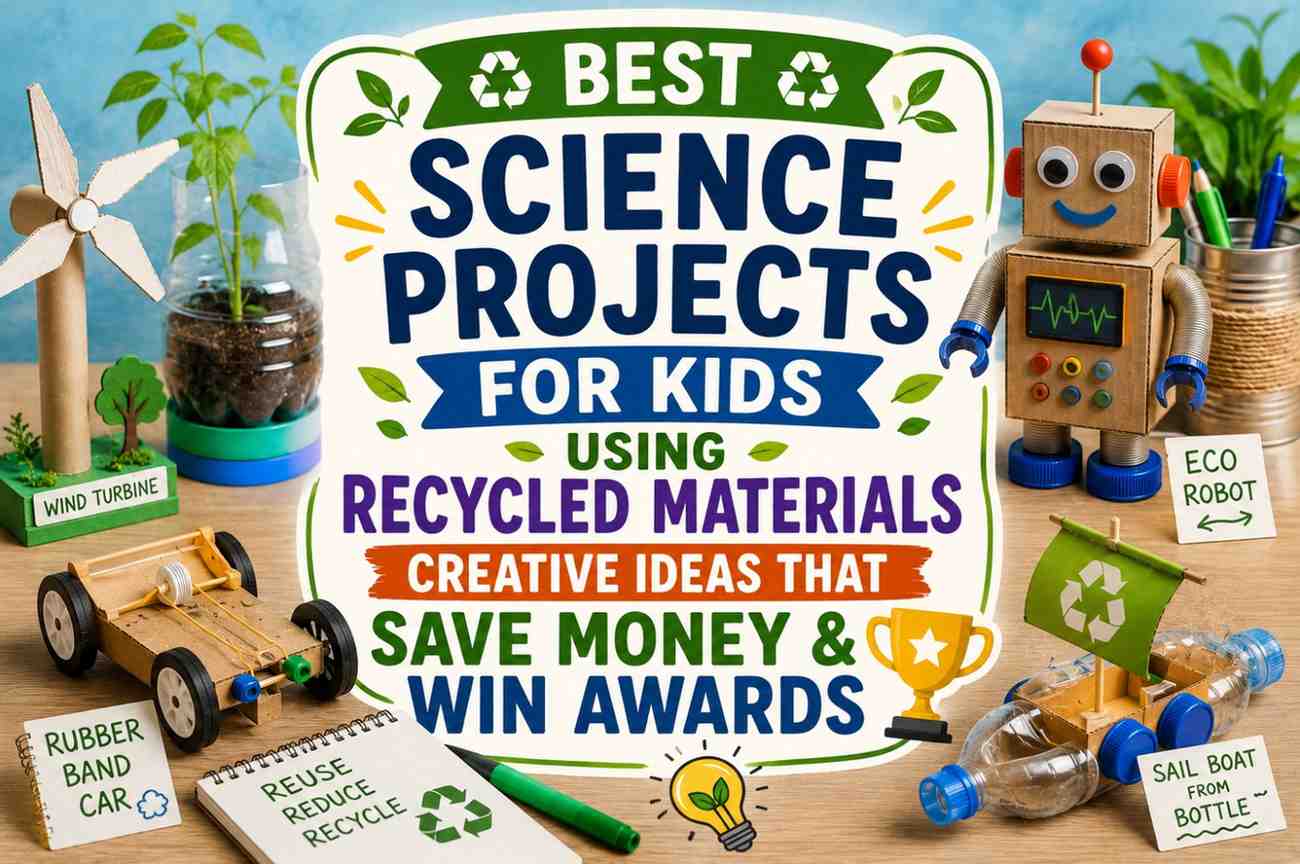
Introduction: Science + Sustainability = Winning Combination
The best science projects for kids using recycled materials accomplish something truly remarkable: they teach environmental responsibility while demonstrating scientific principles. And as a bonus, they are almost free to build.
In a world increasingly focused on sustainability, science fair judges actively reward projects that use recycled or upcycled materials thoughtfully. A project built from cardboard tubes, plastic bottles, and old newspapers doesn’t just save money — it tells a story about resourcefulness, creativity, and environmental awareness that resonates deeply with modern educators and judges.
This guide features 12 creative and award-worthy science projects for kids using recycled materials — complete with what to collect, how to build it, and what science it demonstrates.
Why Recycled Material Projects Win Awards
Before we dive into the projects, let’s understand why these projects are so effective at science fairs.
Judges are looking for creativity, not cost. A project built from repurposed bottles and cardboard that demonstrates a sophisticated scientific principle shows far more ingenuity than an expensive kit assembled straight from a box. Additionally, projects that connect to environmental themes — upcycling, reducing waste, clean energy — are increasingly rewarded as schools and competitions prioritize sustainability education.
The best science projects for kids using recycled materials combine both: strong science and a sustainability story.
What Recycled Materials to Collect Before You Start
Start collecting these items two weeks before your project deadline:
- Plastic bottles (various sizes)
- Cardboard boxes and tubes (toilet rolls, paper towel tubes)
- Old CDs or DVDs
- Newspaper and old magazines
- Aluminum cans and foil
- Egg cartons
- Bottle caps
- Used straws
- Old wire and string
- Broken umbrellas (great for rib structures)
You will be surprised how many impressive science projects emerge from this simple list.
12 Best Science Projects for Kids Using Recycled Materials
1. Plastic Bottle Water Filter Materials: 2 plastic bottles, sand, gravel, activated charcoal (from a pet store), cotton balls, dirty water
Cut one bottle at the bottom and flip it over the second bottle. Layer cotton, charcoal, fine sand, and gravel inside the top bottle. Pour dirty water through and collect filtered water in the bottom bottle. Compare the clarity before and after using a simple turbidity test. This is one of the most practically impactful best science projects for kids using recycled materials — and directly relevant to global water challenges.
2. Egg Carton Seed Sprouter With Germination Data Materials: Egg carton, soil, various seeds, water, ruler
Use the cups of an egg carton as individual seed-growing pods. Plant different seeds in each cup and record germination rates daily. Compare which seeds sprout fastest, which grow tallest, and how the small compartment size affects root development. A beautifully simple biology experiment from a material destined for the recycling bin.
3. Cardboard Tube Kaleidoscope Materials: Paper towel tube, old CD, reflective foil, colored tissue paper, tape
Line the inside of the cardboard tube with strips of reflective foil at 60-degree angles. Place a circular piece of colored tissue paper at one end sealed with clear tape. Look through the other end toward a light source. The result is a stunning optical kaleidoscope that demonstrates light reflection and the geometry of symmetry — using nothing but recycled materials.
4. Aluminum Can Solar Heater Materials: Aluminum cans, black paint, cardboard box, plastic wrap, tape, thermometer
Paint aluminum cans black and connect them in a vertical row inside a cardboard box lined with foil. Seal the front of the box with plastic wrap. Leave the box in sunlight for 2 hours. Measure the air temperature coming out of the top of the can column versus ambient temperature. This working solar heater demonstrates radiant heat absorption and passive solar heating principles entirely from recycled materials.
5. Newspaper Bridge Engineering Challenge Materials: Newspapers, tape only
Challenge yourself to build the strongest bridge spanning 30 cm using only rolled or folded newspaper and tape. Add books on top until it fails. Record the maximum load held. Try different tube sizes, shapes, and support strategies. The science of structural engineering has never been cheaper to explore.
6. Bottle Cap Density Experiment Materials: Various bottle caps, a large clear container of water, salt
Sort bottle caps by material (plastic, metal, rubber). Predict which will float and which will sink. Test each cap in fresh water, then in saltwater. Graph your predictions vs. results. Explore how adding salt changes the density of water and affects what floats. A compelling density and buoyancy experiment with zero cost.
7. CD Spectroscope Materials: Old CD, cardboard box, tape, scissors, razor blade or craft knife (adult help required)
Cut a narrow slit in one end of a small cardboard box. Mount a CD inside the box at an angle facing the slit. When you point the slit toward a light source, the CD diffracts the light into a visible spectrum of colors. This low-cost spectroscope demonstrates how white light contains all colors — the same principle used in professional laboratory spectroscopes worth thousands of dollars.
8. Plastic Bottle Terrarium Ecosystem Materials: Large plastic bottle, small rocks, soil, small plants or moss, water
Cut a large plastic bottle two-thirds of the way up. Layer small rocks (drainage), charcoal (to prevent mold), and soil inside the bottom. Plant small ferns, moss, or succulents. Place the top half of the bottle back over the bottom as a transparent dome. The closed terrarium creates its own water cycle — water evaporates, condenses on the sides, and drips back down to the roots. A miniature self-sustaining ecosystem built from a single recycled bottle.
9. Newspaper Insulation Test Materials: Newspaper, two identical glass jars, hot water, thermometer, other insulation materials (bubble wrap, foil, cloth)
Fill two jars with equal amounts of hot water. Wrap one jar in multiple layers of newspaper; leave the other bare. Record the water temperature in both jars every 5 minutes for 30 minutes. Compare heat loss rates. Extend the experiment by testing newspaper against other materials. Students learn about thermal insulation — with direct real-world implications for building design and energy efficiency.
10. Cardboard Periscope Materials: Long cereal box or two smaller boxes, two small mirrors, tape, scissors
Build a periscope from cereal boxes by mounting two mirrors at 45-degree angles at opposite ends of the connected tube. This demonstrates the law of reflection practically — and the entire model costs nothing since all materials are recycled.
11. Plastic Straw Anemometer (Wind Speed Meter) Materials: 4 plastic straws, 4 small paper cups, a pencil, a pin, modeling clay
Form a cross shape with four straws and tape a paper cup at each end, all facing the same rotational direction. Push a pin through the center of the cross into a pencil’s eraser so the cross can spin freely. Hold the anemometer in wind and count rotations per minute. Compare readings in different locations. Students build a real meteorological instrument from recycled straws and cups.
12. Aluminum Foil Boat Load Test Materials: Aluminum foil sheets, a container of water, coins or marbles
Challenge yourself to build the boat from a single sheet of aluminum foil that holds the most coins before sinking. Try different hull shapes — flat, V-shaped, box-shaped — and record how many coins each design holds. Graph your results and discuss buoyancy, displacement, and hull design principles used by real naval engineers.
Environmental Impact: The Story Judges Want to Hear
Every project using recycled materials has a built-in second story: the environmental one. Calculate how much plastic, cardboard, or metal you diverted from a landfill by using it in your project. Present this figure on your display board. Judges — especially at district and state level — respond very positively to students who can articulate both the scientific and environmental dimensions of their work.
For inspiration on connecting science to sustainability, the Ellen MacArthur Foundation’s education resources offer excellent free materials on circular economy principles for young learners.
Frequently Asked Questions
Q: What are the best science projects for kids using recycled materials that cost absolutely nothing? A: The newspaper bridge, bottle cap density test, aluminum foil boat, cardboard periscope, and egg carton seed sprouter all use only items most families already have at home — total cost: zero.
Q: Do recycled material projects score lower at science fairs because they look less polished? A: Not at all. Judges score on scientific merit, methodology, and presentation — not on how expensive the materials look. A well-explained, carefully executed project using recycled materials often scores higher than an expensive kit project with little original thinking.
Q: How do I make my recycled material science project look professional for the display board? A: Label everything clearly. Take good photographs at each stage of the build process. Print your data in clean charts or graphs. A well-organized board with real data always looks professional regardless of the project’s material cost.
Q: Can I combine multiple recycled materials in one project? A: Absolutely! In fact, projects that creatively combine several recycled materials — like the aluminum can solar heater inside a cardboard box with a plastic wrap window — show more ingenuity and earn higher creativity scores.
Q: Are recycled material science projects appropriate for all age groups? A: Yes. The 12 projects in this guide range from grade 3 difficulty (aluminum foil boat) to grade 8 difficulty (CD spectroscope, solar heater). Choose the project that matches your child’s grade level and available time.
Related Articles
- Working Model Science Project Ideas for Kids 2026 — 12 Weekend Builds
- Volcano Science Project for Kids Step by Step — Build the Best One in Class
- Bridge Building Science Project for Kids — Which Design Holds the Most Weight?
Conclusion
The best science projects for kids using recycled materials prove something powerful: great science doesn’t require expensive equipment. It requires curiosity, creativity, and a willingness to look at ordinary objects — a plastic bottle, a stack of newspapers, an old CD — and imagine what they could become.
Every project in this guide teaches real science, costs almost nothing, and helps the planet by keeping materials out of landfills. That combination — scientific learning, zero cost, and environmental impact — is exactly what makes recycled material science projects not just award-worthy, but genuinely meaningful.
Dig through your recycling bin this weekend. Your next award-winning science project is already in there, waiting to be discovered.