
 creator@scienceexplore.site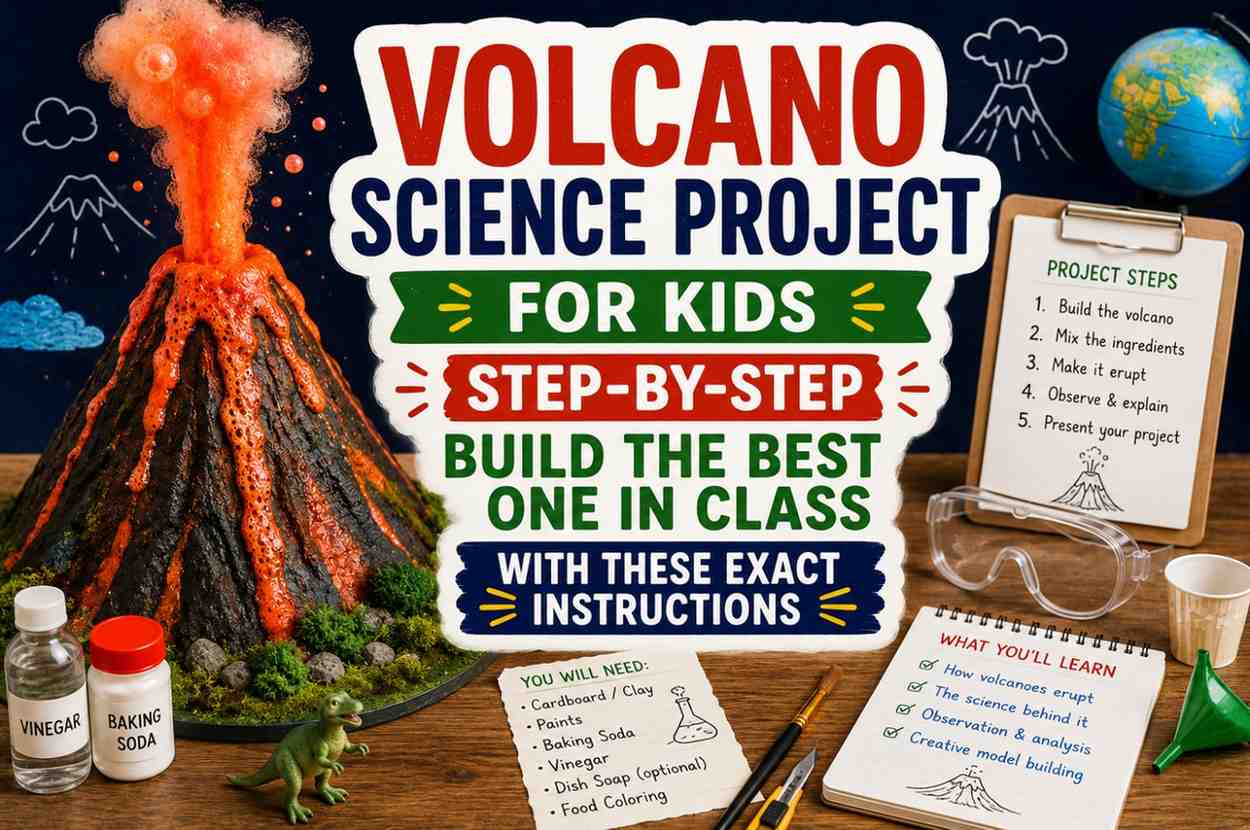
Introduction: The Classic That Never Gets Old
The volcano science project for kids, step-by-step, is the most iconic science fair project in history—and for very good reason. It combines visual drama, accessible chemistry, and real geological science into one eruption-worthy demonstration.
But here’s the problem: most kids build the same basic version. Same shape, same vinegar-and-baking-soda reaction, same result. To truly win your science fair with a volcano project, you need to go further — better design, deeper science understanding, multiple eruption variables, and a presentation that shows you actually know your geology.
This complete volcano science project for kids step-by-step guide gives you exactly that—from building the most visually impressive volcano model in class to explaining the chemistry and geology like a real volcanologist.
What Science Does the Volcano Project Teach?
Before building, understand what you’re actually demonstrating. The volcano project teaches two main things: the chemistry of the acid-base reaction between sodium bicarbonate (baking soda) and acetic acid (vinegar), and the basic geological process of volcanic eruption driven by gas pressure buildup.
When baking soda and vinegar mix, they produce carbon dioxide gas rapidly. The gas builds pressure and forces the liquid mixture upward and outward—mimicking how magma is forced upward through a volcanic vent by gas pressure from deep underground.
Understanding this science — not just the spectacle — is what separates a winning volcano from a forgettable one.
Materials You Need
For the volcano body:
- 1 plastic bottle (500ml works well)
- Newspaper strips or papier-mâché paste (flour + water)
- OR air-dry modeling clay
- Brown, black, red, and orange acrylic paint
- A flat base (cardboard, plywood, or foam board)
- Green moss or artificial grass for landscaping (optional)
For the eruption:
- Baking soda (sodium bicarbonate) — 3 tablespoons
- White vinegar — 100ml
- Liquid dish soap — 1 tablespoon
- Red and orange food coloring
- Warm water — 50ml
Step-by-Step Build Instructions
Step 1: Prepare Your Base Place the plastic bottle in the center of your flat base. Hot glue it securely in place. The base should be at least 40 cm × 40 cm to catch lava overflow cleanly during demonstrations.
Step 2: Build the Volcano Shape If using papier-mâché: Soak newspaper strips in flour-water paste (1 part flour to 2 parts water). Layer the strips around the bottle in a cone shape, building up the mountain gradually. Leave the bottle opening clear. Apply at least 3–4 layers for strength. Allow it to dry completely—this takes 24–48 hours.
If using air-dry clay: Simply mold the clay around the bottle in a cone shape directly. This is faster but heavier. Allow to dry fully before painting.
Step 3: Paint Your Volcano Start with a base coat of dark brown or black for the rocky surface. While wet, dry-brush orange and red near the opening to suggest heat and lava channels. Add lighter brown and gray for rocky texture. Apply a green wash at the base to suggest vegetation at lower elevations. The more realistic the painting, the more dramatic the overall effect—and the better it looks on your display board photos.
Step 4: Add Landscape Details (Optional but Impressive) Glue small pebbles around the base for rocky terrain. Add artificial moss or green-painted crumpled paper for vegetation. You can even add a small foam village at the base to emphasize the destructive power of eruptions—judges love the dramatic scale this creates.
Step 5: Prepare the Eruption Mixture In a separate cup, mix 100ml of warm water with red and orange food coloring and 1 tablespoon of dish soap. Set this mixture aside.
Step 6: Load the Volcano for Eruption When you are ready to demonstrate, add 3 tablespoons of baking soda directly into the bottle.
Step 7: Erupt! Pour the colored water and soap mixture into the bottle, then quickly add the vinegar. The reaction is immediate—foamy, colored “lava” will erupt from the opening and cascade down the sides of the volcano. The dish soap creates larger, more dramatic bubbles that flow more slowly and convincingly down the slopes.
How to Make Your Eruption More Impressive: 3 Advanced Variations
Variation 1: Layered Eruption Add the baking soda in two stages—a small amount first for a minor eruption, then a larger amount for a bigger one. This mimics the way real volcanoes often have multiple eruption phases of varying intensity.
Variation 2: Yeast and Hydrogen Peroxide “Elephant Toothpaste” Eruption For a more dramatic and longer-lasting eruption, use hydrogen peroxide (3% solution, available at pharmacies) and dry yeast mixed with warm water as your reactants. The decomposition reaction produces oxygen gas rapidly, creating a massive foam eruption that overflows dramatically. This version is safe but visually far more impressive than the standard baking soda version.
Variation 3: Scientific Variable Testing Test three different amounts of baking soda (1 tablespoon, 2 tablespoons, and 3 tablespoons) and measure how high each eruption reaches and how long it lasts. Record your results in a table. This turns the volcano from a demonstration into a genuine controlled experiment—which scores significantly higher at science fairs.
The Science Behind the Eruption: Impress Your Judges
When a judge asks you to explain your project, use this script:
“My project demonstrates an acid-base chemical reaction between acetic acid in the vinegar and sodium bicarbonate, which is the baking soda. When they react, they produce carbon dioxide gas very rapidly. This gas builds pressure inside the bottle and forces the liquid upward through the opening—the same way that volcanic gases build pressure inside a magma chamber and eventually force magma up through a volcanic vent during a real eruption.”
Then connect it to real-world volcanology: “Famous examples of explosive eruptions driven by gas pressure include Mount Pinatubo in 1991 and Krakatoa in 1883. Understanding this chemistry helps volcanologists predict when eruptions might occur.”
This level of explanation — combining chemistry, physics, and geology — shows judges the depth of understanding behind the dramatic visual.
For accurate volcanology background information, the USGS Volcanoes and Eruptions portal is an authoritative free resource worth citing in your project bibliography.
Display Board Layout for Volcano Project
Organize your trifold display board as follows:
- Left panel: Background information on real volcanoes, types of eruptions, and geological context. Include a world map showing major volcanic zones.
- Center panel: Your project title, hypothesis, materials, and step-by-step procedure with photographs.
- Right panel: Results table (if testing variables), conclusion, and bibliography.
Include at least 3–4 clear photographs taken at each stage of your build. Place your actual volcano model in front of the board where judges can see it and — ideally — watch it erupt live.
Frequently Asked Questions
Q: What is the best recipe for the most dramatic volcano eruption? A: Use warm water with dish soap and food coloring mixed with baking soda, then add vinegar. For an even more dramatic result, try the yeast and hydrogen peroxide “elephant toothpaste” variation described above—it produces a much larger, longer-lasting eruption.
Q: How do I make my volcano model look more realistic and professional? A: Use multiple paint colors blended while wet, add real small pebbles and moss for texture, and include a small village or trees at the base for dramatic scale. Taking good progress photos and displaying them on your board also elevates the overall professional appearance significantly.
Q: How long does a papier-mâché volcano take to dry? A: Allow at least 24–48 hours of drying time at room temperature. In humid climates, it may take up to 3 days. Do not rush the drying with a hairdryer—the surface may crack. Start building at least 3 days before your science fair date.
Q: Can I reuse my volcano for multiple eruptions at the science fair? A: Yes! Simply rinse the inside of the bottle thoroughly with water between eruptions to neutralize any remaining acid. Pre-mix multiple batches of your baking soda and vinegar solution in separate cups so you can erupt quickly multiple times for different judges.
Q: How do I turn the volcano project into a proper controlled experiment? A: Test one variable at a time — the amount of baking soda, the temperature of the vinegar, or the concentration of the acid solution. Measure the height and duration of each eruption and record results in a table. This transforms the demonstration into a real experiment with quantitative data.
Related Articles
- Best Science Projects for Kids Using Recycled Materials — Creative Ideas
- Water Cycle Project for Kids 3D Model — Step-by-Step Build Guide
- Working Model Science Project Ideas for Kids 2026 — 12 Weekend Builds
Conclusion
The volcano science project for kids, step-by-step, remains one of the most powerful science fair demonstrations because it combines accessible chemistry, dramatic visual impact, and genuine geological science into a single, unforgettable moment.
But the students who win with volcano projects are not those who simply mix baking soda and vinegar in a clay mound. They are the students who understand why it erupts, who test variables to generate real data, and who can explain the connection between their kitchen chemistry and the geological forces reshaping our planet’s surface.
Build your volcano carefully. Paint it realistically. Load it with your best eruption mixture. And when the foam flows down the slopes and the judges lean in for a closer look—be ready to explain the chemistry, the geology, and the science behind every single bubble.
That’s how you build the best volcano in class.