 creator@scienceexplore.site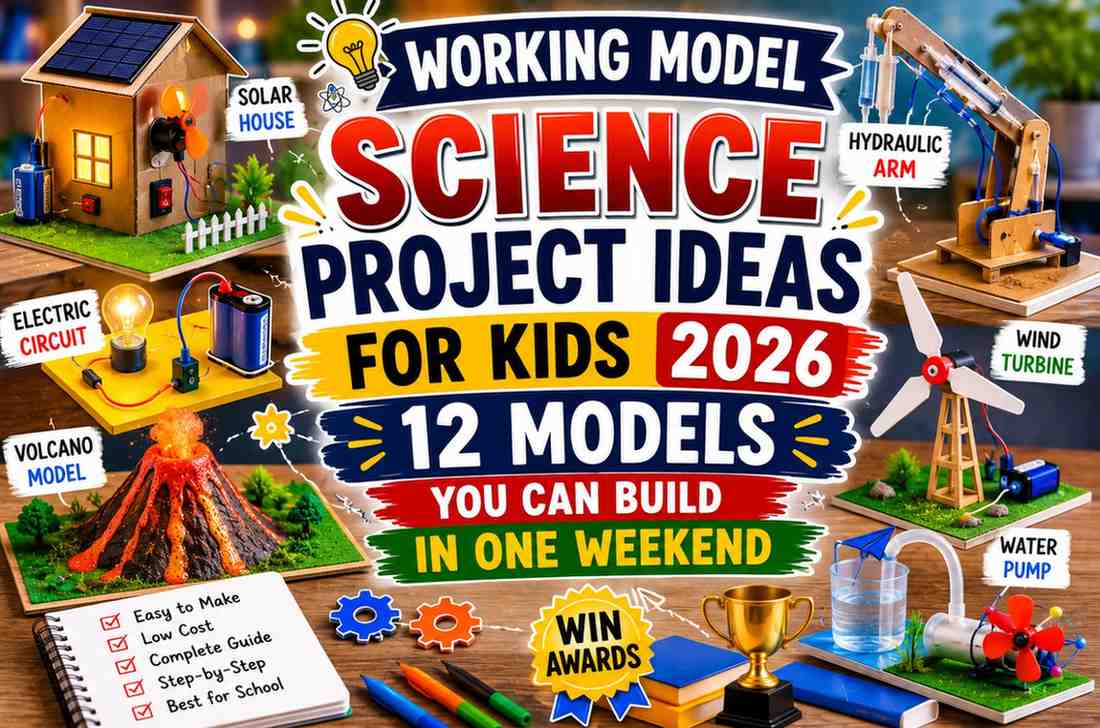
Introduction: Why Working Models Win Science Fairs in 2026
When it comes to science fairs, nothing beats a working model. Static charts fade into the background. A model that moves, reacts, or produces something commands instant attention from every judge who walks past.
The demand for working model science project ideas for kids in 2026 is higher than ever. Parents, teachers, and students are all searching for projects that are visually impressive, scientifically sound, and realistic to complete in a single weekend—without a professional engineering degree or a hefty budget.
This guide delivers exactly that: 12 outstanding working model science project ideas for kids in 2026, each designed to be completed within two days using affordable, easily sourced materials.
What Makes a Working Model Better Than a Static Display?
A working model demonstrates cause and effect in real time. When a judge sees water actually filtering through your layers of sand and gravel, or watches a wind turbine actually generating electricity to light an LED, the impact is immediate and undeniable.
Working models also give students something to do during their presentation — operate the model — which eases nervousness and makes explanations far more compelling and memorable.
12 Working Model Science Project Ideas for Kids 2026
1. Wind Turbine That Powers an LED Light
Difficulty: Medium | Time: 6–8 hours | Concepts: Renewable energy, electromagnetism
Build turbine blades from cardboard or PVC sheets. Mount them on a small DC motor salvaged from a toy or purchased cheaply online. Attach the motor’s output leads to a small LED. When you blow on the blades or hold it in a breeze, the LED lights up. This is one of the most impactful working model science project ideas for kids in 2026 because it demonstrates clean energy production visually and tangibly. Add a voltmeter to show actual electricity generated.
2. Hydraulic Arm (Robotic Claw)
Difficulty: Medium-Hard | Time: 8–10 hours | Concepts: Pascal’s law, hydraulics, simple machines
Connect four syringes in pairs using flexible tubing filled with water. Mount two syringes as the “muscles” of a cardboard arm that ends in a claw shape. When you push one syringe plunger, the linked syringe extends or retracts, moving the arm. Students learn how hydraulic systems use liquid pressure to multiply force—the same principle used in excavators and airplane landing gear.
3. Earthquake-Proof Building Model
Difficulty: Medium | Time: 6–8 hours | Concepts: Physics, structural engineering, seismology
Build a small building frame from popsicle sticks and marshmallows. Mount it on a cardboard sheet placed on top of a container of sand or jello. Shake the base to simulate earthquake vibrations. Compare different frame designs — triangulated bracing, cross-bracing, and solid walls — to see which survives the shake test best. Graph your results to show which design was most earthquake-resistant.
4. Lung Model With Balloons and a Bottle
Difficulty: Easy | Time: 2–3 hours | Concepts: Human biology, respiratory system, pressure
Cut the bottom off a clear plastic bottle. Insert a Y-shaped straw junction with small balloons (the lungs) inside the bottle through the top. Seal the cut bottom with a large stretched balloon (the diaphragm). Pull the diaphragm down—the lungs inflate. Push it up—they deflate. This working model perfectly demonstrates how breathing actually works mechanically and is one of the most reliable working model science project ideas for kids in 2026.
5. Water Wheel Generator
Difficulty: Medium | Time: 5–6 hours | Concepts: Hydroelectric power, energy conversion
Carve or cut paddle shapes from a plastic bottle and attach them radially to a wooden dowel axle. Mount the axle between two supports and connect it to a small DC motor. Pour water over the paddles—the wheel turns, the motor spins, and a connected LED lights up. Students learn how moving water converts kinetic energy into electrical energy—the basis of hydroelectric dams.
6. Solar-Powered Water Purifier
Difficulty: Medium | Time: 6–8 hours | Concepts: Solar energy, evaporation, condensation
Build a sloped clear plastic box with a dark tray of dirty water inside. Place it in direct sunlight. The water evaporates, condenses on the cooler plastic top, and drips into a clean collection channel. This elegant model demonstrates the entire water cycle and solar distillation process — two crucial environmental science concepts — in one working demonstration.
7. Working Periscope
Difficulty: Easy | Time: 2–3 hours | Concepts: Optics, reflection, light
Build a tall rectangular cardboard tube with two mirrors mounted at 45-degree angles at opposite ends. Looking through the bottom mirror, you can see what is above — just like a submarine periscope. This classic model demonstrates the law of reflection with perfect precision and is surprisingly easy to build with impressive results.
8. Electromagnetic Train
Difficulty: Medium-Hard | Time: 8 hours | Concepts: Electromagnetism, magnetic fields, physics
Coil copper wire tightly inside a clear plastic tube. Place a small cylindrical neodymium magnet at one end of the coil. Connect the wire ends to a battery hidden inside the tube. The magnet accelerates through the coil as it enters the magnetic field—propelled by electromagnetism. This model feels almost magical and is one of the most visually stunning working model science project ideas for kids in 2026.
9. Rain Gauge and Barometer Weather Station
Difficulty: Medium | Time: 4–5 hours | Concepts: Meteorology, atmospheric pressure, measurement
Build a functioning barometer from a sealed jar with a balloon stretched over its mouth, a straw glued to the balloon center, and a paper scale behind it. Changes in atmospheric pressure push the balloon up or down, moving the straw indicator. Add a homemade rain gauge from a cut bottle and ruler. Record readings daily for one week and compare to local forecasts.
10. Working Model of a Lock and Key (Simple Mechanism)
Difficulty: Medium | Time: 4–5 hours | Concepts: Mechanical engineering, simple machines, levers
Build a working pin tumbler lock mechanism from cardboard, wooden dowels, and springs made from bent wire. Show how the correct key lifts all pins to the shear line simultaneously, allowing the cylinder to rotate and “unlock.” This model demonstrates mechanical engineering principles in a surprisingly accessible and fascinating way.
11. Hovercraft From a CD
Difficulty: Easy | Time: 1–2 hours | Concepts: Air pressure, friction reduction, physics
Glue a pop-top bottle cap (the kind used on sports drink bottles) directly over the center hole of an old CD. Inflate a balloon and stretch its neck over the closed pop-top. Place the CD on a smooth surface and open the pop-top. Air flows under the disc, creating a thin cushion that almost eliminates friction — and the hovercraft glides across the surface with almost no force needed. Fascinating physics in under two hours.
12. Automatic Plant Watering System
Difficulty: Medium | Time: 5–6 hours | Concepts: Capillary action, soil science, engineering design
Fill a plastic bottle with water and invert it into a pot of dry soil. The water drips out only as the soil dries—because as moisture decreases, air pressure pulls more water down from the bottle. This self-regulating system requires no electronics and demonstrates capillary action, soil moisture dynamics, and simple engineering design—all in one practical model with real daily utility.
Weekend Build Schedule: How to Finish in 2 Days
Saturday:
- Morning: Gather all materials (hardware store + kitchen items).
- Afternoon: Build the main structure of your model.
- Evening: Test your model and identify any issues.
Sunday:
- Morning: Fix problems and refine your model.
- Afternoon: Prepare your display board and write up results.
- Evening: Practice your 3-minute explanation out loud five times.
This schedule is realistic for any of the 12 working model science project ideas for kids 2026 listed above.
Where to Find Materials Cheaply
Most materials for these models cost under ₹300 in India or under $5 in the US. Check dollar stores, local hardware shops, or kitchen drawers before buying anything. Electronics components like small DC motors and LEDs are available cheaply on Amazon, Flipkart, or any local electronics components shop.
For detailed STEM project inspiration and science education resources, Science Buddies is an excellent free external reference for students and parents alike.
Frequently Asked Questions
Q: What are the best working model science project ideas for kids in 2026 that can be built in one day? A: The hovercraft, working periscope, lung model, and leaf battery are all achievable in 2–4 hours. The electromagnetic train and hydraulic arm take longer but are worth the extra effort for top-tier science fairs.
Q: Do working models score higher than charts at science fairs? A: Consistently, yes. A functional model that a judge can see operating in real time makes a far stronger impression than a static poster, even if the poster is beautifully designed. Always choose a working model when you can.
Q: What grade levels are these working models appropriate for? A: The 12 models in this list are appropriate for students in grades 4 through 9, with difficulty clearly labeled. Easier models suit grades 4–5, medium models suit grades 6–7, and medium-hard models are designed for grades 8–9.
Q: How do I explain a working model to a science fair judge? A: Use the “point and explain” method. Point to each part of the model and explain what it does and why it does it. Then operate the model live in front of the judge and describe what they are observing in real time.
Q: Can I modify these working model ideas to make them more original? A: Absolutely — and you should! Adding a second variable to test (like comparing two different wind turbine blade shapes) or extending the experiment over time (recording daily weather station readings for a week) instantly makes any model more sophisticated and impressive.
Related Articles
- Best Science Fair Projects for Class 5 Students — 15 Award-Winning Ideas
- Simple Machine Science Project for Kids Class 6 — Lever, Pulley & Wheel Guide
- Bridge Building Science Project for Kids — Which Design Holds the Most Weight?
Conclusion
The right working model science project ideas for kids in 2026 transform a science assignment into a genuinely exciting engineering challenge. Whether you’re building a wind turbine that lights an LED, a hydraulic arm that picks up objects, or a solar purifier that produces clean water from dirty water, the act of making science work is the most powerful learning experience a student can have.
Choose a model that connects to something you care about. Follow the build schedule. Test, fail, improve, and test again. And when you stand in front of that judge on science fair day, operate your model with confidence—because you built it with your own hands, and you understand exactly how and why it works.
That is what real science looks like.