 creator@scienceexplore.site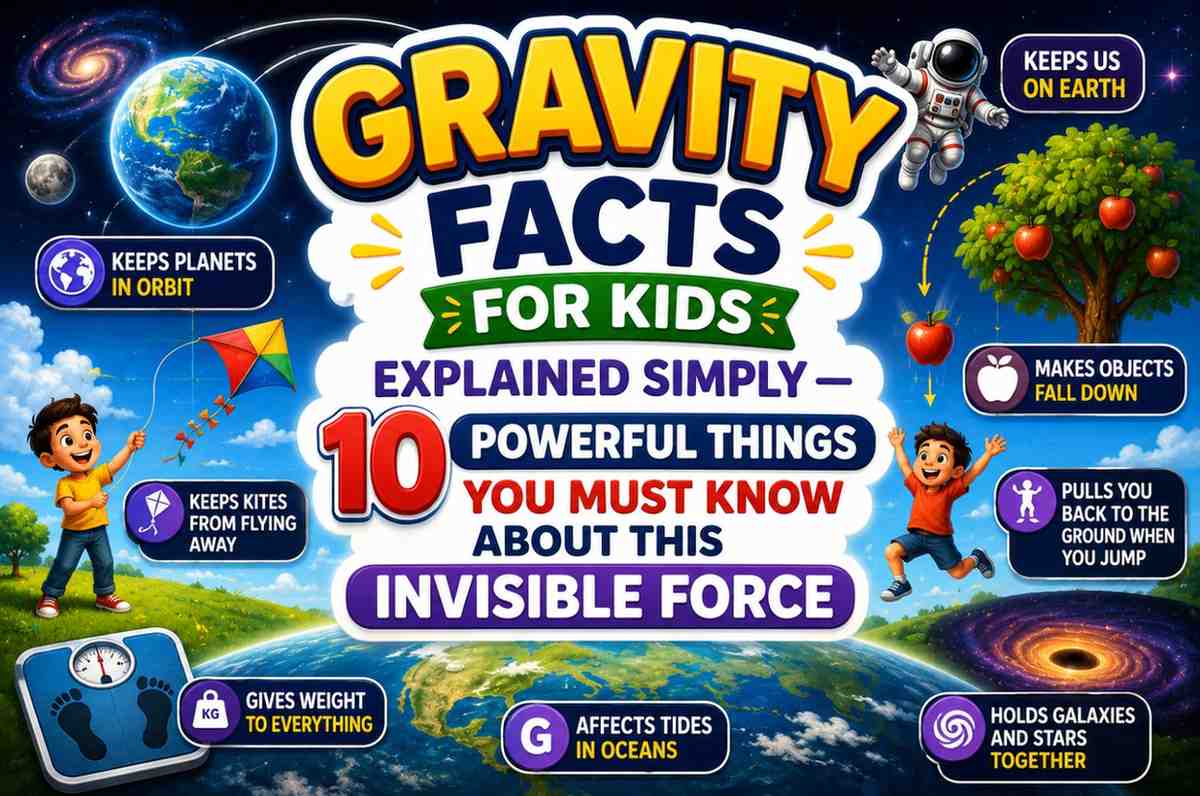
Drop a ball and it falls to the ground. You jump up and you come back down. Why? The answer is gravity—one of the most powerful and fascinating forces in the entire universe. Gravity facts for kids explained simply will help you understand this invisible but absolutely essential force that affects everything, from an apple falling off a tree to planets orbiting the Sun.
In this guide, we will explore what gravity is, how it works, how strong it is, and — most excitingly — what would happen if gravity disappeared tomorrow. Get ready for some truly mind-blowing science!
What Is Gravity? Gravity Facts for Kids Explained Simply
Gravity is a natural force of attraction between objects that have mass. The more massive an object is, the stronger its gravitational pull. Every single object in the universe—from you, to the Earth, to the Sun—exerts a gravitational pull on everything else.
The reason we feel gravity so strongly is because the Earth is enormously massive compared to us. Earth’s gravity pulls everything toward its center, which is why when you jump, you always come back down and why water flows downhill.
Who Discovered Gravity? The Famous Apple Story
The English scientist Sir Isaac Newton is famous for discovering the law of gravity in 1687. Legend has it that an apple fell from a tree near him, which made him think, “Why does the apple always fall downward?” Why not sideways or upward?
This led him to develop his famous Law of Universal Gravitation, which states that every object in the universe attracts every other object with a force. The bigger the objects and the closer they are, the stronger the force of gravity between them.
Newton’s discovery is one of the greatest moments in scientific history and a core part of gravity facts for kids explained simply.
How Strong Is Gravity? Amazing Numbers for Young Learners
- Earth’s gravity pulls everything down with an acceleration of 9.8 meters per second squared.
- On the Moon, gravity is only about 1/6th as strong as on Earth — that is why astronauts bounce around!
- On Jupiter, you would weigh about 2.5 times more than you do on Earth because Jupiter is so massive.
- The Sun’s gravity is strong enough to hold all eight planets in their orbits despite them being millions of kilometers away.
- Black holes have such extreme gravity that not even light can escape from them.
What Would Happen If Gravity Disappeared?
This is one of the most exciting gravity facts for kids explained simply. Imagine—what if gravity suddenly vanished? Here is what would happen very quickly:
- Everything not bolted to the ground would float upward—people, cars, water, and animals.
- The atmosphere would drift away into space within minutes, taking our breathable air with it.
- Oceans would separate into giant floating blobs of water.
- The Moon would fly off into space instead of orbiting Earth.
- Earth itself would begin to break apart since gravity holds the planet together.
As you can see, gravity is not just the force that keeps us on the ground—it is the force that holds everything in the universe together. Without it, all structure in the cosmos would collapse.
Gravity in Space — Orbits and Weightlessness
Astronauts on the International Space Station appear to float—but they are not weightless because gravity has disappeared! They are actually in a constant state of falling.
The space station is moving so fast sideways (about 7.7 kilometers per second!) that as it falls toward Earth, Earth curves away beneath it at the same rate. This creates a continuous orbit—a beautiful balance between gravity pulling inward and the speed of the station moving forward.
Gravity on Other Planets — Fascinating Comparisons
| Planet | Gravity Compared to Earth |
|---|---|
| Mercury | 0.38× (much weaker) |
| Venus | 0.91× (slightly weaker) |
| Mars | 0.38× (much weaker) |
| Jupiter | 2.53× (much stronger) |
| Saturn | 1.07× (slightly stronger) |
| Moon | 0.17× (very weak) |
These comparisons make gravity facts for kids explained simply, very visual, and memorable!
Fun Gravity Experiments to Try at Home
Experiment 1 — Drop Two Objects: Drop a heavy book and a piece of paper at the same time from the same height. The book lands first. Now crumple the paper into a tight ball and drop it again. They land at almost the same time! Without air resistance, gravity pulls all objects at the same rate.
Experiment 2 — Gravity and Water: Fill a plastic bottle with water and punch small holes in the side. The water shoots out horizontally due to gravity pulling it down. Higher holes shoot further because there is more water weight above them.
10 Must-Know Gravity Facts for Kids
- Gravity is one of the four fundamental forces of nature.
- The word “gravity” comes from the Latin word “gravitas,” meaning weight or heaviness.
- Gravity keeps the Moon in orbit around Earth.
- Without gravity, blood would not flow properly through the human body.
- Gravity causes tides in the ocean — the Moon’s gravity pulls the water toward it.
- A feather and a hammer would fall at exactly the same speed on the Moon (no air resistance). This was demonstrated by astronaut David Scott in 1971!
- Gravity is the weakest of the four fundamental forces, yet it has the greatest range.
- Albert Einstein described gravity as a curvature in space-time caused by mass in his Theory of General Relativity (1915).
- Gravitational waves — ripples in space-time caused by massive events like colliding black holes — were first detected in 2015.
- The escape velocity from Earth (the speed needed to leave Earth’s gravity) is approximately 11.2 kilometers per second.
External Resource on Gravity for Kids
For brilliant interactive content about gravity and space, visit:
🔗 NASA Space Place — All About Gravity (DoFollow)
Check out our companion article on Basic Science Facts for Kids Class 3, 4, 5 for 50 more amazing science facts covering the human body, space, plants, and much more!
Frequently Asked Questions (FAQ)
Q1. What is gravity in simple words?
Gravity is a pulling force between objects. The bigger the object, the stronger its gravitational pull. Earth’s gravity pulls everything on its surface toward its center, which is why things fall down.
Q2. Is there gravity on the Moon?
Yes, the Moon has gravity, but it is only about 1/6th as strong as Earth’s gravity. This is why astronauts on the Moon can jump much higher and feel much lighter than on Earth.
Q3. Why do astronauts float in space?
Astronauts float because they are in a continuous free fall around the Earth in orbit. Both the astronaut and the spacecraft are falling at the same rate, creating the sensation of weightlessness.
Q4. Does gravity have a speed?
Gravitational effects travel at the speed of light—approximately 300,000 kilometers per second. This was confirmed by the detection of gravitational waves in 2015.
Q5. Who discovered gravity?
Sir Isaac Newton formulated the Law of Universal Gravitation in 1687. Albert Einstein later expanded our understanding through his theory of general relativity in 1915.
Conclusion
Gravity is one of the most powerful and essential forces in the universe—and now you know 10 incredible things about it! Gravity facts for kids explained simply show us that this invisible force is not just about things falling; it shapes the structure of the entire cosmos.
From Newton’s falling apple to astronauts floating in orbit, from the Moon circling the Earth to black holes swallowing light—gravity is the great organizer of the universe. Without it, there would be no planets, no stars, no galaxies, and no life.
Keep looking up at the sky, keep dropping things, and watch them fall, and remember—every time something falls toward the ground, you are witnessing one of the most fundamental forces in all of existence!