 creator@scienceexplore.site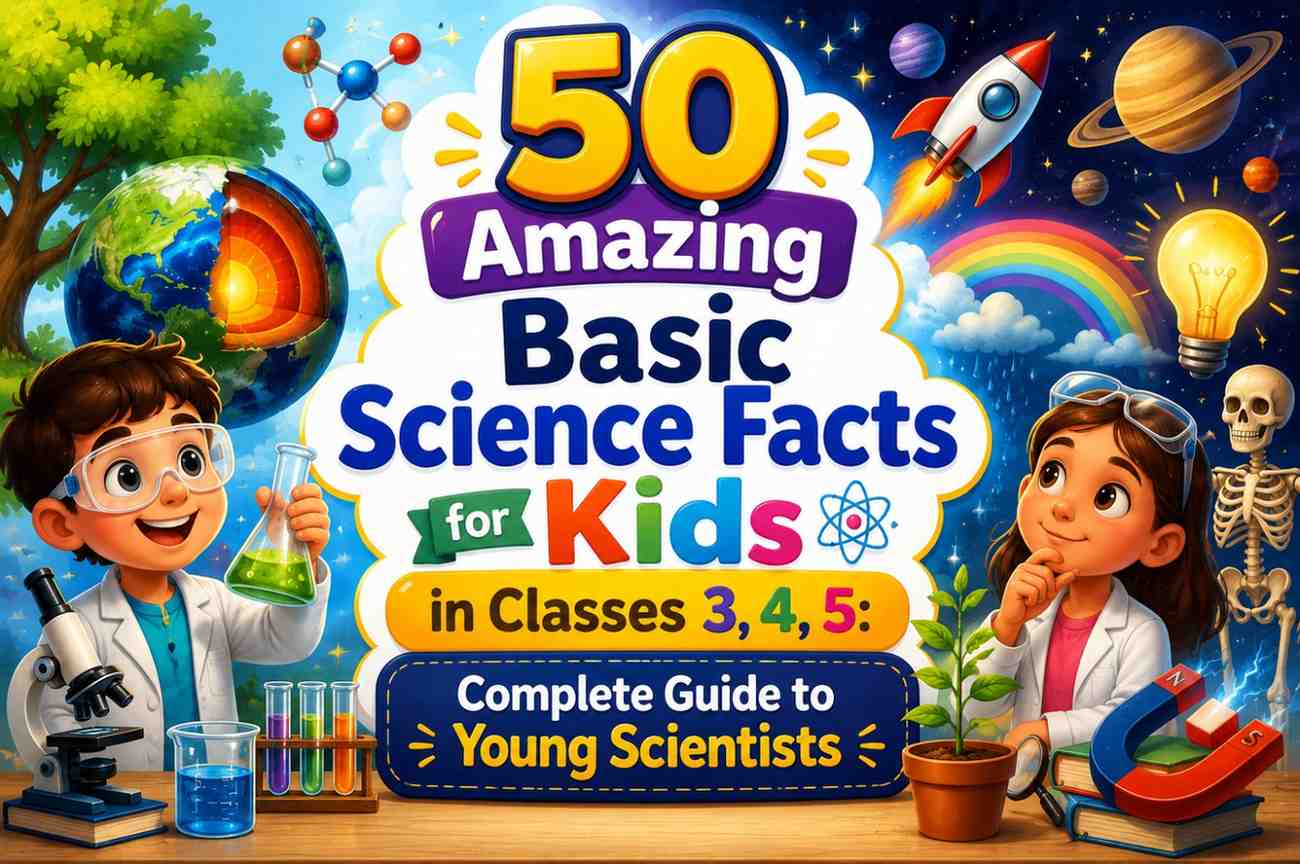
Introduction
Learning basic science facts for kids in classes 3, 4, and 5 opens up a wonderful world of discovery. At this age, children become curious about everything around them, from how plants grow to why water boils. Basic science facts help young students understand the fundamentals of nature, physics, chemistry, and biology in simple, engaging ways.
This comprehensive guide presents 50 amazing basic science facts for kids in classes 3, 4, and 5 that will spark curiosity and make science exciting. Whether your child is in class 3, class 4, or class 5, these basic science facts are perfect for building strong scientific foundations.
What Are Basic Science Facts for Kids in Classes 3, 4, and 5?
Basic science facts are simple, easy-to-understand information about how the world works. These basic science facts cover topics like
- How living things work
- What objects are made of
- Why weather changes
- How energy moves
- What our bodies can do
Understanding basic science facts helps young learners become better problem-solvers and critical thinkers.
50 Amazing Basic Science Facts for Kids Classes 3, 4, and 5
Fact Category 1: Your Amazing Body
1. Your heart beats about 100,000 times per day
The human heart is a powerful muscle that pumps blood throughout your body. Basic science facts include knowing that your heart works non-stop, even when you’re sleeping.
2. You have 206 bones in your body
Babies are born with over 300 bones, but many fuse together as they grow. Understanding basic science facts means learning how your skeleton supports and protects you.
3. Your skin completely renews itself every 28 days
Old skin cells fall off and new ones grow underneath. This is one of the most fascinating basic science facts about how your body repairs itself.
4. Your brain weighs about 1.4 kilograms
Despite its small size, your brain controls everything you do. Basic science facts show that your brain is the most important organ in your body.
5. You blink about 15,000 times per day
Your eyelids keep your eyes moist and protected. Learning basic science facts helps you appreciate these automatic body functions.
Fact Category 2: Amazing Animals
6. A cat can rotate its ears 180 degrees
Cats have incredible hearing abilities. These basic science facts show how different animals have special abilities.
7. Dolphins sleep with one eye open
Dolphins must stay alert in the ocean. Basic science facts reveal how animals adapt to survive in their environments.
8. A goldfish has a three-second memory
This is a common myth! Actually, goldfish can remember things for months. Understanding basic science facts means learning what’s true and what’s false.
9. Penguins can swim up to 22 miles per hour
These amazing birds are built for speed underwater. Basic science facts show adaptation in animals.
10. An octopus has three hearts
One heart pumps blood to the body, and two pump blood to the gills. These basic science facts prove nature is incredibly diverse.
Fact Category 3: Plants and Trees
11. Plants produce the oxygen we breathe
Photosynthesis is nature’s amazing process. Basic science facts include understanding that we depend on plants for survival.
12. The oldest tree on Earth is over 5,000 years old
It’s called Methuselah and grows in California. Learning basic science facts helps you appreciate nature’s age and strength.
13. Bananas are berries, but strawberries are not
This confuses many people! Basic science facts teach us that science can be surprising.
14. Sunflowers follow the sun across the sky
Young sunflowers track the sun from east to west. Understanding basic science facts shows how plants are alive and responsive.
15. Grass is actually a type of plant with flowers
Most people don’t realize grass flowers exist. Basic science facts reveal hidden truths about common things.
Fact Category 4: Water and Weather
16. Water covers 71% of Earth’s surface
Most of it is salty ocean water. Basic science facts help us understand our planet’s makeup.
17. A single raindrop takes about 9 days to fall from cloud to ground
Rain doesn’t fall straight down! These basic science facts show water’s incredible journey.
18. Lightning is hotter than the surface of the sun
Lightning can reach 30,000 degrees Kelvin. Learning basic science facts reveals nature’s power.
19. Snow is always white because of how light reflects off ice crystals
Basic science facts explain why snow looks white even though ice is clear.
20. Clouds weigh millions of pounds but still float
This seems impossible! Basic science reveal the mysteries of air pressure and density.
Fact Category 5: Space and Stars
21. The sun is so large that 1.3 million Earths could fit inside it
Our sun is massive. Basic science help us understand space’s enormous scale.
22. Light from the sun takes 8 minutes to reach Earth
When you see the sun, you’re seeing it as it was 8 minutes ago! These basic science facts for kids in classes 3, 4, and 5 are mind-blowing.
23. A year on Mercury is shorter than its day
Mercury spins very slowly. Basic science show how different planets work in unique ways.
24. Saturn’s rings are made of ice and rock
They’re not solid but are billions of pieces. Understanding basic science facts reveals Saturn’s beauty and complexity.
25. There are more stars than grains of sand on all Earth’s beaches
Space is infinite and amazing. Basic science facts for kids in classes 3, 4, and 5 inspire wonder about the universe.
Fact Category 6: Energy and Movement
26. A moving object will keep moving unless something stops it
This is Newton’s first law of motion. Basic science facts explain why seatbelts are important in cars.
27. Sound travels slower than light
That’s why you see lightning before hearing thunder. Learning basic science facts for kids in classes 3, 4, and 5 helps explain everyday observations.
28. Magnets have a north pole and a south pole
Opposite poles attract, and the same poles repel. Basic science facts show how invisible forces work.
29. Electricity and magnetism are connected
Moving electricity creates magnetism. These basic science facts reveal deep scientific connections.
30. A spinning top stays upright because of angular momentum
This is why spinning objects are stable. Basic science explain the physics behind toys.
Fact Category 7: Matter and Materials
31. Everything is made of atoms
Even you are made of atoms! Basic science facts break down matter into its smallest pieces.
32. Diamonds are made of the same element as pencil lead
Both are carbon, just arranged differently. Understanding basic science facts shows that arrangement matters.
33. Water is the only substance that exists naturally as solid, liquid, and gas on Earth
Ice, water, and steam are all water. These basic science facts introduce states of matter.
34. Rubber becomes harder when it’s cold
Temperature changes material properties. Basic science facts connect science to real experiences.
35. Glass is actually a liquid that moves very slowly
It doesn’t flow noticeably in human lifetimes. Learning basic science facts reveals surprising truths about familiar objects.
Fact Category 8: Human Abilities and Senses
36. Your nose can remember 50,000 different smells
Your sense of smell is incredibly powerful. Basic science facts show how amazing your body is.
37. Your tongue has about 10,000 taste buds
They help you taste sweet, salty, sour, and bitter. Understanding basic science facts explains your senses.
38. Your eyes are the same size from birth to death
But your nose and ears grow throughout life! These basic science facts are surprising.
39. You use 43 muscles to frown but only 17 to smile
Smiling is actually easier than frowning. Basic science facts encourage positive thinking.
40. Your fingerprints are completely unique
No two people have the same fingerprints. Learning basic science facts shows how individual you are.
Fact Category 9: Natural Phenomena
41. Rainbows always appear opposite the sun
You’ll never see a rainbow in front of the sun. Basic science facts explain light refraction and reflection.
42. The moon influences Earth’s tides
Gravity from the moon pulls on our oceans. Understanding basic science facts shows cosmic connections.
43. Earthquakes happen because Earth’s crust is broken into moving pieces
These pieces are called tectonic plates. These basic science facts explain powerful natural forces.
44. Volcanoes release pressure from deep inside Earth
They’re not random; they happen in specific places. Basic science facts reveal Earth’s active nature.
45. Fossils are the preserved remains of ancient living things
They tell us about life millions of years ago. Learning basic science facts connects us to Earth’s history.
Fact Category 10: Technology and Innovation
46. The microwave oven was invented by accident
A scientist accidentally melted a chocolate bar with a radar machine. These basic science facts for kids in classes 3, 4, and 5 show how discoveries happen.
47. Velcro was inspired by burrs stuck to a dog’s fur
Nature inspires many inventions. Basic science facts show that observation leads to innovation.
48. Plastic takes 400 years to decompose
This is why recycling matters. Understanding basic science facts teaches environmental responsibility.
49. Your body produces enough heat daily to boil water
All that energy comes from metabolism. These basic science facts show your body’s power.
50. The Internet was invented to help scientists share research
Now billions of people use it daily. Learning basic science facts shows how technology evolves.
Why Basic Science Facts for Kids Matter
Builds Strong Foundations
Basic science facts create the foundation for advanced learning. When children understand basic science facts for kids in classes 3, 4, and 5, they develop critical thinking skills. These basic science facts for kids in classes 3, 4, and 5 prepare them for higher-level science classes.
Encourages Curiosity
Sharing basic science facts sparks questions and wonder. Kids who know basic science facts f become lifelong learners. Teaching basic science facts encourages exploration.
Connects Science to Real Life
Basic science facts show how science exists everywhere. Understanding basic science facts helps children see science in daily activities. These basic science facts make learning relevant and engaging.
How to Teach Basic Science Facts for Kids of Classes 3, 4, and 5
Use Hands-On Experiments
Basic science facts come alive through experiments. Simple activities help children understand basic science facts. Try growing plants or making volcanoes to demonstrate these facts.
Tell Engaging Stories
Children remember basic science facts for kids in classes 3, 4, and 5 better through storytelling. Frame basic science facts for kids in classes 3, 4, and 5 within interesting narratives. Share why basic science facts for kids in classes 3, 4, and 5 matter in fun, relatable ways.
Create Visual Aids
Pictures help explain basic science facts . Diagrams make understanding basic science facts for kids in classes 3, 4, and 5 easier. Use colorful charts to display basic science facts .
Ask Questions
Encourage kids to ask questions about basic science facts for kids in classes 3, 4, and 5. Let them investigate basic science facts for kids in classes 3, 4, and 5 through discovery. Support their curiosity about basic science facts for kids in classes 3, 4, and 5.
Images & Media Suggestions
Image 1: Colorful diagram showing the human body systems with labeled organs
- Placement: After the “Your Amazing Body” section
- ALT Text: “Human body diagram showing heart, brain, and lungs explained for basic science facts for kids class 3, 4, 5”
Image 2: Infographic of the solar system with planets and sun
- Placement: After the “Space and Stars” section
- ALT Text: “Solar system illustration demonstrating space basic science facts for kids classes 3, 4, and 5”
FAQ Section
Q1: What are the best basic science facts for kids in classes 3, 4, and 5 to start with?
Start with facts about the human body since children can relate to their own bodies. These basic science facts for kids in classes 3, 4, and 5 are the most engaging and personally meaningful.
Q2: How many basic science facts for kids in classes 3, 4, and 5 should kids learn per week?
Quality over quantity matters when learning basic science facts for kids in classes 3, 4, and 5. Focus on understanding 2-3 facts deeply rather than memorizing many. Revisit basic science facts for kids in classes 3, 4, and 5 regularly for retention.
Q3: Are these basic science facts for kids in classes 3, 4, and 5 age-appropriate?
Yes! All basic science facts for kids in classes 3, 4, and 5 in this guide are designed for children aged 8-10 years. These basic science facts for kids in classes 3, 4, and 5 match school curricula for classes 3, 4, and 5.
Q4: How can parents help kids remember basic science facts for kids in classes 3, 4, and 5?
Use repetition, real-world examples, and hands-on activities. Connect basic science facts for kids in classes 3, 4, and 5 to their observations. Make learning basic science facts for kids in classes 3, 4, and 5 fun through games and experiments.
Q5: Where can kids learn more about basic science facts for kids in classes 3, 4, and 5?
Science textbooks, educational websites, and documentaries expand knowledge of basic science facts for kids in classes 3, 4, and 5. Museum visits provide interactive ways to explore basic science facts for kids in classes 3, 4, and 5.
Conclusion
Learning basic science facts for kids in classes 3, 4, and 5 opens doors to understanding our amazing world. These 50 incredible facts about basic science for kids in classes 3, 4, and 5 are just the beginning of an exciting journey. Whether your child discovers facts about their body, animals, plants, or space, basic science facts for kids in classes 3, 4, and 5 inspire lifelong curiosity and wonder.
Start exploring basic science facts for kids in classes 3, 4, and 5 today with your children. Share these amazing discoveries and watch their love for science grow. Encourage questions, conduct experiments, and make science an adventure. Basic science facts for kids in classes 3, 4, and 5 are the keys to developing young scientists who will change the world.
Call to Action: Share these basic science facts for kids in classes 3, 4, and 5 with the children in your life today. Download our free science activity guide to make learning basic science facts for kids in classes 3, 4, and 5 even more fun!
External Links (Authority Sources)
- Khan Academy – Science for Kids – Comprehensive science lessons and resources for young learners
- National Geographic Kids – Amazing facts about animals, nature, and space for children
- NASA Space Place – Interactive space science facts and activities
- Smithsonian Learning Lab – Educational resources about science and nature
- BBC Learning – Science – Science topics explained for primary school students