 creator@scienceexplore.site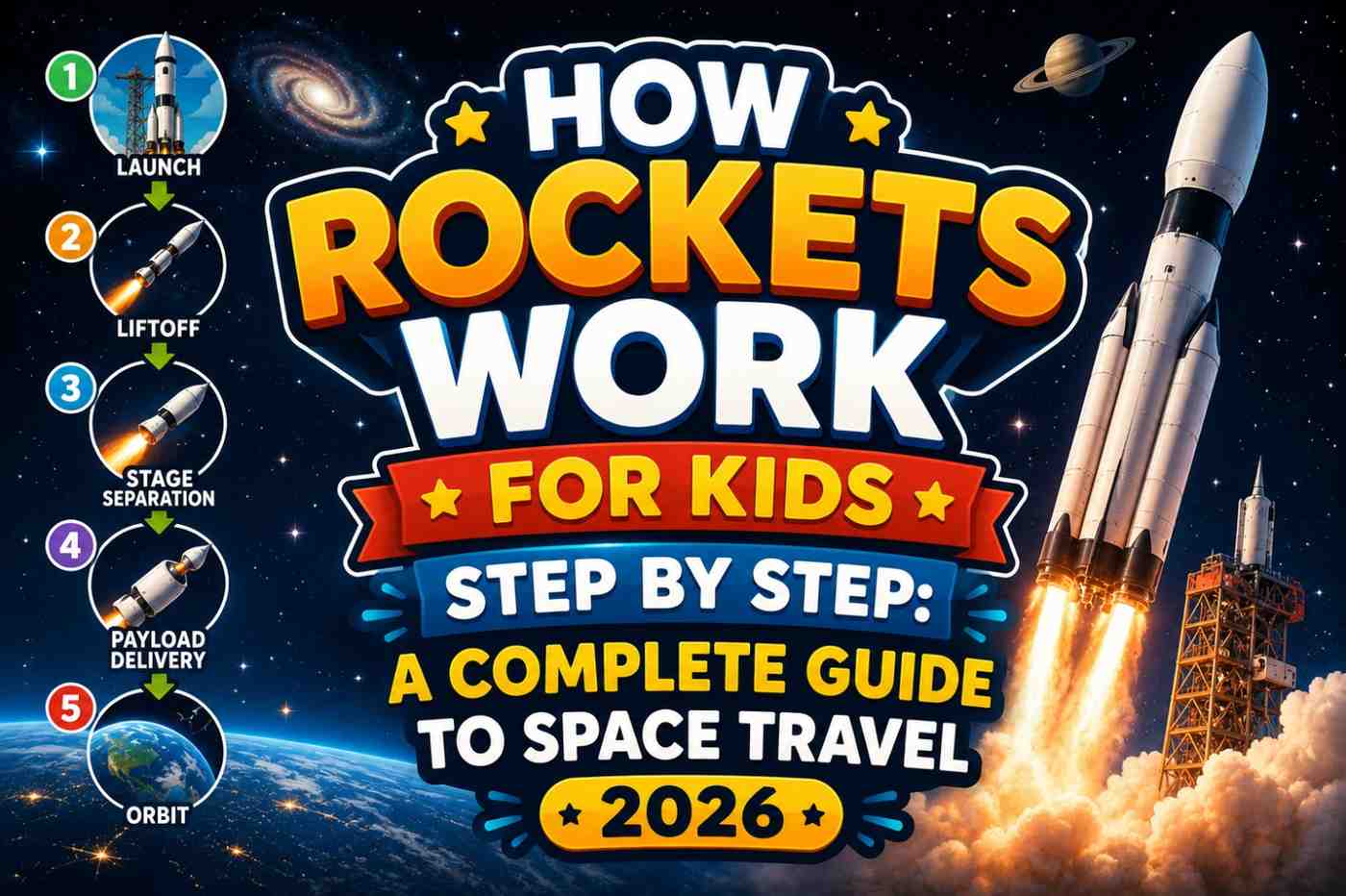
Have you ever wondered how rockets work for kids? Rockets are incredible machines that carry astronauts and equipment into space. Understanding how do rockets work for kids step by step is easier than you might think. This guide will explain everything about rockets in simple language that anyone can understand.
Rockets are like super-powerful flying machines. They push themselves into space by burning fuel and shooting hot gases downward. When you want to understand how rockets work for kids, the basic idea is simple: push down to go up. Let’s explore this amazing technology together!
What Is a Rocket and Why Do We Need Them?
A rocket is a vehicle designed to travel through space. We use rockets to send astronauts to the International Space Station, explore Mars, and launch satellites that help us with phones and weather forecasts. Learning how rockets work for kids helps us appreciate these incredible machines.
Rockets are the only vehicles that can escape Earth’s gravity and reach space. They’re different from airplanes because they don’t need air to fly. This is why rockets work perfectly in space, where there’s no air at all.
Key reasons we need rockets:
- Send humans to space
- Launch communication satellites
- Explore other planets like Mars
- Study the universe with telescopes
- Send supplies to astronauts in space
How Do Rockets Work for Kids: The Basic Principle
The main idea behind how rockets work for kids is Newton’s Third Law of Motion. For every action, there’s an equal and opposite reaction. When a rocket pushes hot gases down very fast, those gases push the rocket up.
Think of it like a balloon. When you blow up a balloon and let it go, air rushes out one end, and the balloon flies around the room. Rockets work the same way, just much more powerfully and controlled.
The simple rocket equation:
Fuel burns → Creates hot gases → Gases exit down → Rocket goes up
This is the foundation of understanding how rockets work for kids, step by step.
Step 1 – The Fuel System: What Powers a Rocket?
Every rocket needs fuel to work. The most common rocket fuel is a combination of two things: a fuel substance and an oxidizer. The fuel might be liquid hydrogen or kerosene, while the oxidizer is usually liquid oxygen.
When these two substances mix in the rocket’s combustion chamber, they create a powerful explosion of hot gases. These gases are much hotter than anything you’ve ever experienced. Learning how rockets work for kids means understanding that fuel is absolutely essential.
Types of rocket fuel:
- Liquid fuel – Used in big rockets like NASA’s Space Launch System
- Solid fuel—Used in rocket boosters attached to the Space Shuttle
- Ion fuel – Used in some advanced spacecraft for slow, steady acceleration
The fuel burns incredibly fast, creating pressure that builds up inside the rocket’s engine.
Step 2 – The Combustion Chamber: Where the Magic Happens
The combustion chamber is where fuel burns inside the rocket. This small space gets extremely hot—hotter than the surface of the Sun! The fuel ignites, and enormous pressure builds up quickly.
Understanding how rockets work for kids includes knowing that the combustion chamber is sealed on all sides except for one opening: the nozzle. This sealed space is crucial because it forces all the hot gases to exit through the nozzle at incredible speeds.
The temperature inside reaches about 5,000 degrees Fahrenheit. That’s hot enough to melt most metals! Scientists use special heat-resistant materials to build combustion chambers.
Step 3 – The Nozzle: Directing the Power
The nozzle is a specially shaped tube at the bottom of the rocket. It narrows down like a funnel, which makes the hot gases exit even faster. This is a critical part of understanding how rockets work for kids step by step.
When hot gases are forced through a narrowing space, they move faster. This creates more thrust—the force that pushes the rocket upward. The nozzle is like the final step that gives the rocket its incredible power.
Why the nozzle shape matters:
- Narrow opening speeds up gases
- Faster gases = more thrust
- Better nozzle design = more power
Rocket scientists spend years perfecting nozzle designs.
Step 4 – Creating Thrust: The Push That Sends Rockets to Space
Thrust is the force that lifts the rocket off the ground. It’s created when hot gases shoot out the nozzle downward at extremely high speeds. This creates an equal and opposite force pushing the rocket upward.
To truly understand how rockets work for kids, you need to grasp thrust. Without it, rockets couldn’t leave the ground. The rocket must create enough thrust to overcome its own weight plus the weight of everything it’s carrying.
A powerful rocket can create millions of pounds of thrust. The Space Launch System creates over 8 million pounds of thrust at launch!
Step 5 – Overcoming Gravity: Breaking Free from Earth
Gravity pulls everything toward Earth. To escape gravity, a rocket must reach a speed called “escape velocity.” This is about 25,000 miles per hour. Learning how rockets work for kids step-by-step includes understanding this critical speed.
Before reaching escape velocity, the rocket reaches “orbital velocity”—about 17,500 miles per hour. At this speed, the rocket is going so fast that it falls around Earth instead of falling back to the surface. That’s called being in orbit.
Velocity milestones:
- 1,000 mph – Leaving lower atmosphere
- 5,000 mph – Reaching space
- 17,500 mph – Orbital velocity
- 25,000 mph – Escape velocity
Step 6 – Stages and Separation: Dropping Weight as You Go
Big rockets like the Saturn V that went to the Moon had multiple stages. Each stage is a separate rocket that falls away when its fuel is used up. This is an important part of how rockets work for kids.
When one stage runs out of fuel, it separates from the rocket. The next stage ignites, carrying the rocket higher and faster. By dropping stages, the rocket becomes lighter and can go higher with less fuel.
Why stages matter:
- Each stage carries its own engines and fuel
- Lighter rocket = easier to accelerate
- Multiple stages = reach higher speeds
- More efficient use of fuel
The Apollo spacecraft used three stages to reach the Moon.
Step 7 – Reaching Space: The Final Stage
Once the rocket reaches space, the final stage separates, and the spacecraft continues on its mission. Whether it’s reaching the International Space Station or traveling to another planet, the basic principles of how rockets work for kids have gotten the spacecraft there.
In space, there’s no air and very little gravity from Earth. Spacecraft can coast for long distances without needing to burn fuel constantly. Some spacecraft use small rockets to adjust their direction and speed.
Different Types of Rockets
Not all rockets are the same. They’re designed for different purposes and have different shapes and sizes.
The Space Launch System (SLS) is NASA’s newest big rocket. It’s designed to send humans to the Moon and eventually Mars. It’s as tall as a 36-story building!
SpaceX’s Falcon 9 is a reusable rocket that launches satellites and carries astronauts. It’s special because the first stage can land itself and be used again.
The Saturn V was the rocket that took astronauts to the Moon in the 1960s. It remains one of the most powerful rockets ever built.
Understanding how rockets work for kids helps you appreciate why each rocket is designed differently for its mission.
Fun Facts About Rockets
- The fastest rocket ever was the Parker Solar Probe, traveling at 364,000 mph
- Rockets must carry their own oxygen because there’s none in space
- A rocket uses more fuel in the first minute than a car uses in a year
- The Saturn V rocket released 7.5 million pounds of thrust
- Modern rockets can land themselves and be reused
Common Questions About How Rockets Work
How fast do rockets go?
Rockets reach different speeds depending on their purpose. To reach space, they need to go about 17,500 miles per hour. To escape Earth’s gravity completely, they need to go 25,000 miles per hour.
Why do rockets need so much fuel?
Most of a rocket’s weight is fuel. Rockets need enormous amounts of fuel to push their massive weight against Earth’s gravity and air resistance.
Can rockets turn around in space?
Yes, spacecraft have smaller rockets called thrusters that let them change direction and speed while in space.
Do all rockets look the same?
No, rockets have different shapes and sizes. Some are very tall and thin, while others are wider and shorter. The design depends on what the rocket needs to carry and where it’s going.
FAQ SECTION
1. How do rockets work for kids in simple terms?
Rockets work by burning fuel that creates hot gases. These gases shoot downward very fast, which pushes the rocket upward. It’s like letting go of a blown-up balloon—air pushes out one end, and the balloon flies around.
2. What makes a rocket go up?
Hot gases shooting downward create thrust, which is a force pushing upward. This thrust must be stronger than the rocket’s weight to lift it off the ground.
3. How do rockets work for kids without air?
Rockets carry their own oxygen mixed with fuel. They don’t need air from Earth because they have everything they need inside the rocket engines.
4. Why do rockets have multiple stages?
Stages fall away when their fuel is used up, making the rocket lighter. A lighter rocket can go faster and higher with the same fuel that’s left.
5. How do rockets work for kids to reach space?
Rockets accelerate to about 17,500 miles per hour. At this speed, they’re going so fast that they orbit around Earth instead of falling back down.
IMAGE SUGGESTIONS
Image 1: Rocket Stages Diagram
- Placement: After “Step 6 – Stages and Separation” section
- Description: Colorful diagram showing rocket separation stages with labels
- ALT Text: “How do rockets work for kids, showing three stages separating from each other during launch?”
- Purpose: Visual explanation of stage separation concept
Image 2: Rocket Engine Thrust Diagram
- Placement: After “Step 4 – Creating Thrust” section
- Description: Cross-section of rocket engine showing fuel burning and exhaust
- ALT Text: “How do rockets work for kids diagram showing combustion chamber, nozzle, and hot gases creating thrust.”
- Purpose: Shows the internal mechanics of thrust generation
CONCLUSION
Understanding how rockets work for kids opens up a world of wonder about space exploration. Rockets are incredible machines that follow simple scientific principles: burn fuel, create hot gases, and shoot them downward to go upward. These amazing vehicles have taken humans to the Moon, sent rovers to Mars, and helped us explore the universe.
The next time you see a rocket launch on the news, you’ll know exactly what’s happening. You’ll understand the fuel burning in the combustion chamber, the gases rushing through the nozzle, and the thrust pushing the rocket into space.
Ready to learn more about space? Explore our other articles about Mars, the International Space Station, and how to become an astronaut. Space exploration is the future, and understanding how rockets work for kids is your first step toward the stars!
EXTERNAL LINKS (Authority Sources)
- NASA Space Launch System Official – dofollow
- SpaceX Falcon 9 Information—dofollow
- How Rockets Work – Space.com – dofollow
- Rocket Science Explained – Khan Academy – dofollow
- Newton’s Laws of Motion – Royal Institution – dofollow