 creator@scienceexplore.site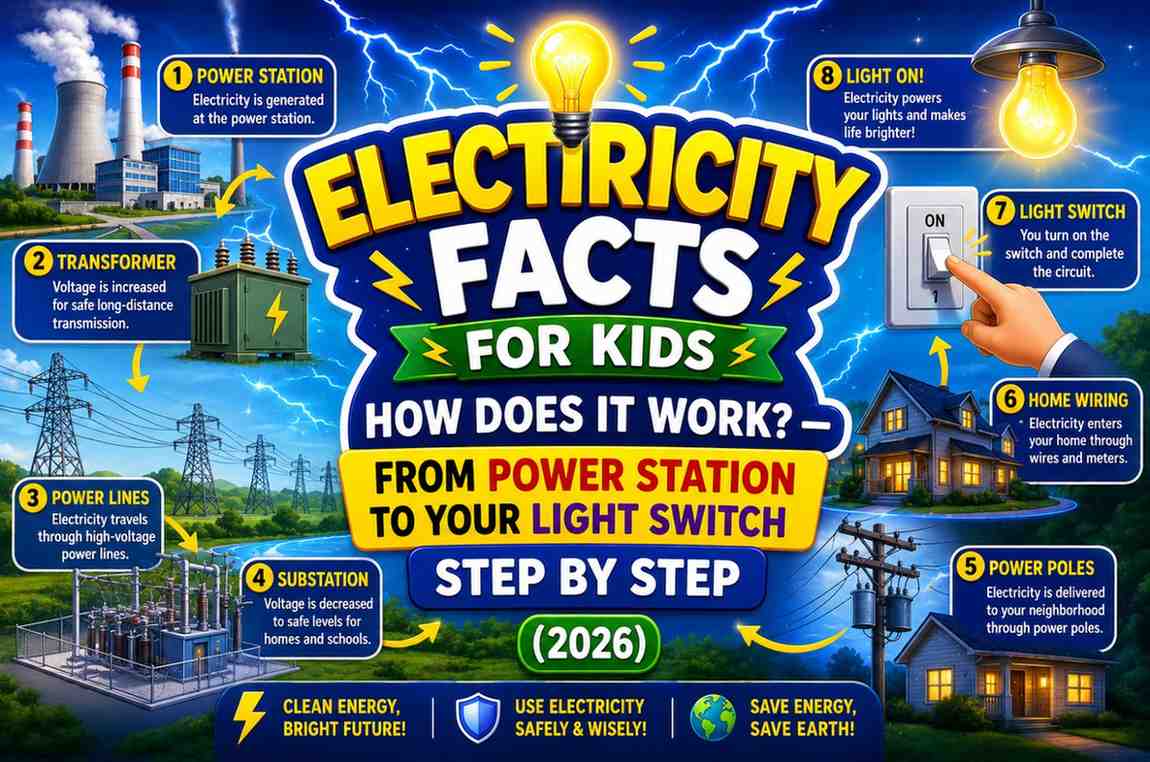
Every time you switch on a light, charge your phone, or turn on the television, you are using one of the most important scientific discoveries in human history—electricity. “Electricity Facts for Kids: How Does It Work?” is a topic that connects everyday life to brilliant physics, chemistry, and engineering.
In this guide, we will follow electricity on its incredible journey from a power station all the way to the light switch in your room—step by step, in clear and simple language. By the end, you will never look at a light bulb the same way again!
What Is Electricity? Simple Explanation for Kids
Electricity is a form of energy caused by the movement of tiny particles called electrons. Electrons are found in atoms, orbiting around the nucleus. In some materials (called conductors), electrons can move freely from atom to atom—and this flow of electrons is what we call electric current.
When billions of electrons flow through a wire in the same direction, they carry energy with them. This energy can power motors, light bulbs, computers, and countless other devices. This is the core of electricity facts for kids: How does it work?
How Is Electricity Generated at a Power Station?
Most electricity is generated at power stations using a device called a generator. Here is how it works in simple steps:
Step 1 — Fuel Is Burned: In many power stations, fuel such as coal, gas, or oil is burned to produce heat. Some power stations use nuclear energy, wind, or water instead.
Step 2 — Water Becomes Steam: The heat boils water to create high-pressure steam.
Step 3 — Steam Spins a Turbine: The steam rushes past the blades of a turbine and makes it spin very fast—like a pinwheel in a strong wind.
Step 4 — The Turbine Spins a Generator: The spinning turbine is connected to a generator—a large coil of wire inside a magnetic field. When the coil spins, it creates an electrical current.
This process is based on Faraday’s Law—one of the most important discoveries in all of electricity facts for kids. How does it work?
How Does Electricity Travel from the Power Station to Your Home?
Once electricity is generated, it must travel hundreds of kilometers to reach your home. Here is how it makes that remarkable journey:
Step 5 — Step-Up Transformer: The electricity from the generator is sent to a step-up transformer. This increases the voltage to very high levels (up to 400,000 volts!) for efficient long-distance transmission. High voltage means less energy is wasted as heat in the wires.
Step 6 — Power Lines: The high-voltage electricity travels through thick cables supported by the tall pylons (towers) you see in the countryside. These are the national grid lines.
Step 7—Step-Down Transformer: When electricity reaches towns and cities, step-down transformers reduce the voltage to safer levels—around 230 volts for homes.
Step 8 — Into Your Home: The electricity enters your home through a cable connected to your electricity meter and consumer unit (fuse box). From there, it flows through wires hidden in your walls to every socket and switch in your house.
How Does a Light Bulb Work?
When you flip a light switch, you complete an electric circuit—creating a continuous pathway for electrons to flow. The electricity flows into the bulb, through a very thin wire called a filament (in traditional bulbs), and back out again.
The filament resists the flow of electrons and gets so hot (up to 2,700°C in some bulbs) that it glows and produces light.
In modern LED bulbs, a different process causes light to be emitted much more efficiently, using far less electricity — which is why switching to LED bulbs saves energy and money!
Static Electricity — Electricity Without Wires
Not all electricity flows through wires! Static electricity is an electric charge that builds up on the surface of an object when electrons are transferred by friction.
When you rub a balloon on your hair, electrons transfer from your hair to the balloon. The balloon becomes negatively charged, and your hair becomes positively charged. Opposite charges attract, which is why the balloon sticks to the wall!
Lightning is also a form of static electricity — just on a massive, awesome scale! Giant static charges build up in storm clouds and discharge as enormous bolts of electricity streaking to the ground.
Electricity Safety Facts for Kids
Understanding electricity facts for kids, how does it work? It includes knowing how to stay safe:
- ⚠️ Never put anything into an electrical socket — only plugs belong there!
- ⚠️ Never use electrical devices near water — water conducts electricity and is very dangerous.
- ⚠️ If you see a fallen power line, stay far away and tell an adult immediately.
- ⚠️ Never fly kites near power lines.
- ⚠️ Always ask an adult before handling any electrical equipment.
Renewable Electricity — The Future of Power
- ☀️ Solar panels convert sunlight directly into electricity using the photovoltaic effect.
- 💨 Wind turbines generate electricity from wind energy — the wind spins the blades, which turn a generator.
- 💧 Hydroelectric power stations use the flow of water through dams to turn turbines.
- 🌊 Tidal energy harnesses the movement of ocean tides to generate electricity.
Renewable energy is the future of electricity. As fossil fuels run out and climate change accelerates, solar, wind, and water power are becoming increasingly vital to our world.
Key Electricity Terms Every Kid Should Know
| Term | Meaning |
|---|---|
| Voltage (Volts) | The electrical pressure that pushes electrons through a circuit |
| Current (Amps) | The flow rate of electrons through a conductor |
| Power (Watts) | How much energy is used per second |
| Circuit | A complete loop through which electricity can flow |
| Conductor | A material that allows electricity to flow easily (e.g., copper) |
| Insulator | A material that blocks electricity (e.g., rubber, plastic) |
External Resource — Electricity for Kids
For fantastic interactive electricity simulations and experiments, visit:
🔗 PhET Interactive Simulations — Circuit Construction Kit (DoFollow)
You might also enjoy our related guide on Basic Science Facts for Kids Class 3, 4, 5, which covers atoms, forces, chemistry, and much more in one comprehensive article.
Frequently Asked Questions (FAQ)
Q1. What is electricity made of?
Electricity is the flow of electrons—tiny particles that orbit the nucleus of an atom. When electrons flow through a conductor (like a copper wire), they carry energy that can be used to power devices.
Q2. How is electricity measured?
Electricity is measured using several units. Voltage (volts) measures the electrical pressure. Current (amperes or amps) measures the flow of electrons. Power (watts) measures how much energy is being used per second.
Q3. Why does electricity flow through metal but not through plastic?
Metal is a conductor — its atoms have free electrons that can move easily. Plastic is an insulator — its atoms hold onto their electrons tightly. That is why electrical wires are metal on the inside (to carry electricity) and plastic on the outside (for safety).
Q4. What is the difference between AC and DC electricity?
DC (direct current) flows in one direction—like the electricity from a battery. AC (Alternating Current) changes direction many times per second — this is the type of electricity supplied to homes through the power grid.
Q5. Can electricity be stored?
Yes! Batteries store chemical energy and convert it into electrical energy when needed. Modern rechargeable batteries (like those in phones and electric cars) can store large amounts of energy and be recharged hundreds of times.
Conclusion
From a spinning turbine in a power station to the glow of a light bulb in your bedroom, electricity makes one of the most extraordinary journeys in all of science. Electricity facts for kids: How does it work? Reveal a world of invisible forces, incredible engineering, and life-changing technology.
Electricity powers almost everything in the modern world. Understanding where it comes from, how it travels, and how to use it safely is one of the most important and practical areas of science education for young learners.
kilometersNext time you switch on a light, take a moment to think about the incredible journey that tiny flow of electrons has made—all the way from a generator hundreds of kilometres away to the very bulb above your head. Now that is truly electrifying science!