 creator@scienceexplore.site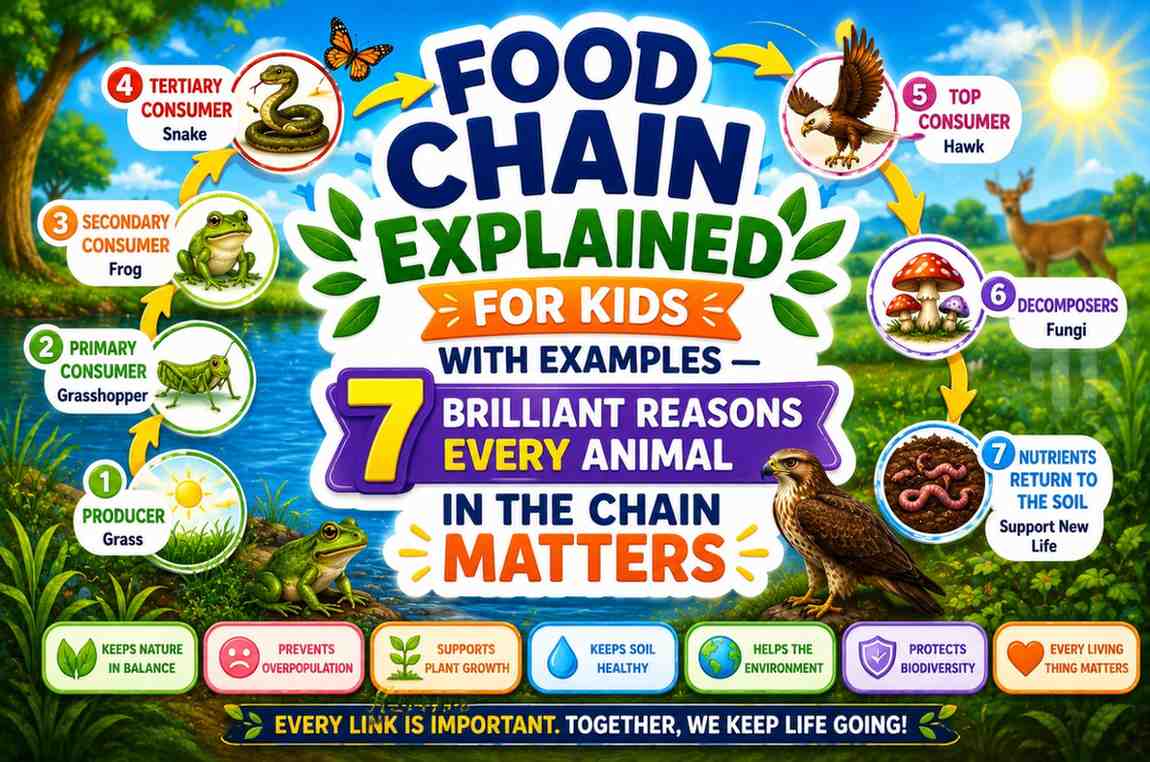
Have you ever watched a lion hunt a zebra on a nature documentary and wondered — why do animals eat each other? The answer lies in the food chain, one of the most important ideas in all of biology. A food chain explained for kids with examples makes this fascinating concept clear, exciting, and easy to remember.
In this guide, we will walk through what a food chain is, look at real examples from different habitats around the world, and discover why every single link in the chain — from the tiniest plant to the biggest predator — plays a vital role.
What Is a Food Chain? Simple Definition for Kids
A food chain shows the order in which living things eat each other, starting from a plant and ending with a top predator. It shows how energy and nutrients pass from one organism to the next.
Every food chain begins with a producer — a plant or organism that makes its own food through photosynthesis. After that come consumers — animals that eat plants or other animals to get their energy.
Food Chain Explained for Kids With Examples — Key Terms to Know
- Producer: An organism that makes its own food using sunlight (plants, algae). They form the base of every food chain.
- Primary Consumer (Herbivore): An animal that eats only plants. Examples: rabbits, grasshoppers, deer, cows.
- Secondary Consumer (Carnivore or Omnivore): An animal that eats the primary consumer. Examples: frogs, foxes, small fish.
- Tertiary Consumer (Top Predator): An animal that eats secondary consumers. Examples: lions, eagles, sharks, wolves.
- Decomposer: Organisms like fungi and bacteria that break down dead matter and return nutrients to the soil.
Real-Life Examples of Food Chains
Example 1 — Grassland Food Chain:
🌿 Grass → 🦗 Grasshopper → 🐸 Frog → 🐍 Snake → 🦅 Eagle
The grass is the producer. The grasshopper eats the grass. The frog eats the grasshopper. The snake eats the frog. The eagle eats the snake.
Example 2 — Ocean Food Chain:
🌊 Algae → 🐟 Small Fish → 🐠 Larger Fish → 🦈 Shark
This is a classic ocean food chain. Algae produce food through photosynthesis and form the base of the entire marine ecosystem.
Example 3 — Forest Food Chain:
🌳 Oak Tree → 🐛 Caterpillar → 🐦 Blue Tit → 🦅 Sparrowhawk
This shows how a woodland habitat connects plants, insects, small birds, and birds of prey.
Example 4 — Arctic Food Chain:
❄️ Arctic Moss → 🐇 Arctic Hare → 🦊 Arctic Fox → 🐻 Polar Bear
Even in freezing conditions, the food chain begins with plants and ends with a top predator.
These examples make food chain explained for kids with examples vivid and memorable. Each habitat has its own unique chain, but all follow the same fundamental pattern.
What Is a Food Web? When Chains Overlap
In reality, most animals eat more than one thing — and are eaten by more than one predator. When many food chains overlap and connect, they form a food web. A food web is a much more realistic picture of how energy flows through an ecosystem.
For example, a fox does not only eat rabbits. It might also eat mice, birds, berries, and insects. Each of these organisms is part of a different food chain. Together they form a complex web of feeding relationships.
Why Does Every Animal in the Food Chain Matter?
This is one of the most important lessons in food chain explained for kids with examples. If one link in a food chain disappears, it can disrupt the entire ecosystem. This is called a trophic cascade.
Real-Life Example — Wolves in Yellowstone: When wolves were removed from Yellowstone National Park in the early 20th century, deer populations exploded. The deer ate so much vegetation that riverbanks eroded, rivers changed course, and countless other species were affected — all because one predator was removed.
When wolves were reintroduced in 1995, the entire ecosystem recovered over time. This real-life example shows why every animal, no matter how big or small, matters in the food chain.
How Energy Flows Through a Food Chain
Energy enters a food chain through producers. However, only about 10% of the energy from one level is transferred to the next. The rest is used up in life processes like moving, breathing, and keeping warm.
This is why food chains rarely have more than four or five links — there is simply not enough energy to support another level at the top.
| Level | Example | Energy Remaining |
|---|---|---|
| Producer | Grass | 100% |
| Primary Consumer | Grasshopper | 10% |
| Secondary Consumer | Frog | 1% |
| Tertiary Consumer | Eagle | 0.1% |
Decomposers — The Forgotten Heroes of the Food Chain
Decomposers like bacteria and fungi break down dead plants and animals. Without them, dead matter would pile up everywhere and nutrients would never return to the soil. Plants need those nutrients to grow, which means without decomposers, all food chains would eventually collapse.
Decomposers are often overlooked but they are absolutely essential — truly the unsung heroes of every ecosystem on Earth.
7 Brilliant Reasons Every Animal in the Chain Matters
- Producers create the energy that drives the entire system.
- Herbivores control plant growth and stop any one plant from dominating.
- Predators keep prey populations in balance — preventing overgrazing.
- Scavengers clean up dead matter and prevent disease.
- Decomposers recycle nutrients back into the soil for plants.
- Keystone species (like wolves, sea otters) have a disproportionately large impact on their ecosystem.
- Every extinction weakens the food web, making the whole system more fragile.
External Resource — Food Chains for Kids
For brilliant visual food web diagrams and interactive resources, explore:
🔗 BBC Bitesize — Food Chains and Food Webs (DoFollow)
Also explore our main article on Basic Science Facts for Kids Class 3 4 5 which covers ecosystems, animals, space, and more in one comprehensive guide.
Frequently Asked Questions (FAQ)
Q1. What is a food chain in simple words?
A food chain is a sequence showing who eats who in nature. It starts with a plant (producer) that gets energy from the Sun, then shows the animals that eat the plant and the animals that eat those animals.
Q2. What is the difference between a food chain and a food web?
A food chain shows one single line of eating relationships. A food web shows how many different food chains connect and overlap in a real ecosystem, giving a much more complete picture.
Q3. What happens if one animal in the food chain goes extinct?
Losing one species can have a ripple effect throughout the entire food chain. Prey animals may overpopulate while predators may starve. This can cause entire ecosystems to become unbalanced.
Q4. What is a producer in a food chain?
A producer is an organism that makes its own food, usually through photosynthesis. Plants, algae, and some bacteria are producers. They form the essential base of every food chain on Earth.
Q5. Why are decomposers important in a food chain?
Decomposers break down dead organisms and return nutrients to the soil. Without them, dead matter would accumulate, soil would lose fertility, plants could not grow, and the entire food chain would eventually collapse.
Conclusion
Now you have food chain explained for kids with examples — from grasslands to oceans, from tiny algae to mighty polar bears! Every living thing is connected through these chains of energy and nutrition.
Understanding food chains teaches us one of the most important lessons in science: everything in nature is connected. Every plant, every insect, every animal plays a role in keeping the ecosystem balanced and healthy.
This is why protecting nature — preventing extinction, reducing pollution, preserving forests — is so critically important. Every link in the chain matters. And now that you know that, you are already thinking like a scientist!