 creator@scienceexplore.site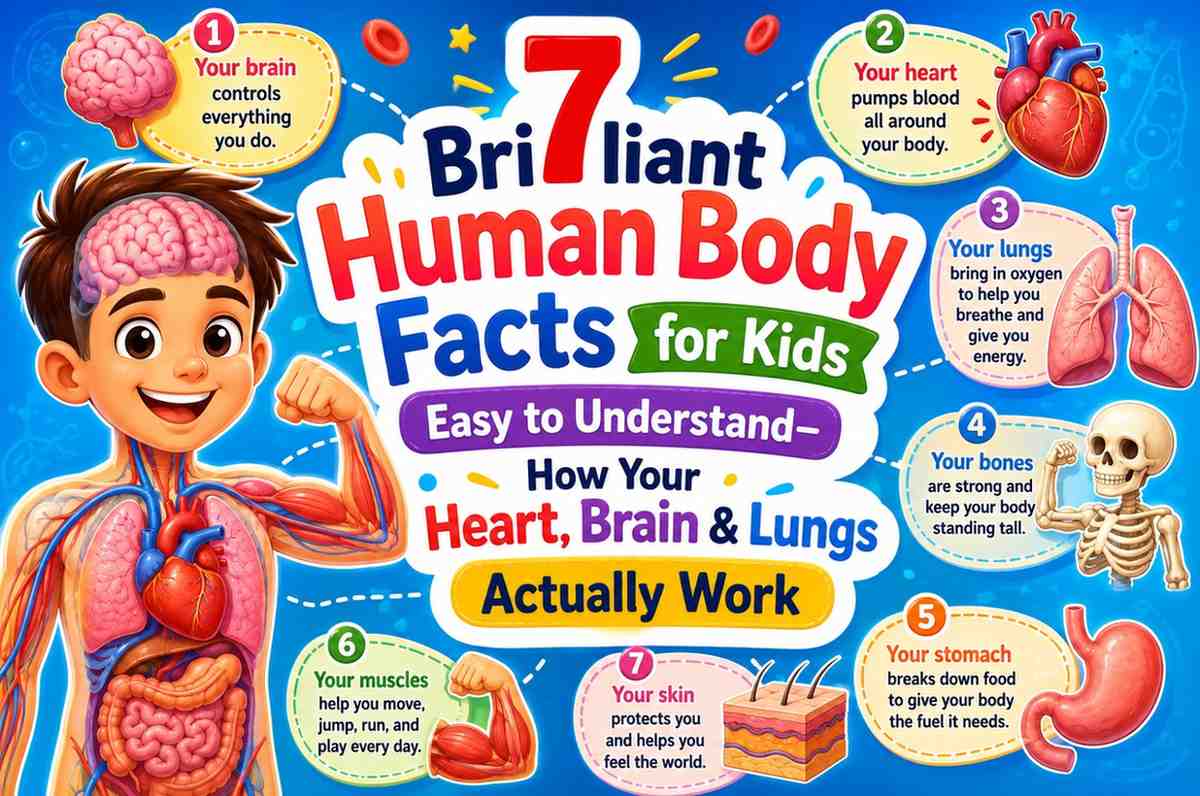
Have you ever wondered what is happening inside your body right now? The truth is, your body is doing thousands of incredible things every second—and most of it happens without you even thinking about it! Easy-to-understand human body facts for kids can transform the way young learners see themselves and the world around them.
In this guide, we will explore how your heart pumps blood, how your brain controls everything you do, and how your lungs keep you breathing—all explained in clear, simple language perfect for kids in classes 3, 4, and 5.
Human Body Facts for Kids Easy to Understand — Your Amazing Heart
Your heart is one of the most hard-working organs in your entire body. Here are some incredible facts about this powerful muscle:
- Your heart is about the size of your fist. It sits slightly to the left in the middle of your chest.
- It beats approximately 100,000 times every day — that is over 35 million beats in a single year!
- Your heart pumps about 5 liters of blood every single minute around your body.
- In an average lifetime, the human heart beats more than 2.5 billion times.
- The heart has four chambers: the left atrium, right atrium, left ventricle, and right ventricle.
Understanding the heart is one of the most important human body facts for kids easy to understand. The heart is essentially a pump that keeps all our organs alive by delivering blood full of oxygen and nutrients.
When you exercise, your heart beats faster because your muscles need more oxygen. This is completely normal and healthy!
How the Brain Works — Human Body Facts for Kids Explained Simply
Your brain is the control center of your entire body. Everything you feel, think, see, hear, smell, and taste is processed by your brain. Here are some stunning brain facts:
- Your brain weighs about 1.4 kilograms — roughly the weight of a small pineapple.
- The brain uses about 20% of all the energy your body produces, even though it is only about 2% of your body weight.
- You have about 86 billion neurons (brain cells), each connected to thousands of others.
- Electrical signals travel through your brain at speeds of up to 120 meters per second.
- The brain never truly switches off — it is even active while you sleep, sorting through memories and information.
These are remarkable human body facts for kids easy to understand. The brain controls breathing, heartbeat, digestion, emotions, and memory—all at the same time!
Did you know that sleep is incredibly important for brain health? When you sleep, your brain processes everything you learned during the day and stores it as memory.
How Your Lungs Keep You Breathing — Simple Body Facts for Young Learners
Every breath you take is thanks to your lungs. These two sponge-like organs fill with air and extract oxygen to keep your body alive. Here are some amazing lung facts:
- You take about 20,000 breaths every single day without even thinking about it.
- Your lungs contain tiny air sacs called alveoli. You have approximately 480 million of them!
- If you spread out all the alveoli flat, they would cover an area the size of a tennis court.
- The right lung is slightly larger than the left—because the left makes room for your heart.
- When you breathe in, your diaphragm (a dome-shaped muscle under your lungs) pulls down to create space for air.
These easy-to-understand human body facts for kids show just how perfectly designed your lungs are. Every breath in brings fresh oxygen into your blood, and every breath out removes carbon dioxide.
The Digestive System — How Your Body Turns Food Into Energy
Did you know your food goes on an amazing journey through your body? The digestive system is fascinating! Here is what happens:
- Digestion begins in your mouth. Chewing breaks down food, and saliva starts to dissolve it.
- Food travels down the esophagus (throat tube) in about 4 to 8 seconds.
- The stomach uses acid and enzymes to break food into a liquid-like mush.
- The small intestine is about 6 metres long. Nutrients are absorbed through its walls into the blood.
- The large intestine absorbs water and turns the remaining waste into solid matter.
This is one of the most fascinating human body facts for kids—easy to understand—the entire digestive process takes between 24 and 72 hours from start to finish!
Your Bones and Muscles—The Body’s Framework
Without bones and muscles, you would be a shapeless blob on the floor! Here are some remarkable facts:
- Adults have 206 bones. Babies are born with around 270 bones, which fuse together as they grow.
- The strongest muscle in the body relative to its size is the masseter—the jaw muscle.
- The longest bone in your body is the femur (thigh bone). The smallest is the stapes in your ear.
- Your skeleton is constantly rebuilding itself. About 10% of your skeleton is replaced every year.
Bones protect vital organs and provide structure. Muscles pull on bones to make movement possible. Together, they form an incredible mechanical system.
Skin — Your Body’s Largest Organ
Most people do not think of skin as an organ, but it is—and it is the biggest one you have! Here are some skin facts kids will love:
- Your skin accounts for about 15% of your total body weight.
- Skin renews itself about every 27 days. You shed thousands of dead skin cells every hour.
- Skin has three layers: the epidermis, dermis, and hypodermis.
- Your fingerprints are unique to you — no two people in the world have the same ones.
These easy-to-understand human body facts for kids help children appreciate how their body protects them from germs, regulates temperature, and allows them to feel the world around them.
The Senses—How Your Body Experiences the World
Humans have five main senses: sight, hearing, smell, taste, and touch. Here are some brilliant science facts:
- The eye can distinguish about 10 million different colors.
- Your ears never stop working — even while you sleep, they detect sounds.
- The nose can detect over 1 trillion different scents.
- Taste buds on your tongue last only about 10 to 14 days before being replaced.
Each of our senses sends signals to the brain at incredible speed, allowing us to react to our environment in milliseconds.
External Learning Resource for Kids
Want to learn more about the human body in a fun, visual way? Visit this brilliant resource:
🔗 BBC Bitesize — Human Body for Kids (DoFollow)
You might also like to read our related article on Basic Science Facts for Kids Class 3, 4, 5—which covers plants, space, chemistry, and much more!
Frequently Asked Questions (FAQ)
Q1. How many organs does the human body have?
The human body has 78 major organs. The five most vital organs are the brain, heart, lungs, liver, and kidneys. Without any one of these, life cannot continue.
Q2. What is the hardest substance in the human body?
Tooth enamel is the hardest substance in the human body — even harder than bone! It protects the inner parts of your teeth from damage.
Q3. How fast does blood travel around the body?
Blood travels at varying speeds, but on average it takes about 20 seconds for blood to complete a full circuit of the body. The heart pumps it around continuously.
Q4. Can kids understand how the brain works?
Absolutely! The brain can be explained simply as a supercomputer inside your head. It receives information from your senses, processes it, and sends instructions to your body — all in milliseconds.
Q5. Why do we need to breathe?
Breathing brings oxygen into the body, which every cell needs to produce energy. It also removes carbon dioxide, a waste gas. Without breathing, cells would die within minutes.
Conclusion
Your body is truly a masterpiece of nature. From the tireless beating of your heart to the lightning-fast signals of your brain, every system works together in perfect harmony to keep you alive and thriving.
Human body facts for kids easy to understand are not just interesting—they are empowering. When children understand how their body works, they are more likely to take care of it, make healthy choices, and develop a natural curiosity about biology and science.
Keep learning, keep asking questions, and remember — the most amazing science lab in the world is right there inside you!