 creator@scienceexplore.site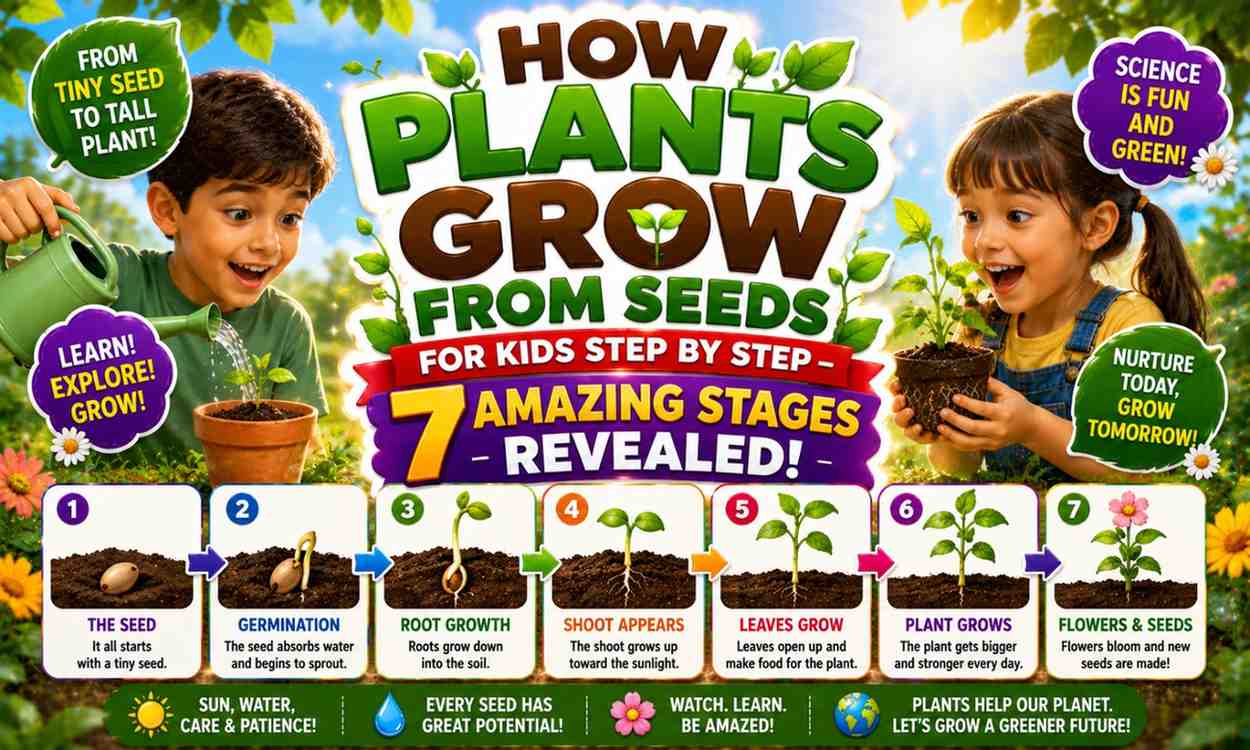
Introduction: A Tiny Seed Holds a Big Secret
Have you ever held a tiny seed in your hand and wondered, how does this little thing turn into a giant tree? It seems almost like magic, doesn’t it? Well, it’s even better than magic. It’s science!
Learning how plants grow from seeds for kids step-by-step is one of the most exciting nature adventures you can go on—without even leaving your backyard. Every apple you eat, every flower you smell, and every big shady tree you sit under started as a tiny seed. Today, we’re going to follow that incredible journey from the very beginning all the way to a full-grown plant or tree.
Get ready to dig in! 🌱
What Is a Seed, Anyway?
Before we explore how plants grow from seeds for kids step by step, let’s understand what a seed actually is.
A seed is like a tiny package. Inside that small shell, there are three very important parts:
- The embryo — this is the baby plant sleeping inside the seed.
- The seed coat — this is the hard outer shell that protects the baby plant.
- The endosperm — this is the food supply for the baby plant when it first starts to grow.
Seeds come in all shapes and sizes. A coconut is one of the biggest seeds in the world! A poppy seed is one of the tiniest. But no matter the size, every seed works the same wonderful way.
Step 1: Finding the Right Conditions (Germination Begins!)
The very first step in understanding how plants grow from seeds for kids, step by step, is germination. This is the moment when a sleeping seed wakes up and starts to grow.
But seeds don’t wake up just anywhere. They need the right conditions:
🌡️ Warmth
Seeds need the soil around them to be warm enough. Most seeds love temperatures between 65°F and 75°F (18°C–24°C). Cold soil keeps them sleeping!
💧 Water
When water soaks through the seed coat, the embryo inside begins to activate. Water softens the hard outer shell and sends a signal to the baby plant that it’s time to grow.
🌍 Soil
Seeds need good soil to settle into. Soil gives seeds something to hold on to, and it’s full of nutrients — tiny bits of food the plant will need later.
🌬️ Air (Oxygen)
Seeds also need oxygen to begin the process of germination. Healthy, loose soil allows air to flow around the seed.
Interestingly, most seeds do not need sunlight to germinate. They actually grow underground first, in the dark! The light comes later.
Step 2: The Seed Cracks Open
Once a seed gets enough water, warmth, and oxygen, something amazing happens — the seed coat splits open!
Inside, the embryo begins to grow. The very first root, called the radicle, pushes downward into the soil. This root has one job: to anchor the plant in place and start drinking water from the soil.
At the same time, a tiny shoot begins to push upward through the soil. This shoot is heading toward the sunlight.
This is one of the most exciting parts of learning how plants grow from seeds for kids step by step—because what happens next is truly remarkable.
Step 3: The Shoot Breaks Through the Soil 🌱
After the root is established, the shoot continues pushing up and up until it finally breaks through the surface of the soil. This is called emergence.
The first leaves that appear are called cotyledons (say it like “cot-ee-LEE-dons”). These are special seed leaves. They’re not like the normal leaves you’ll see later. Their job is to provide energy to the tiny seedling using the food stored in the seed.
At this point, the young plant is called a seedling—a baby plant. It’s fragile and needs care, but it’s officially alive and growing!
Step 4: The Seedling Grows Real Leaves
Now the plant does something amazing: it begins making its own food. This process is called photosynthesis (say it like foe-toe-SIN-thuh-sis).
Here’s how photosynthesis works in simple terms:
- The leaves absorb sunlight. ☀️
- The roots soak up water from the soil. 💧
- The leaves take in carbon dioxide (a gas from the air). 🌬️
- The plant uses sunlight to turn water and carbon dioxide into sugar (food for the plant). 🍃
The green color in leaves comes from a substance called chlorophyll, which is the magical ingredient that captures sunlight. This is also why plants need light to survive!
You can learn more about photosynthesis on National Geographic Kids—a fantastic resource for young nature lovers.
Step 5: The Plant Gets Stronger — Roots, Stems & Leaves
As the seedling continues to grow, its parts get bigger and stronger. Let’s look at what each part does:
🌿 The Roots
Roots grow deeper and wider underground. They have two jobs:
- Absorbing water and nutrients from the soil
- Anchoring the plant so it doesn’t blow away in the wind
Some trees have roots that stretch as far underground as their branches spread above!
🪵 The Stem
The stem acts like a highway, carrying water and nutrients up from the roots to the leaves and carrying sugar made in the leaves down to the rest of the plant. In trees, the stem becomes the thick trunk you see.
🍃 The Leaves
Leaves are the plant’s solar panels. The more leaves a plant has, the more food it can make through photosynthesis. Leaves also release extra water into the air through tiny holes called “stomata”—this is called transpiration.
Step 6: The Plant Flowers 🌸
This is one of the most beautiful steps in how plants grow from seeds for kids, step by step—the plant blooms!
Not all plants make flowers, but many do. Flowers have a very important job: they help the plant reproduce (make more plants). Here’s how:
- Flowers produce pollen—a fine, yellow or golden powder.
- Bees, butterflies, and even the wind carry pollen from one flower to another. This is called pollination.
- Once a flower is pollinated, it can create a fruit or seed pod containing new seeds!
So the next time you see a bee buzzing around a flower, remember—that bee is helping make new plants! 🐝
Step 7: Seeds Are Made and Spread
After pollination, the flower changes into a fruit or seed pod. Inside that fruit are new seeds — and the whole journey is ready to begin again!
But first, the seeds need to travel to a new place. Seeds spread in amazing ways:
- 🌬️ Wind — Dandelion seeds float away on tiny parachutes.
- 💧 Water — Coconuts float across oceans to new shores.
- 🐦 Animals & Birds — Animals eat fruits and drop the seeds far away in their droppings.
- 🧲 Hooks & Burrs — Some seeds stick to animal fur or your clothing and get carried to new places.
Once a seed lands in the right spot — with warmth, water, and good soil — the entire journey starts all over again. A new seed, a new plant, a new tree. Life continues! 🌳
From Seedling to Big Tree: How Long Does It Take?
Great question! Different plants grow at different speeds:
| Plant | Time to Grow |
|---|---|
| Bean plant | 7–10 days to sprout |
| Sunflower | Full bloom in 70–90 days |
| Apple tree | Fruit in 4–8 years |
| Oak tree | Fully grown in 20–50 years |
Some trees, like the bristlecone pine, can live for thousands of years—making them among the oldest living things on Earth!
Try It Yourself: Grow a Seed at Home 🏡
The best way to understand how plants grow from seeds for kids, step by step, is to try it yourself! Here’s a simple experiment:
What you need:
- A bean seed
- A clear plastic zip-lock bag
- A damp paper towel
- Tape and a sunny window
Steps:
- Wet the paper towel and wring it out so it’s damp (not dripping).
- Place the bean seed in the paper towel.
- Put the paper towel in the zip-lock bag and seal it.
- Tape the bag to a sunny window.
- Watch every day!
Within 5–7 days, you’ll see the root appear, then the shoot. You’re watching germination happen in real time! 🌱
For more fun science experiments for kids, check out Science Fun for Everyone—a DoFollow resource packed with activities.
Why Is It Important to Understand How Plants Grow?
Plants are essential to all life on Earth. They:
- Produce the oxygen we breathe 🌍
- Provide food for humans and animals 🥦
- Give us shade, wood, and medicine. 🌲
- Help clean the air and water. 💨
When kids learn about plants, they grow a deep love and respect for nature. That respect leads to better choices—like protecting forests, planting trees, and reducing pollution.
Understanding how plants grow from seeds for kids, step by step, isn’t just a school lesson. It’s a life lesson.
Frequently Asked Questions (FAQ)
❓ Q1: How long does it take for a seed to grow into a plant?
It depends on the type of plant! Some seeds, like beans, can sprout in just 5–10 days. Others, like mango trees, may take several weeks to germinate and years to fully grow. Warmth, water, and good soil all help seeds grow faster.
❓ Q2: Do all seeds need sunlight to grow?
No! Seeds actually germinate underground in the dark. However, once the seedling pushes through the soil, it absolutely needs sunlight to carry out photosynthesis and continue growing.
❓ Q3: Why do some seeds not grow?
Seeds may fail to grow if they are too old, too dry, buried too deep, in soil that is too cold or too wet, or if they don’t get enough oxygen. Seeds that are healthy, fresh, and placed in the right conditions grow best.
❓ Q4: Can a plant grow without soil?
Yes! This is called hydroponics — growing plants in water with added nutrients instead of soil. Many vegetables like lettuce and tomatoes are grown this way in greenhouses around the world.
❓ Q5: What is the biggest seed in the world?
The coco de mer palm produces the world’s largest seed—it can weigh up to 25 kilograms (55 pounds)! It grows on islands in the Seychelles in the Indian Ocean.
Conclusion
The journey of how plants grow from seeds for kids, step by step, is truly one of nature’s greatest stories. It starts with a tiny, sleeping seed and ends—over months or even decades—as a towering tree or beautiful flower.
Every step matters: the cracking of the seed coat, the first root pushing into the soil, the seedling reaching for sunlight, the flower blooming, and new seeds being scattered to start the cycle all over again.
The next time you hold a seed or bite into a fruit, remember you’re holding an entire future forest in your hand. Nature is patient, powerful, and endlessly amazing.
So go outside, plant a seed, and watch life happen.