
 creator@scienceexplore.site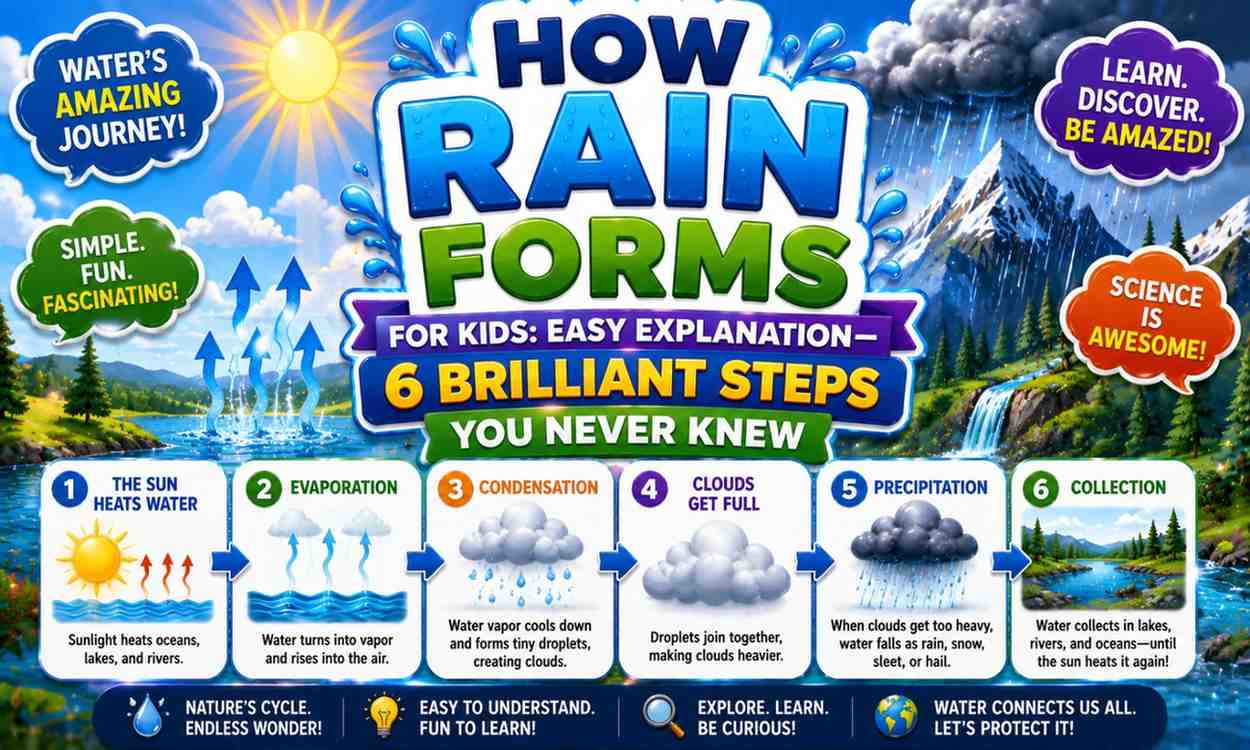
Introduction: Where Does Rain Come From?
Have you ever stood outside during a rainstorm and looked up at those dark, heavy clouds and wondered—where did all that water come from? How did it get all the way up there in the sky?
Understanding how rain forms for kids: easy explanation is one of the coolest science journeys you’ll ever take. Spoiler alert: the water falling on your head today might be the same water that a dinosaur drank millions of years ago! 🦕
Yes, really. Water keeps moving around our planet in a never-ending cycle called the water cycle. Let’s explore every step of this incredible journey together.
What Is the Water Cycle?
The water cycle (also called the hydrological cycle) is the continuous movement of water through Earth’s environment—from the oceans, to the sky, to the rain, and back again. It has no beginning and no end. It just keeps going, forever.
The main stages of the water cycle are:
- Evaporation — Water turns into vapour and rises into the sky
- Condensation — Water vapour cools and forms clouds
- Precipitation—Water falls from clouds as rain, snow, or hail
- Collection—Water flows into rivers, lakes, and oceans
- Transpiration — Plants release water into the air
Understanding how rain forms for kids with an easy explanation means following water through all of these stages. Let’s do it!
Step 1: Evaporation — Water Disappears Into the Sky ☀️
The water cycle begins with the Sun. The Sun’s energy heats up water in oceans, lakes, rivers, and puddles. When water gets warm enough, it evaporates—it turns from liquid water into an invisible gas called water vapor.
This is just like when a wet floor dries up after mopping—the water doesn’t disappear; it turns into vapor and floats into the air.
Every single day, the Sun causes billions of tonnes of water to evaporate from Earth’s oceans. This vapor rises upward into the atmosphere (the layers of air that surround Earth).
Fun fact: The oceans cover about 71% of Earth’s surface, which makes them the biggest source of water vapor in the atmosphere!
Step 2: Transpiration — Plants Help Too! 🌿
Plants also add water to the air. Through tiny holes in their leaves called stomata, plants release water vapor into the atmosphere. This process is called transpiration.
A single large tree can release hundreds of liters of water into the air every single day! Forests are so full of transpiring plants that they actually create their own clouds and rainfall. The Amazon Rainforest, for example, is sometimes called “the lungs of the Earth”—and it produces enormous amounts of rainfall through transpiration.
This is another key part of how rain forms for kids (easy explanation)—water doesn’t only come from oceans and lakes. Plants are rainmakers too!
Step 3: Condensation — Clouds Are Born ☁️
As water vapor rises higher into the atmosphere, the air gets colder and colder. Cold air cannot hold as much water vapor as warm air. So when the vapor cools down, it condenses—it turns from invisible gas back into tiny liquid water droplets.
These microscopic water droplets cluster around tiny particles in the air—like dust, smoke, or pollen. These particles are called condensation nuclei.
Millions and millions of these tiny water droplets come together to form a cloud.
So a cloud is not made of steam or cotton — it’s actually made of millions of tiny water droplets floating in the air. Isn’t that amazing?
Types of clouds:
- 🌤️ Cumulus clouds — fluffy, white, puffy clouds on nice days
- 🌧️ Cumulonimbus clouds — tall, dark storm clouds that produce heavy rain and thunder
- 🌫️ Stratus clouds — flat, grey, low clouds that produce light rain or drizzle
- 🔵 Cirrus clouds — thin, wispy, high-up clouds made of ice crystals
Step 4: Precipitation — Rain Falls From the Sky 🌧️
Now we reach the most exciting part of how rain forms for kids—easy explanation—the rain itself!
Inside a cloud, water droplets keep bumping into each other and joining together. They get bigger and heavier. When the droplets become too heavy for the air to hold them up, they fall to the ground. This is called precipitation.
Precipitation can take different forms depending on the temperature:
| Type | What It Is |
|---|---|
| 🌧️ Rain | Liquid water droplets |
| ❄️ Snow | Frozen water crystals |
| 🌨️ Sleet | Part-frozen, part-liquid drops |
| 🌩️ Hail | Solid balls of ice |
Whether it’s rain or snow, the process starts the same way — with clouds full of water droplets that grow too heavy to stay up in the sky.
How Do Raindrops Form?
Here’s a more detailed look at how raindrops form—a brilliant part of how rain forms for kids: easy explanation.
- Tiny water droplets in a cloud are about 0.01 mm in size—100 times smaller than a raindrop you’d feel on your hand.
- As air moves inside the cloud, droplets collide and merge with each other.
- They grow bigger and bigger until they are about 2mm wide.
- At that size, they’re too heavy to float, and they fall as rain.
- As they fall, they push through the air and form that classic teardrop shape we always draw—though real raindrops are actually more shaped like a hamburger bun as they fall!
A raindrop falls at a speed of about 9 meters per second (that’s about 20 miles per hour). But because there’s air resistance, it doesn’t hurt when it hits you!
What About Thunder and Lightning? ⚡
This is a question every curious kid asks! When you understand how rain forms (easy explanation for kids), thunder and lightning make perfect sense too.
Inside a big storm cloud (called a cumulonimbus cloud):
- Ice crystals and water droplets crash into each other furiously.
- This builds up electrical charges inside the cloud—like the static electricity that makes your hair stand up when you rub a balloon on it.
- When the electrical charge gets strong enough, it releases as a huge spark of electricity—this is lightning!
- Lightning heats the air around it to about 30,000°C — that’s five times hotter than the surface of the Sun! 🌞
- This superheated air expands incredibly fast, creating a shockwave of sound—which is the thunder we hear!
Because light travels faster than sound, we always see lightning before we hear thunder. You can count the seconds between lightning and thunder to estimate how far away the storm is—every 3 seconds equals roughly 1 kilometer!
You can learn more about storms on National Geographic Kids—Weather, a trusted DoFollow resource for young scientists.
Step 5: Collection — Water Gathers Again 🌊
Once rain falls, it collects in the following:
- Oceans, seas, and lakes — the biggest collectors of water
- Rivers and streams — rainwater flows downhill into waterways
- Groundwater — water soaks into the soil and collects underground in aquifers
- Snowpacks and glaciers — in cold areas, precipitation builds up as snow and ice
All of this collected water will eventually evaporate again when the sun warms it up—and the whole incredible cycle starts over from the beginning!
Why Is Rain So Important?
Rain is not just interesting science—it is absolutely essential to life. Here’s why:
🌱 Plants need rain to grow. Without rain, there would be no crops, no forests, and no food.
🐘 Animals need rain to drink and to keep their habitats healthy.
💧 Humans need rain for drinking water, farming, and cleaning.
🌍 Earth needs rain to keep its climate balanced. Rainforests, which receive enormous amounts of rainfall, regulate global temperatures and absorb carbon dioxide.
When areas don’t get enough rain, they experience droughts—and when they get too much, they experience flooding. Balance in the water cycle is incredibly important for our planet.
Fun Experiments: Make Your Own Rain at Home 🏠
Want to see how rain forms for kids—easy explanation—with your own eyes? Try this simple experiment!
The Hot Water Cloud Experiment:
What you need:
- A glass jar
- Very hot water (ask a grown-up!)
- A plate or lid
- A few ice cubes
Steps:
- Pour about 5cm of very hot water into the jar.
- Place the plate on top of the jar.
- Put the ice cubes on the plate.
- Watch inside the jar!
The hot water evaporates and rises as vapor. When it hits the cold plate (cooled by the ice), it condenses into tiny water droplets — just like clouds forming. Eventually, those droplets run down the sides of the jar—just like rain! 🌧️
For more amazing weather experiments, visit Science Bob—a wonderful resource for kids who love science.
The Water Cycle and Climate Change 🌍
It’s important to mention that our water cycle is being affected by climate change. As Earth’s temperatures rise:
- More water evaporates from oceans, leading to heavier rainfall in some places.
- Other areas experience longer and more severe droughts.
- More extreme storms — including hurricanes and flooding — are becoming more common.
Learning about how rain forms for kids with an easy explanation also means understanding why we need to protect our planet. Reducing pollution, planting trees, and saving water are all ways kids can help!
Frequently Asked Questions (FAQ)
❓ Q1: Why is rain water not salty if it comes from the sea?
When seawater evaporates, only the water molecules rise as vapor—the salt is left behind. So the water that forms clouds and falls as rain is fresh, clean water!
❓ Q2: What is acid rain?
Acid rain forms when pollution (like factory gases) mixes with water vapor in the atmosphere. This creates a slightly acidic type of rainfall that can damage plants, fish, and buildings.
❓ Q3: How much rain falls on Earth every year?
Earth receives an average of about 990 mm (39 inches) of rainfall per year overall, though it varies greatly—from nearly zero in deserts to over 11,000 mm per year in the wettest places on Earth.
❓ Q4: Can it rain fish or frogs?
Believe it or not—yes! Strong storm winds (like waterspouts) can pick up small animals from lakes or oceans and carry them miles away before dropping them. This is very rare, but it has happened!
❓ Q5: What makes some clouds dark?
Dark clouds are thicker clouds. The more water droplets they contain, the less sunlight passes through them — which is why storm clouds look grey or black. They’re simply full of water and ready to rain!
Conclusion
Now you know exactly how rain forms for kids—easy explanation—and it really is a breathtaking process. The sun heats the water, the water rises as vapor, clouds form through condensation, and eventually gravity pulls the water back down as rain.
The water cycle is one of nature’s greatest recycling systems. It never stops, never wastes a single drop, and keeps our planet alive and beautiful. Every raindrop you feel is part of an ancient, endless journey that has been happening on Earth for billions of years.
So next time you see rain falling outside your window, don’t feel gloomy—feel amazed!