
 creator@scienceexplore.site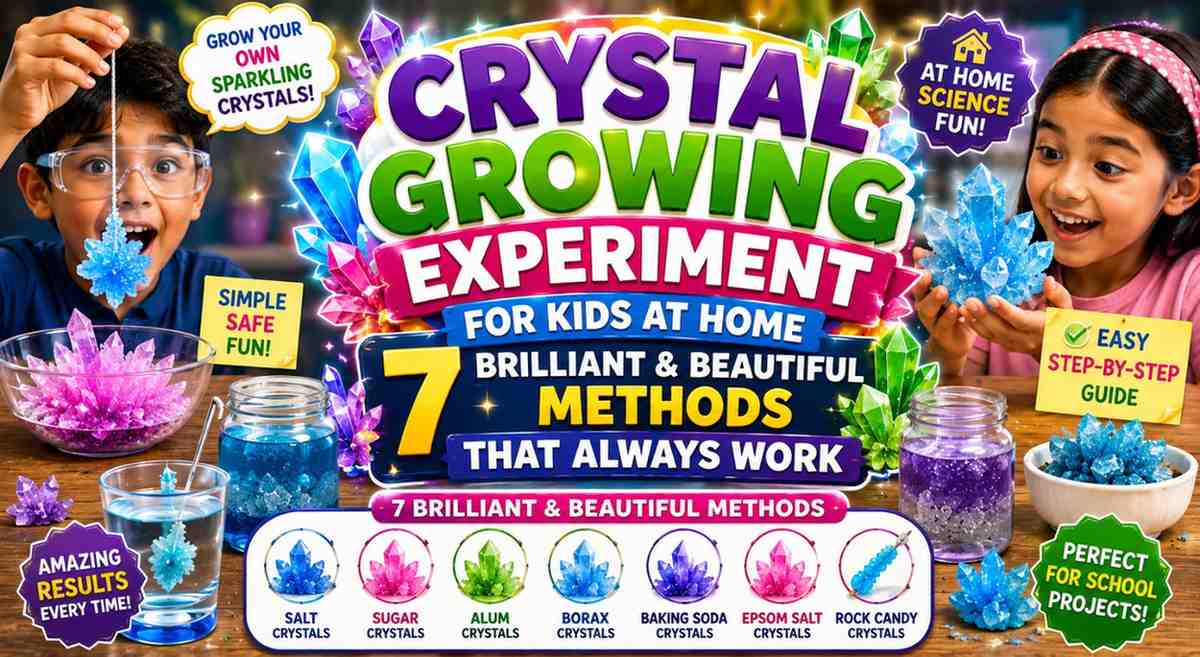
Introduction
There is something almost magical about watching crystals grow. One day you have a jar of cloudy liquid with a string hanging in it. Three days later — sometimes less — that same string is covered in glittering, geometric, perfectly structured crystals that look like they belong in a museum of natural history rather than on your kitchen windowsill.
The crystal growing experiment for kids at home is one of the most rewarding science activities available to young learners precisely because it combines immediate setup excitement with the slow satisfaction of watching something beautiful emerge over days. It teaches patience, careful observation, and the discipline of recording daily changes—habits that are as valuable in science as any specific concept.
But beyond the habits, the crystal-growing experiment for kids at home teaches some genuinely profound chemistry. The process of crystal formation — called crystallization — involves molecules arranging themselves into perfect, repeating three-dimensional structures driven by nothing more than the laws of physics and chemistry. No human hand guides the geometry. No instruction is given. The molecules simply find their most stable arrangement and lock themselves into it, one layer at a time, building structures of extraordinary precision and beauty.
In this complete guide, you will find 7 brilliant, thoroughly tested crystal-growing methods using household and easily available ingredients—from salt and sugar to Epsom salts, alum, and borax—each with full step-by-step instructions, detailed science explanations, expected timelines, and tips for growing the largest, most beautiful crystals possible.
You will also find a complete troubleshooting guide, science fair project ideas, and a thorough FAQ section covering every question parents and teachers most commonly ask about the crystal growing experiment for kids at home.
The Science Behind the Crystal Growing Experiment for Kids at Home
Before exploring the seven methods, understanding the science of crystallization transforms the crystal-growing experiment for kids at home from a waiting game into a genuine scientific investigation.
What Is a Crystal?
A crystal is a solid material in which the atoms, ions, or molecules are arranged in a highly ordered, repeating three-dimensional pattern called a crystal lattice. Every crystal of table salt, for example, is built from sodium ions and chloride ions arranged in a cubic pattern—alternating like a three-dimensional checkerboard. This internal order is what gives crystals their characteristic flat faces, sharp edges, and precise geometric angles.
Different substances crystallize into different geometric structures based on the shape and bonding preferences of their molecules. Salt crystals are cubic. Alum crystals are octahedral (eight-faced). Sugar crystals are monoclinic. Quartz crystals are hexagonal. The external shape of a crystal always reflects the internal arrangement of its molecules—a concept called “crystal symmetry.”
Supersaturation — The Essential Starting Point
Crystal growth from solution always begins with a supersaturated solution—a liquid that contains more dissolved material than it can normally hold at a given temperature.
To understand supersaturation, it helps to understand regular saturation first. When you stir salt into water, the salt dissolves—water molecules surround each sodium and chloride ion and pull them into solution. But there is a limit to how much salt a given amount of water can hold. Once that limit is reached, additional salt simply sinks to the bottom undissolved. This limit is called the saturation point.
Hot water can hold significantly more dissolved material than cold water because heat increases the energy of water molecules, allowing them to interact with and hold more dissolved particles. So if you dissolve a very large amount of salt in hot water — more than cold water could normally hold — and then allow that solution to cool, the water can suddenly no longer hold all the dissolved material. The solution is supersaturated—it contains more dissolved material than it can stably hold.
Nucleation — Where Crystal Growth Begins
In a supersaturated solution, dissolved molecules are actively looking for somewhere to settle. Nucleation is the process by which molecules begin to cluster together and form the first tiny seed of a crystal structure.
Nucleation can happen spontaneously in the liquid (homogeneous nucleation) or — more relevantly for our experiments — on the surface of an object suspended in the solution (heterogeneous nucleation). This is why we use a string, a seed crystal, or a pipe cleaner in most crystal-growing experiments for kids at home. The rough surface of these objects provides nucleation sites — places where the first molecules can attach and begin building the crystal lattice.
Once the first tiny crystal seeds have formed on the string, subsequent molecules find it much easier to attach—they simply join the existing pattern rather than starting a new one. The crystal grows layer by layer, with each new layer following the exact same geometric pattern as the one below it.
The Rate of Growth
Crystal growth rate is controlled by several factors that children can investigate experimentally:
Temperature — Slower cooling produces larger, better-formed crystals. Rapid cooling produces many small crystals rather than a few large ones.
Concentration—More concentrated solutions grow crystals faster but sometimes produce less perfect structures.
Vibration—Disturbance causes new nucleation sites to form, producing many small crystals instead of a few large ones. The best crystals grow in completely undisturbed conditions.
Evaporation — Slower evaporation generally produces larger, better crystals.
Crystal Growing Experiment for Kids at Home — 7 Methods
Method 1: Salt Crystals — Classic and Reliable
Crystal Type: Cubic (perfect cube-shaped crystals) Timeline: Visible growth in 24 hours, impressive results in 3 days Difficulty: Very Easy Age Range: 5 and above
What You Need:
- 1 cup (240ml) water
- 3–4 tablespoons table salt (or more—keep adding until no more dissolves)
- A clean glass jar
- A piece of string or thread (about 15 cm)
- A pencil or chopstick
- A small weight (a paper clip works perfectly)
Step-by-Step Instructions:
Step 1: Heat the water in a saucepan or microwave until nearly boiling. Very hot water is essential — it allows far more salt to dissolve than cold water would.
Step 2: Add salt to the hot water one tablespoon at a time, stirring thoroughly after each addition. Keep adding salt until no more will dissolve — you will see undissolved salt settling on the bottom despite vigorous stirring. This is your supersaturated solution.
Step 3: Allow the solution to cool for 5 minutes, then pour it carefully into the clean glass jar, leaving any undissolved salt behind in the saucepan.
Step 4: Tie one end of the string to the pencil and one end to the paper clip weight. Lay the pencil across the top of the jar so the string hangs down into the solution without touching the sides or bottom.
Step 5: Place the jar in a cool, stable location away from vibration, direct sunlight, and temperature fluctuations. Do not move it.
Step 6: Check daily. Within 24 hours you should see tiny cubic crystals forming on the string. By Day 3, the crystals will be clearly visible and beautifully formed. Leave for up to 7 days for truly impressive results.
Step 7: When satisfied with the crystal size, remove the string carefully and allow the crystals to dry on a paper towel. They can be kept indefinitely as long as they are kept dry.
Tips for Larger Crystals:
- Use distilled water rather than tap water — tap water contains minerals that can interfere with crystal formation.
- Keep the jar in the coolest part of your home—slower evaporation and cooling produce larger crystals.
- If many tiny crystals form everywhere rather than on the string, your solution may have cooled too slowly or been disturbed. Start again with a fresh solution.
Method 2: Sugar Crystals — Rock Candy on a Stick
Crystal Type: Monoclinic (elongated, faceted crystals) Timeline: 7–14 days for impressive results Difficulty: Easy Age Range: 6 and above
What You Need:
- 2 cups (480ml) water
- 4 cups (800g) white granulated sugar
- Wooden skewers or craft sticks
- Tall, clean glass jars (one per skewer)
- Food coloring and flavoring extract (optional)
- Clothespins to hold skewers in place
Step-by-Step Instructions:
Step 1: The night before, prepare your skewers. Wet each skewer with water, then roll it in granulated sugar. Allow it to dry overnight completely. This coats the skewer with sugar seed crystals that will encourage faster nucleation.
Step 2: Bring water to a boil in a saucepan. Add sugar gradually—about 1/2 cup at a time—stirring thoroughly between additions. The solution will be very concentrated. Keep adding sugar until you have added all 4 cups. The result should be a thick, clear syrup.
Step 3: Remove from heat. Add food coloring and flavoring if desired. Allow to cool for 10–15 minutes—not fully, just enough that it will not crack glass jars.
Step 4: Pour the syrup into glass jars. Clip a sugar-coated skewer to a clothespin and balance it across the jar opening so the skewer hangs in the center of the syrup without touching the sides or bottom.
Step 5: Place jars in a cool, undisturbed location. Loosely cover the top with a paper towel to slow evaporation while still allowing some evaporation to occur.
Step 6: Check daily. If a crust forms on the surface, carefully break it with a spoon to allow evaporation to continue. After 7–14 days, remove the skewers and allow to dry.
The Result: Genuine rock candy — edible, beautiful, crystal-covered sticks that demonstrate the same crystallization process as geologically formed crystals. This is one of the most satisfying crystal-growing experiments for kids at home because the product is both scientifically impressive and delicious.
Method 3: Alum Crystals — The Fastest and Most Beautiful
Crystal Type: Octahedral (eight-faced, jewel-like crystals) Timeline: Visible growth in 12 hours, large crystals in 3 days Difficulty: Easy Age Range: 7 and above
What You Need:
- 1 cup (240ml) hot water
- 2–3 tablespoons alum powder (potassium aluminum sulfate — available at pharmacies and grocery stores in the spice or canning section)
- A clean glass jar
- A string and pencil
- Optional: a small seed crystal grown from an initial batch
Step-by-Step Instructions:
Step 1: Dissolve as much alum as possible in hot water — typically 2–3 tablespoons per cup. The solution will look clear when all alum is dissolved.
Step 2: Pour into a clean jar and allow to cool undisturbed for 12–24 hours. Small alum crystals will form on the bottom of the jar.
Step 3: For large single crystals—carefully select the largest, most perfectly formed crystal from the bottom of the jar. This becomes your seed crystal. Tie it to a thread with a small loop.
Step 4: Make a fresh batch of alum solution. Allow to cool slightly, then suspend your seed crystal in it using the thread and pencil method.
Step 5: Place in a cool, completely undisturbed location. Check every 12 hours. Alum crystals grow significantly faster than salt crystals—within 3 days you can grow a crystal the size of a marble.
Why Alum is Special: Alum crystals grow into perfect octahedral shapes — eight triangular faces meeting at precise angles that look extraordinarily like cut gemstones. When held up to light, a large alum crystal refracts light in genuinely beautiful ways. Alum crystals are among the most impressive results of any crystal-growing experiment for kids at home.
Method 4: Epsom Salt Crystal Needles — Overnight Results
Crystal Type: Orthorhombic (long needle-like crystals) Timeline: Visible results in 3–6 hours, complete growth overnight Difficulty: Very Easy Age Range: 5 and above
What You Need:
- 1/2 cup (120ml) hot water
- 1/2 cup (100g) Epsom salts (magnesium sulfate — available at pharmacies)
- A shallow dish or plate
- Food coloring (optional)
Step-by-Step Instructions:
Step 1: Dissolve Epsom salts completely in very hot water. Add food coloring if desired.
Step 2: Pour a thin layer of the solution into the shallow dish — just enough to cover the bottom.
Step 3: Place the dish in the refrigerator or in a warm spot near a sunny window—both work but produce different results.
Step 4: Do not disturb. Check after 3–6 hours.
Step 5: In the refrigerator, the solution cools rapidly and forms a dense mat of long, thin crystal needles covering the entire dish. Near a window, the solution evaporates and forms larger but more scattered crystals.
The Science Difference: Refrigerator growth demonstrates rapid cooling crystallization — many nucleation sites form simultaneously, producing many small crystals. Window evaporation demonstrates slow evaporation crystallization—fewer nucleation sites and larger individual crystals. Comparing the two side by side makes a perfect controlled experiment for the crystal growing experiment for kids at home.
Method 5: Borax Crystal Snowflakes — Festive and Spectacular
Crystal Type: Monoclinic (clustered, fuzzy-looking crystals) Timeline: Overnight (8–12 hours) Difficulty: Easy Age Range: 7 and above (adult supervision for hot water)
What You Need:
- 3 cups (720 ml) boiling water
- 9 tablespoons borax powder (available in the laundry aisle)
- White pipe cleaners
- String and pencil
- A wide-mouthed glass jar or large bowl
- Blue food coloring (optional — makes beautiful ice-blue snowflakes)
Step-by-Step Instructions:
Step 1: Shape white pipe cleaners into a snowflake shape — three pipe cleaner segments twisted together in the center and bent into six equal arms. Make the snowflake small enough to fit inside your jar without touching the sides.
Step 2: Tie a string to the top of the snowflake and attach it to a pencil so it can be suspended in the jar.
Step 3: Boil water and carefully dissolve 3 tablespoons of borax per cup of water (9 tablespoons total for 3 cups). Stir until completely dissolved. Add blue food coloring if desired.
Step 4: Pour the hot borax solution into the jar. Immediately suspend the pipe cleaner snowflake in the solution so it is completely submerged and not touching the jar’s sides.
Step 5: Leave completely undisturbed overnight — do not check until the next morning.
Step 6: In the morning, remove the snowflake carefully. Every surface of every pipe cleaner arm will be completely covered in a thick coat of sparkling borax crystals—transforming the pipe cleaner into a glittering crystal snowflake.
Display: These crystal snowflakes can be hung as ornaments, used as decorations, or displayed under a magnifying glass to see the individual crystal structures. They are one of the most visually dramatic results of any crystal growing experiment for kids at home and make beautiful gifts.
Method 6: Charcoal Crystal Garden — Surreal and Colorful
Crystal Type: Various—grows on porous surfaces Timeline: 24–48 hours Difficulty: Easy Age Range: 6 and above
What You Need:
- Charcoal briquettes or porous rocks
- 4 tablespoons table salt
- 4 tablespoons liquid bluing (Mrs. Stewart’s Liquid Bluing — available online or in laundry sections)
- 4 tablespoons water
- 1 tablespoon ammonia (optional — speeds growth but requires ventilation)
- Food coloring in multiple colors
- A shallow dish
Step-by-Step Instructions:
Step 1: Arrange charcoal briquettes in the shallow dish.
Step 2: Mix together salt, liquid bluing, and water. Add ammonia if using—ensure good ventilation.
Step 3: Pour the mixture over the charcoal pieces, distributing evenly.
Step 4: Drop several drops of different food colors onto different areas of the charcoal.
Step 5: Leave undisturbed in a location with good air circulation.
Step 6: Within 24 hours, colorful, delicate, feathery crystal structures will begin emerging from the charcoal—growing upward in remarkable formations. The result looks more like a coral reef or alien landscape than a kitchen experiment.
The Science: Liquid bluing contains very fine iron particles suspended in water. As the water evaporates through the porous charcoal by capillary action, salt crystallizes on the iron particles—which act as nucleation sites—creating elaborate branching crystal formations. The food coloring is drawn up with the liquid and colors different crystal clusters, producing a genuinely surreal and beautiful result.
Method 7: Seed Crystal Method — Growing One Perfect Giant Crystal
Crystal Type: Depends on chosen material — salt, alum, or sugar Timeline: 2–4 weeks for truly impressive results Difficulty: Moderate Age Range: 9 and above
This advanced method produces a single, large, perfectly formed crystal rather than a cluster—the type of specimen you would see in a geology museum.
Step-by-Step Instructions:
Stage 1 — Grow Seed Crystals (Day 1–3): Make a saturated solution of your chosen material (alum works best for large single crystals). Pour into a shallow dish and leave undisturbed for 24–48 hours. Small crystals will form. Select the largest, most perfectly symmetrical crystal — this is your seed.
Stage 2 — Prepare the Seed Crystal (Day 3): Tie a fine thread around your seed crystal very carefully. This is delicate work—alum crystals in particular can be fragile at small sizes. Alternatively, use a drop of clear nail polish to attach the crystal to the thread.
Stage 3—Grow the Large Crystal (Days 3–28): Make a fresh, slightly less concentrated solution of the same material—slightly undersaturated solutions prevent new nucleation sites from forming while allowing the existing seed crystal to grow. Suspend the seed crystal in the center of this solution.
Stage 4 — Maintenance: Check every 2–3 days. If other crystals begin forming on the thread above the seed crystal, remove them carefully. Replace the solution every 5–7 days with fresh, slightly undersaturated solution. Keep in a completely undisturbed, cool location.
The Result: After 2–4 weeks, you will have a single crystal of remarkable size and clarity—sometimes reaching 3–5 cm for alum and clearly displaying perfect geometric faces. This is the same method used by research scientists and gemologists to grow perfect crystals for industrial and scientific use.
Comparing Results — Which Method Grows the Best Crystals?
One of the most valuable extensions of the crystal growing experiment for kids at home is a systematic comparison of different methods or materials. Here is what to expect from each:
Salt crystals produce reliable cubic forms—recognizable and geometric but relatively small. Best for beginners and young children.
Sugar crystals (rock candy) take the longest but produce beautiful edible results—excellent for patience development and the most rewarding to taste.
Alum crystals produce the most jewel-like octahedral forms and grow relatively quickly—the best choice for visually impressive standalone crystals.
Epsom salt produces results fastest and demonstrates needle crystal morphology—excellent for overnight projects.
Borax snowflakes produce the most dramatic and decorative result—best for display and gifting.
Charcoal crystal garden produces the most surreal and artistic result—least geometric but most visually complex.
The seed crystal method produces the most scientifically impressive single specimen—best for older children and science fair projects.
Tips for Growing the Largest, Most Beautiful Crystals
Getting the best results from the crystal growing experiment for kids at home consistently comes down to these key principles.
Use the hottest water possible when making your initial solution—hot water dissolves significantly more material, creating a more concentrated supersaturated solution that drives faster and larger crystal growth.
Filter your solution before pouring it into the growing jar—pour it through a coffee filter to remove any undissolved particles or impurities that could create unwanted nucleation sites and disrupt crystal geometry.
Minimize vibration absolutely — even minor vibrations from nearby traffic, appliances, or footsteps can trigger new nucleation sites throughout the solution, producing many small crystals rather than a few large ones. The best crystal-growing location is a high shelf away from windows, air conditioning vents, and foot traffic.
Never disturb the solution by stirring, touching, or moving the jar during crystal growth. Patience is not just a virtue in crystal growing—it is a scientific necessity.
Cover loosely but do not seal—some evaporation is needed to drive crystal growth, but covering with a paper towel reduces evaporation rate and produces slower, larger, better-formed crystals.
Crystal Growing as a Science Fair Project
The crystal-growing experiment for kids at home has exceptional potential as a school science fair project. Here are the most effective approaches.
Research Question Examples:
- Which dissolved material (salt, sugar, alum, Epsom salt) produces the largest crystals in 7 days?
- Does water temperature at the start of growth affect final crystal size?
- Does vibration during growth affect crystal size and quality?
- How does the concentration of solution affect crystal growth rate?
- Does the material the seed is attached to (thread, string, pipe cleaner) affect crystal formation?
Measuring Results: Use a ruler to measure crystal length and width. Use a magnifying glass or smartphone macro photograph to compare crystal geometry. Weigh the crystal cluster on a kitchen scale before and after growth. Record all observations in a dated journal with photographs.
Presenting Findings: Display the actual crystals alongside your data table and graphs. Include photographs taken at 24-hour intervals to show growth progression. A poster that includes the science of supersaturation and nucleation alongside your experimental results demonstrates genuine scientific understanding that impresses judges consistently.
For additional guidance on crystal science and mineralogy for young learners, the Mineralogical Society of America’s educational resources provide excellent reference material.
Frequently Asked Questions (FAQ)
Q1: How long does the crystal growing experiment for kids at home take to show results? It depends on the material. Epsom salt crystals show results in 3–6 hours. Borax snowflakes grow overnight. Salt and alum crystals show clear results in 24–48 hours and become impressive within 3 days. Sugar rock candy requires 7–14 days. The seed crystal method for a single large crystal takes 2–4 weeks.
Q2: Why did my crystals not grow? The most common reasons are an insufficiently concentrated solution, disturbance during growth, or impure water. Ensure you dissolved as much material as physically possible in the hottest water available. Use distilled water if tap water is producing poor results. Keep the growing container completely undisturbed.
Q3: Why did my crystals turn out small and powdery instead of large and geometric? Rapid cooling or high vibration causes many nucleation sites to form simultaneously, producing many small crystals rather than a few large ones. Cool your solution more slowly, keep it in the most undisturbed location available, and consider filtering before pouring into the growing jar.
Q4: Can crystal-growing experiments be done with colored crystals? Yes—food coloring can be added to the solution before growing to produce colored crystals. The color is incorporated into the crystal structure as it grows. Blue and green food coloring works particularly well. Some materials, like copper sulfate (for older children with adult supervision), produce naturally vivid blue crystals without any added coloring.
Q5: Are borax crystals safe for children? Borax is not acutely toxic but can cause skin and eye irritation with prolonged contact. The borax snowflake method requires hot water—adult supervision is essential. Once the crystals are grown and dry, they are safe to handle briefly. Wash hands after handling. Borax crystals should not be ingested. For younger children, stick to salt, sugar, alum, or Epsom salt methods.
Q6: How do I keep my crystals from dissolving? Crystals dissolve when exposed to water or high humidity. Store finished crystals in a dry location. Seal them with a thin coat of clear nail polish or craft varnish to protect them from humidity and make them permanent display pieces. Avoid storing in bathrooms or near kitchen steam.
Q7: What is the difference between a crystal and a mineral? All minerals are crystalline — they are defined by their crystal structure. But not all crystals are minerals—sugar crystals, salt crystals, and Epsom salt crystals are all laboratory-grown or food-grade crystalline materials. Minerals are naturally occurring crystalline solids found in the Earth’s crust. The crystal-growing experiment for kids at home produces the same types of structures as natural minerals—just from a solution rather than from geological processes.
Q8: Can I speed up crystal growth? Yes — warmer growing temperatures and higher solution concentrations speed up growth. However, faster growth generally produces less perfect, smaller crystals. The largest, most geometrically perfect crystals always grow slowly in cool, undisturbed conditions. This trade-off between speed and quality is itself an excellent subject for scientific investigation.
Conclusion
The crystal-growing experiment for kids at home is unique among science activities in the way it combines immediate excitement with sustained, daily discovery. The setup takes minutes. The anticipation builds over hours. The reward emerges over days, growing more beautiful, more detailed, and more impressive with each passing observation.
But beyond the beauty and the patience it develops, the crystal-growing experiment for kids at home teaches something genuinely profound about the natural world. Crystals are not made — they grow. They grow because molecules follow laws of physics and chemistry so precise and so reliable that they produce the same geometric structures every time, from every batch, in every kitchen, in every corner of the world.
A child who grows a perfect octahedral alum crystal in their kitchen has witnessed the same molecular forces that built the quartz crystals in mountain ranges, the salt crystals in ancient seabeds, and the diamond crystals deep in the Earth’s mantle. The scale is different. The geological time is different. But the chemistry — the beautiful, orderly, inevitable chemistry — is exactly the same.
That connection between a jar on a kitchen shelf and the geology of the planet is what makes the crystal growing experiment for kids at home one of the most quietly profound science experiences available to a curious child.
So heat the water, dissolve the salt, hang the string, and wait. Something extraordinary is about to grow — one molecule at a time.
External Resource (DoFollow): For mineralogy education resources, crystal structure explanations, and geology guides for young learners, visit the Mineralogical Society of America’s Educational Resources—a free, authoritative reference for crystal science education.