 creator@scienceexplore.site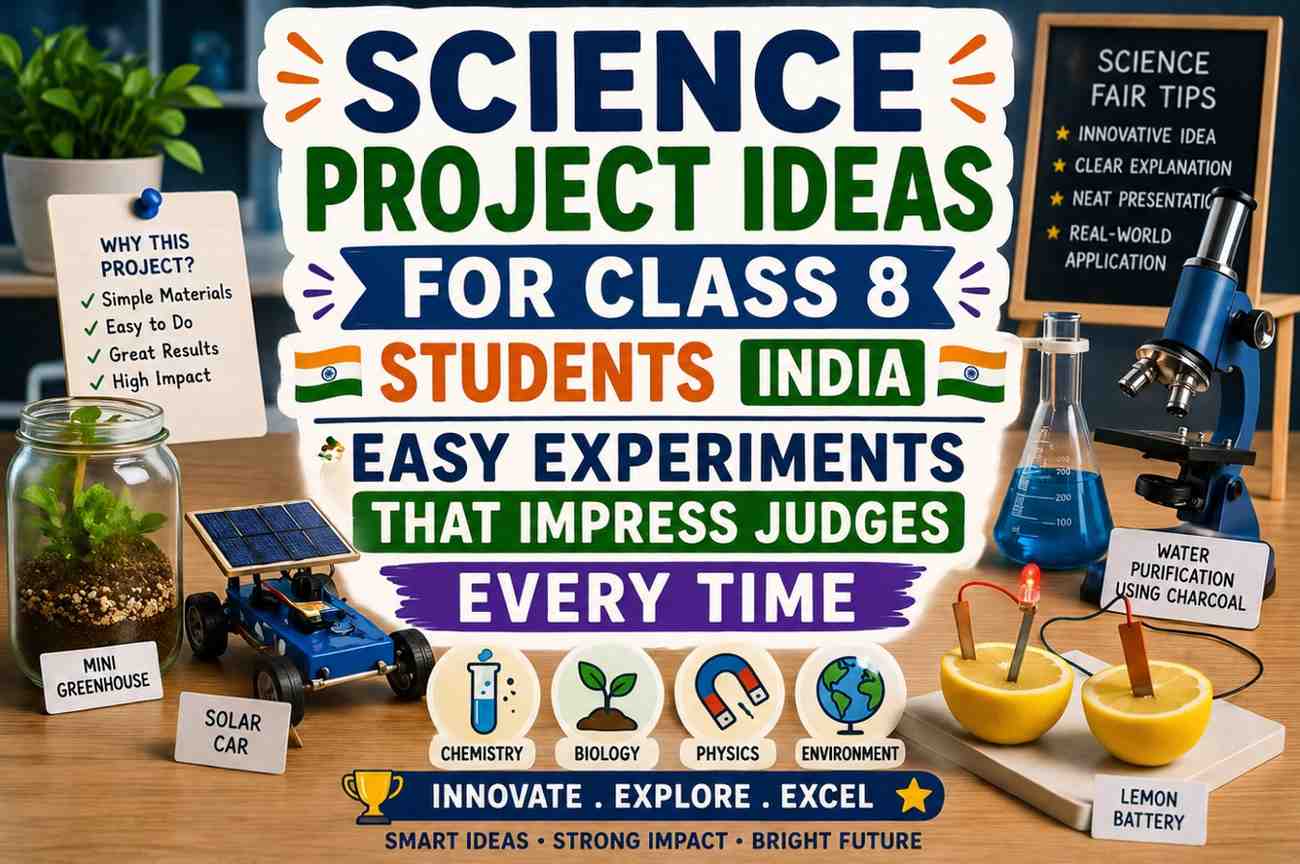
Introduction: Why Class 8 Science Projects Are a Game-Changer
Finding the right science project ideas for class 8 students in India can make all the difference between a forgettable display and a first-place ribbon.
Class 8 in India marks a critical stage in science education. The NCERT syllabus introduces students to force and pressure, microorganisms, combustion, cell biology, and light — all of which are goldmines of science fair project inspiration.
But the challenge many students face is moving from knowing the theory to demonstrating it in a way that impresses both teachers and external judges. This guide solves exactly that problem. You’ll find 12 well-researched, low-cost, and surprisingly impressive science project ideas for class 8 students in India—with full instructions and judge-ready presentation tips.
What Makes a Class 8 Science Project Stand Out in India?
Science fairs in Indian schools — whether CBSE, ICSE, or state board — typically judge projects on the following criteria: relevance to the syllabus, scientific accuracy, originality of approach, quality of the working model or experiment, and the student’s ability to explain the project in Hindi or English clearly.
Projects that tie directly to real-world Indian issues — like water scarcity, agricultural science, or renewable energy — tend to receive particularly high scores from judges.
12 Outstanding Science Project Ideas for Class 8 Students India
1. Working Model of a Biogas Plant Difficulty: Medium | Time: 1 weekend | Syllabus Link: Microorganisms, Fuels
Biogas production is one of the most relevant science project ideas for class 8 students. India given the country’s agricultural context. Build a small model using two plastic bottles connected by a tube. Add kitchen waste and water to the first bottle, seal it tightly, and run the output tube into water. Bubbles of methane gas will appear within 3–5 days as anaerobic bacteria decompose the waste. Students demonstrate microorganism activity, alternative fuel production, and environmental science in one powerful model.
2. Friction and Surface Texture Experiment Difficulty: Easy | Time: 2–3 hours | Syllabus Link: Force and Pressure
Attach a spring balance to a wooden block. Drag the block across surfaces of different textures: smooth tile, rough sandpaper, cloth, and a wooden plank. Record the force reading from the spring balance on each surface. Plot the results on a bar graph. This simple, quantitative experiment clearly demonstrates how surface texture affects frictional force—a key class 8 physics concept.
3. Homemade Periscope Difficulty: Easy | Time: 2 hours | Syllabus Link: Light
Build a periscope using a long cardboard box and two small mirrors placed at 45-degree angles at opposite ends. Students can use it to see around corners and over obstacles. This project elegantly demonstrates the laws of reflection in a working instrument that has real-world military and submarine applications — a fact judges always find impressive.
4. Electrolysis of Water Difficulty: Medium | Time: 3 hours | Syllabus Link: Combustion and Fuels
Connect two pencils (acting as electrodes) to a 9V battery and submerge them in saltwater. Bubbles of hydrogen gas will appear at one electrode and oxygen at the other. Collect each gas separately using inverted test tubes or cups filled with water. Test hydrogen by bringing a lit matchstick near it—it will pop. This is one of the most visually impressive science project ideas for class 8 students in India when it comes to demonstrating clean energy concepts.
5. Water Quality Testing Kit Difficulty: Medium | Time: 1 day | Syllabus Link: Conservation of Plants and Animals, Microorganisms
Collect water samples from different sources: tap water, river water, borewell water, and stagnant pond water. Test each sample for pH using litmus paper, turbidity by viewing through a clear bottle against a page of print, and hardness using soap—hard water produces little lather. Chart your results and discuss water safety. Given India’s water quality challenges, this project resonates powerfully with judges.
6. Model of the Human Eye Difficulty: Medium | Time: 4 hours | Syllabus Link: Light
Build a model eye using a clear round fish bowl filled with water as the vitreous humor, a convex lens as the eye lens, and white paper on the opposite side as the retina. Shine a torch through the lens and observe the focused image formed on the “retina.” Students learn about refraction, focal length, and the optical mechanism of human vision in a tactile, memorable way.
7. Combustion and Fire Triangle Demonstration Difficulty: Medium | Time: 2 hours | Syllabus Link: Combustion and Flame
Set up three identical candles. Extinguish one by removing fuel (blowing it out). Extinguish the second by removing oxygen (covering it with a glass jar). Leave the third burning to demonstrate all three components of the fire triangle—fuel, heat, and oxygen—in action. This is a safe, simple, and scientifically precise class 8 project that directly addresses NCERT combustion concepts.
8. Seed Germination Under Different Soil Types Difficulty: Easy | Time: 10 days | Syllabus Link: Crop Production and Management
Plant identical seeds in pots containing black soil, sandy soil, clay soil, and a commercial potting mix. Water equally and record germination time and plant height every two days for ten days. This directly connects to India’s agricultural context and the class 8 chapter on crop production—making it both academically relevant and socially meaningful.
9. Working Model of a Hand Pump Difficulty: Medium-Hard | Time: 1 weekend | Syllabus Link: Force and Pressure
Build a functional hand pump model using PVC pipes, a syringe, valves made from balloons, and a small water container. Demonstrate how the up-and-down motion of the handle creates pressure differences that draw water upward. Given that hand pumps are still widely used across rural India, this model connects science to real daily life—which judges in India specifically appreciate.
10. Effect of Acid Rain on Plants Difficulty: Easy | Time: 1 week | Syllabus Link: Pollution
Prepare a dilute solution of vinegar in water to simulate acid rain. Water one set of plants with this solution and another set with plain water under identical conditions. Photograph and measure both sets every two days. This experiment demonstrates pollution effects on agriculture—an urgent environmental topic highly valued at Indian school science fairs.
11. Model Lung With a Balloon Difficulty: Easy | Time: 1–2 hours | Syllabus Link: Cell Structure and Functions
Insert two small balloons into the bottom of a cut plastic bottle through a straw Y-junction to represent the two lungs. Seal the bottom with a large balloon stretched over it to represent the diaphragm. Pull the bottom balloon down—the “lungs” inflate. Push it up—they deflate. This working model of breathing mechanics is simple, cheap, and brilliantly effective.
12. Noise Pollution Meter Using a Smartphone Difficulty: Easy | Time: 2–3 hours | Syllabus Link: Sound and Pollution
Download a free decibel meter app on a smartphone. Measure sound levels at different locations in and around the school: classroom, canteen, main road, library, and sports field. Record results on a chart and compare them to safe noise level standards (below 60 dB for residential areas in India as per CPCB guidelines). This tech-integrated project feels modern, relevant, and impactful.
Presentation Tips for Indian Science Fairs
When presenting science project ideas for class 8 students in India at a school or district-level fair, follow these proven strategies.
Prepare a bilingual display board in Hindi and English if your school permits it—it shows confidence and cultural awareness. Memorize three key facts about your project’s real-world relevance in India. Be ready to answer the classic judge question: “How does your project help society?” Prepare your answer before the day arrives.
For curriculum alignment and more project ideas, the NCERT Science textbook portal is an excellent official resource to reference in your project background section.
How to Form a Hypothesis for Class 8
At the class 8 level, your hypothesis should be specific and measurable. Avoid vague guesses like “plants will grow better.” Instead, write: “If plants are watered with a 5% vinegar solution simulating acid rain, then they will show reduced leaf area by at least 30% within 7 days compared to control plants watered with plain water.”
This level of precision signals scientific maturity and earns significant marks from experienced judges.
Frequently Asked Questions
Q: What are the easiest science project ideas for class 8 students in India that can be done at home? A: The friction experiment, noise pollution meter, seed germination test, acid rain effect, and model lung are all easy to do entirely at home with materials costing under ₹200 total.
Q: Do class 8 science projects in India need to be working models, or can they be charts? A: Working models always score higher than charts at competitive fairs. However, a well-designed chart or poster with real experimental data is acceptable for class-level assessments.
Q: How do I connect my science project to the NCERT class 8 syllabus? A: Each chapter in the class 8 NCERT book has a practical applications section. Choose a project that demonstrates one of those applications directly. The friction, combustion, light, and microorganism chapters are especially project-rich.
Q: Can two students work on the same science fair project together? A: This depends on your school’s rules. Many schools allow pairs for district-level fairs. If allowed, divide the work clearly — one student builds the model, the other compiles and presents the data.
Q: What is the ideal size and layout for a class 8 science fair display board? A: A standard trifold board measuring approximately 90 cm × 120 cm works well. Include your title at the top in large text, then clearly labeled sections: Aim, Materials, Procedure, Observations, Results, Conclusion, and Bibliography.
Related Articles
- Best Science Fair Projects for Class 5 Students — 15 Award-Winning Ideas
- Working Model Science Project Ideas for Kids 2026 — 12 Weekend Builds
- Simple Machine Science Project for Kids Class 6 — Full Guide
Conclusion
The right science project ideas for class 8 students in India are those that combine scientific accuracy, real-world relevance, and a student’s genuine curiosity. Whether you choose to demonstrate biogas production, build a working periscope, or map noise pollution around your school, the key is to follow the scientific method rigorously and present your findings with confidence.
India’s young scientists are solving tomorrow’s problems today. Your Class 8 science fair project is not just a school assignment—it’s your first real experiment in changing the world.
Start building. Start experimenting. Start discovering. 🇮🇳🔬