 creator@scienceexplore.site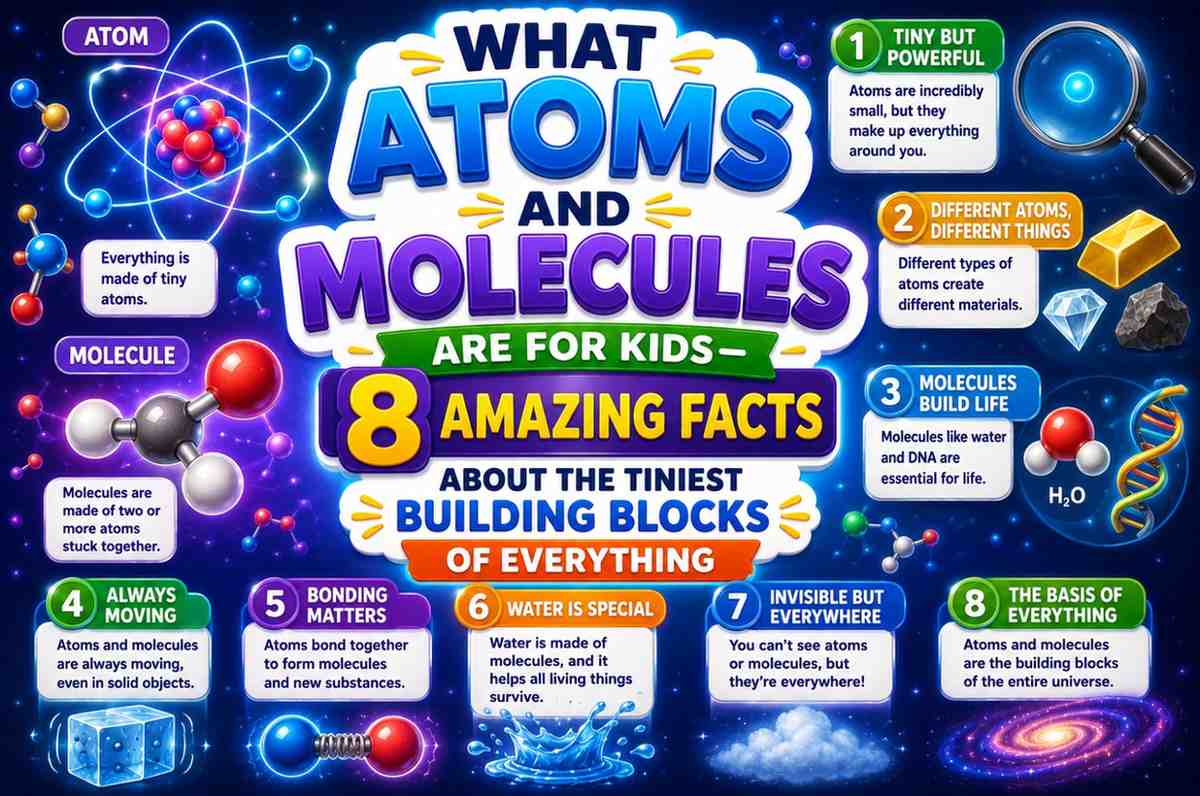
Everything you can see, touch, taste, and smell — your chair, the air, a glass of water, even your own body — is made of incredibly tiny particles called atoms. And when atoms join together, they form molecules. Understanding what atoms and molecules are for kids is one of the most exciting doorways into chemistry and physics.
In this guide, we will explore what atoms are, what molecules are, how they combine to make everything in the universe, and 8 fascinating facts that will absolutely blow your mind. Let us begin!
What Are Atoms? The Simplest Explanation for Kids
An atom is the smallest unit of an element that still has the properties of that element. Think of atoms as the ultimate LEGO bricks of the universe—everything is built from them!
Atoms are so incredibly tiny that you cannot see them with the naked eye—or even with most microscopes. About 10 million atoms could fit side by side across the width of a single human hair!
Every atom has three main parts:
- Protons—positively charged particles found in the nucleus (center) of the atom.
- Neutrons — particles with no charge, also found in the nucleus.
- Electrons — negatively charged particles that orbit around the nucleus in a cloud at incredible speed.
What Are Molecules? How Atoms Join Together
When two or more atoms join together through a chemical bond, they form a molecule. Molecules are the smallest unit of a compound that retains all the properties of that compound.
Some famous molecules that students in class 3, 4, and 5 should know:
- Water (H₂O) — two hydrogen atoms joined to one oxygen atom.
- Carbon dioxide (CO₂) — one carbon atom joined to two oxygen atoms.
- Oxygen gas (O₂) — two oxygen atoms joined together (the oxygen we breathe!).
- Table salt (NaCl) — one sodium atom joined to one chlorine atom.
These examples make what atoms and molecules are for kids wonderfully concrete and connected to real life.
8 Amazing Facts About Atoms and Molecules for Kids
Fact 1 — Atoms Are Mostly Empty Space: If an atom were the size of a football stadium, the nucleus would be a marble in the center, and the electrons would be invisible dots flying around the outer walls. Atoms are almost entirely empty space!
Fact 2 — 118 Known Elements: There are 118 known elements, each made of a unique type of atom. These are all listed on the periodic table of elements—one of the most important tools in all of science.
Fact 3 — Atoms Are Never Created or Destroyed: In chemical reactions, atoms cannot be created or destroyed—they are just rearranged into new molecules. This is known as the Law of Conservation of Mass.
Fact 4 — You Are Made of Stardust: The atoms in your body were forged inside stars billions of years ago. When those stars exploded as supernovas, they scattered atoms across space — atoms that eventually formed planets, oceans, and you!
Fact 5 — Atomic Number = Protons: Different elements have different numbers of protons. Hydrogen has 1, carbon has 6, oxygen has 8, and gold has 79. The number of protons is called the atomic number and defines what element an atom is.
Fact 6 — Molecules Are Always Moving: Molecules move—all the time! In a gas, molecules zoom around at very high speeds. In a liquid, they slide past each other. In a solid, they vibrate in place. This motion is directly related to temperature.
Fact 7 — Your Body Contains 7 Octillion Atoms: The human body contains an estimated 7,000,000,000,000,000,000,000,000,000 (7 octillion) atoms. Most of them are hydrogen, oxygen, and carbon.
Fact 8 — Scientists Can Now Photograph Atoms: Scientists can now photograph individual atoms using advanced electron microscopes. The first photograph of a single atom was taken in 2012 by Australian scientists — a milestone in the history of science!
How Do Atoms Form Different Materials?
The same atoms can form very different materials depending on how they are arranged. Carbon atoms arranged one way form soft, slippery graphite (pencil lead). Arranged differently, the same carbon atoms form diamond, the hardest natural material on Earth!
This amazing property is a key insight into what atoms and molecules are for kids—it shows that it is not just which atoms are present, but how they are arranged, that determines the properties of a material.
Elements and the Periodic Table — A Quick Guide for Kids
An element is a pure substance made of only one type of atom.
- Gold is made only of gold atoms.
- Iron is made only of iron atoms.
- Oxygen is made only of oxygen atoms.
All known elements are organized on the Periodic Table of Elements, one of the most important tools in chemistry. Elements are arranged by their atomic number (number of protons) and grouped by their properties.
The Periodic Table currently contains 118 confirmed elements—from Hydrogen (the lightest and most abundant) to Oganesson (the heaviest currently known, created artificially in a lab).
Atoms in Everyday Life — Real-World Connections
| Molecule | Made Of | Where Found |
|---|---|---|
| Water (H₂O) | 2 Hydrogen + 1 Oxygen | Oceans, rivers, rain, your body |
| Carbon dioxide (CO₂) | 1 Carbon + 2 Oxygen | Air, fizzy drinks, plant food |
| Glucose (C₆H₁₂O₆) | Carbon, hydrogen, and Oxygen | Sugar, fruit, bread |
| Salt (NaCl) | 1 Sodium + 1 Chlorine | Table salt, seawater |
| Oxygen (O₂) | 2 Oxygen atoms | The air we breathe |
External Resource — Atoms and Molecules for Kids
For brilliant animations and interactive content on atoms and molecules, explore:
🔗 Chem4Kids — Atoms and Elements (DoFollow)
Also read our main guide on Basic Science Facts for Kids Class 3, 4, 5, which includes 50 amazing facts covering chemistry, physics, biology, and much more.
Frequently Asked Questions (FAQ)
Q1. What is an atom in simple words?
An atom is the smallest piece of an element that still has the properties of that element. It is made of protons and neutrons in a central nucleus, with electrons orbiting around the outside.
Q2. What is the difference between an atom and a molecule?
An atom is a single building block of an element. A molecule is formed when two or more atoms join together. Water (H₂O) is a molecule made of two hydrogen atoms and one oxygen atom.
Q3. Can we see atoms with our eyes?
No — atoms are far too small to be seen by the naked eye. Even the most powerful ordinary microscopes cannot show individual atoms. Special electron microscopes are needed, and they have only recently captured images of single atoms.
Q4. How many types of atoms are there?
There are 118 known types of atoms, each corresponding to a different element on the Periodic Table. Elements range from hydrogen (the lightest) to oganesson (the heaviest currently known).
Q5. What holds atoms together in a molecule?
Atoms are held together in molecules by chemical bonds. The two main types are covalent bonds (where atoms share electrons) and ionic bonds (where atoms transfer electrons to each other).
Conclusion
Now you have a brilliant understanding of what are atoms and molecules are for kids! From the tiny protons in a nucleus to the enormous molecules that make up our DNA, the atomic world is endlessly fascinating.
Everything in the entire universe — every star, every planet, every living thing, every drop of water — is made of atoms. You are made of atoms. The book you are reading is made of atoms. Even the air around you right now is made of atoms, constantly buzzing and moving.
Understanding atoms and molecules is the very foundation of chemistry, biology, and physics. And now that you know the basics, the door to all of science is wide open for you. Keep exploring!