 creator@scienceexplore.site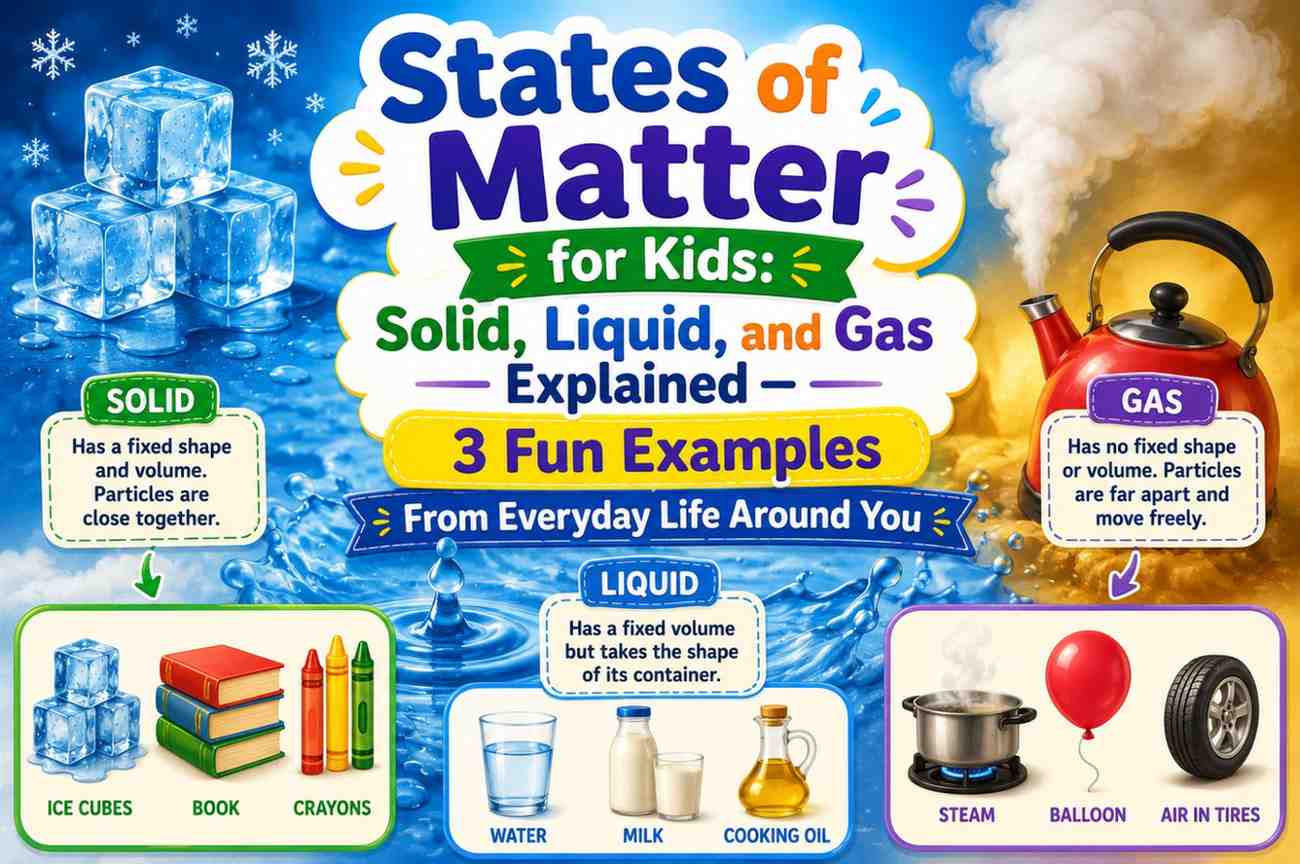
Look around you right now. Everything you can see — your desk, the water in your bottle, the air you breathe — is made of matter. And all matter exists in one of three main forms called states. States of matter for kids: solid, liquid, and gas explained is one of the most fundamental topics in class 3, 4, and 5 science, and it is actually very simple once you know how to look for it in everyday life.
In this guide, we will explore each state of matter, explain what makes each one different, and show you brilliant real-world examples that you see and use every day.
What Is Matter? A Simple Explanation for Kids
Matter is anything that takes up space and has mass (weight). That means solids, liquids, and gases are all forms of matter. Even the air around you—which you cannot see—is made of matter!
Matter is made of tiny particles called atoms and molecules. The way these particles are arranged and how they move determines which state of matter something is in.
States of Matter for Kids Explained — What Is a Solid?
A solid is a state of matter where particles are packed very closely together and held firmly in place. Solids have a definite shape and a definite volume — they do not flow or spread out.
Everyday examples of solids you can find right now:
- Your pencil — it stays the same shape no matter where you put it.
- A wooden table is firm and rigid and does not change shape.
- Ice cubes — water frozen into solid form.
- A brick—particles packed tightly together.
In a solid, the particles vibrate in place but do not move around. That is what makes a solid form and keeps its shape. This is a key part of states of matter for kids, explained.
What Is a Liquid? Understanding the Second State of Matter
A liquid is a state of matter where particles are close together but can flow and move past each other. Liquids have a definite volume but NOT a definite shape—they take the shape of whatever container they are poured into.
Everyday examples of liquids:
- Water in your glass — it takes the shape of the glass.
- Milk in a jug — flows freely and takes any shape.
- Orange juice — pours, flows, and fills any container.
- Honey — a liquid, but a very thick (viscous) one that flows slowly.
Pour water into a round bowl, and it becomes round. Pour it into a square container, and it becomes square. That is what makes liquids so different from solids.
What Is a Gas? The Third and Most Energetic State of Matter
A gas is a state of matter where particles have a lot of energy and move around very freely. Gases have no definite shape and no definite volume—they spread out to fill the entire space available to them.
Everyday examples of gases:
- The air you breathe—a mixture of gases including nitrogen and oxygen.
- Steam rising from a boiling kettle — water that has turned into gas.
- Carbon dioxide in fizzy drinks — dissolved gas that escapes as bubbles.
- The gas in a balloon — it fills the entire balloon and pushes against the sides.
Gas particles zoom around at high speed in all directions, bouncing off each other and the walls of any container they are in.
How Matter Changes State — The Science of Heating and Cooling
One of the most exciting parts of states of matter for kids (solid, liquid, and gas explained) is learning how matter changes from one state to another. It all depends on temperature!
Melting: When a solid is heated enough, its particles gain energy and start moving more freely — the solid melts into a liquid. Example: Ice melts into water at 0°C.
Freezing: When a liquid loses heat, its particles slow down and pack together—the liquid freezes into a solid. Example: Water freezes into ice below 0°C.
Evaporation: When a liquid is heated, its particles gain energy and escape into the air as a gas. Example: Water evaporates from a puddle on a sunny day.
Condensation: When a gas cools down, its particles slow and come together — the gas turns into a liquid. Example: Water vapor in the air condenses as water droplets on a cold glass.
Sublimation: Some solids can turn directly into a gas without becoming liquid first. Example: Dry ice (frozen carbon dioxide) sublimes into gas at room temperature.
Fun Facts About States of Matter for Kids
- Water is the only substance on Earth that naturally exists in all three states—solid (ice), liquid (water), and gas (steam).
- Glass is actually an extremely slow-moving liquid, not a true solid!
- At very high temperatures, a fourth state of matter called “plasma” forms—like the Sun and lightning.
- Metals like iron and gold are solids at room temperature but turn into liquids when heated to very high temperatures.
- Helium gas is so light that it floats — that is why helium balloons rise into the sky!
Experiments to Explore States of Matter at Home
Experiment 1 — Ice to Water to Steam: Fill an ice cube tray with water and freeze it. Then melt the ice cubes in a pan on the stove and watch the water boil into steam. You will have witnessed all three states of matter in one experiment!
Experiment 2—Oobleck: Mix cornflour with water until it forms a thick mixture. This material acts like a solid when you press it hard but flows like a liquid when you stop pressing. It is a brilliant example of how unusual matter can sometimes be.
External Resource for States of Matter
For brilliant videos and interactive content on states of matter, check out the following:
🔗 Science Kids — States of Matter for Children (DoFollow)
Also explore our detailed guide on basic science facts for kids in classes 3, 4, and 5 for a complete overview of all the key science topics your child needs to know.
Frequently Asked Questions (FAQ)
Q1. What are the three states of matter?
The three main states of matter are solid, liquid, and gas. A solid has a definite shape and volume. A liquid has a definite volume but no fixed shape. A gas has neither a definite shape nor volume.
Q2. What is the difference between a solid and a liquid?
In a solid, particles are tightly packed and cannot move around, giving the solid a fixed shape. In a liquid, particles can flow past each other—so a liquid takes the shape of its container.
Q3. Can matter change from one state to another?
Yes! Matter changes state when temperature changes. Heating causes solids to melt and liquids to evaporate. Cooling causes gases to condense and liquids to freeze.
Q4. Is air a solid, liquid, or gas?
Air is a gas—or more accurately, a mixture of different gases, including nitrogen (about 78%), oxygen (about 21%), and small amounts of other gases like carbon dioxide and argon.
Q5. What is the fourth state of matter?
The fourth state of matter is called plasma. It forms at extremely high temperatures when gas particles lose their electrons. The Sun, stars, and lightning bolts are all made of plasma.
Conclusion
Now you have a thorough understanding of states of matter for kids: solid, liquid, and gas explained! From the firm desk you sit at, to the water in your glass, to the air you breathe—matter is absolutely everywhere in one of its three amazing states.
Understanding how solids, liquids, and gases behave — and how they change from one state to another — is one of the most important foundations of science. It explains so much of what we see and experience in the physical world every single day.
Science is all around you. The next time you boil water for tea or watch ice cream melt on a warm day, remember—you are witnessing the incredible science of states of matter in action!