 creator@scienceexplore.site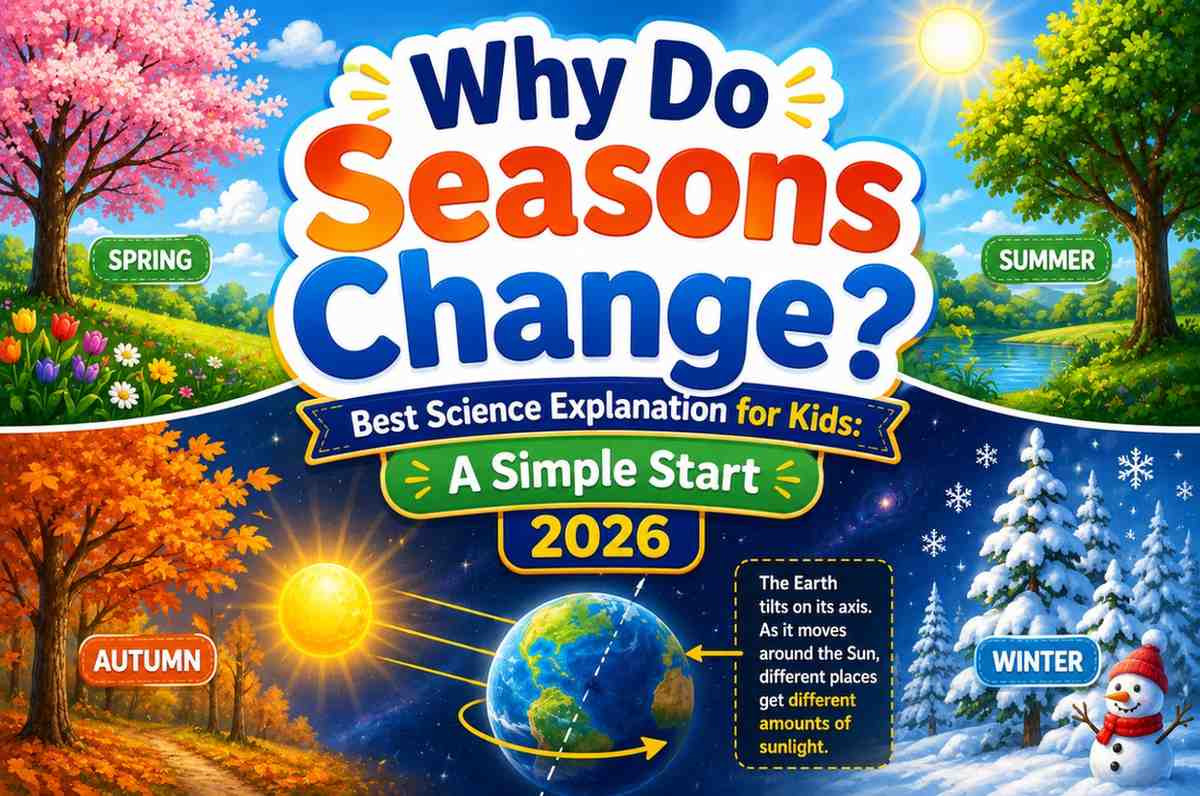
Have you ever noticed that summer feels blazing hot and winter feels freezing cold—even though the Earth is in space the whole time? Why do we have spring flowers and autumn leaves? Why does it stay light so late in summer and get dark so early in winter?
Today we’re going to answer all of this with a clear “Why do seasons change?” science explanation for kids—using the Earth, the Sun, and one very important tilt that changes everything. Let’s explore!
The Big Reason: Why Do Seasons Change? Science Explanation for Kids
Here’s the most important fact in the “Why Do Seasons Change?” science explanation for kids:
Seasons happen because Earth is tilted on its axis!
Earth doesn’t stand straight up as it orbits the Sun. It leans at an angle of about 23.5 degrees. As Earth travels around the Sun over the course of a year, different parts of the planet receive more or less direct sunlight — and that’s what creates the four seasons.
Common Misconception: Many people think seasons happen because Earth is closer to or farther from the Sun in its orbit. This is NOT correct. In fact, Earth is slightly closer to the Sun in January (winter in the Northern Hemisphere) than in July (summer)! The real reason—as any “why do seasons change?” science explanation for kids will tell you—is the tilt, not the distance.
What Is Earth’s Axis? Why Do Seasons Change? Science Explanation for Kids
The axis is an imaginary line that runs from the North Pole to the South Pole through the center of the Earth. Earth spins around this axis every 24 hours, giving us day and night.
But this axis isn’t straight up and down — it’s tilted at 23.5 degrees compared to the direction Earth travels around the Sun.
This tilt is the entire reason for the “Why do seasons change?” science explanation for kids. Without it, every part of Earth would receive the same amount of sunlight all year round, and we’d have no seasons at all!
📷 IMAGE 1 — Placement: After “What Is Earth’s Axis?” section Description: A diagram showing Earth at four positions in its orbit around the Sun, with the tilt clearly labelled and seasons marked for both hemispheres. ALT Text: why do seasons change? Science explanation for kids—diagram showing Earth’s tilt and four seasons around the Sun
The Four Seasons Explained: Why Do Seasons Change? Science Explanation for Kids
🌸 Spring (March–May in the Northern Hemisphere)
- Earth’s tilt means the Northern Hemisphere is beginning to lean toward the Sun.
- Days get longer and temperatures rise.
- Plants start growing, flowers bloom, and animals come out of hibernation.
- The spring equinox (around March 20) occurs when day and night are nearly equal in length.
☀️ Summer (June–August in the Northern Hemisphere)
- The Northern Hemisphere is tilted most toward the Sun.
- The Sun’s rays hit at a more direct angle → more heat per square meter.
- Days are the longest, nights are the shortest.
- The Summer Solstice (around June 21) is the longest day of the year.
🍂 Autumn/Fall (September–November in the Northern Hemisphere)
- Earth continues its orbit, and the tilt begins to favor the Southern Hemisphere.
- Days shorten, temperatures cool.
- Leaves change color and fall from trees.
- The Autumn Equinox (around September 22) balances day and night again.
❄️ Winter (December–February in the Northern Hemisphere)
- The Northern Hemisphere is tilted away from the Sun.
- Sunlight hits at a shallow angle → less heat, shorter days.
- Winter Solstice (around December 21) is the shortest day of the year.
- Snow, frost, and cold temperatures dominate.
This four-season cycle is the heart of the “Why do seasons change?” science explanation for kids.
Why Are Seasons Opposite in the Southern Hemisphere?
When the Northern Hemisphere tilts toward the Sun (summer in North America, Europe, and Asia), the Southern Hemisphere tilts away—giving it winter.
So while children in London are building snowmen in December, children in Sydney, Australia, are enjoying summer on the beach!
| Month | Northern Hemisphere | Southern Hemisphere |
|---|---|---|
| December–February | Winter ❄️ | Summer ☀️ |
| March–May | Spring 🌸 | Autumn 🍂 |
| June–August | Summer ☀️ | Winter ❄️ |
| September–November | Autumn 🍂 | Spring 🌸 |
This flip-flop is one of the most fascinating parts of the “Why Do Seasons Change?” science explanation for kids!
What Are Equinoxes and Solstices?
Equinoxes (2 per year):
- Day and night are roughly equal in length (about 12 hours each).
- Spring Equinox: ~March 20
- Autumn Equinox: ~September 22
Solstices (2 per year):
- The Sun reaches its most extreme position.
- Summer Solstice (~June 21): longest day, shortest night.
- Winter Solstice (~December 21): shortest day, longest night.
Cultures around the world have celebrated these days for thousands of years—from Stonehenge in England to ancient Egyptian monuments designed to align with the solstice Sun.
How Does the Angle of Sunlight Affect Temperature?
Imagine shining a flashlight straight down on a table — you get a small, bright, concentrated circle of light. Now tilt the flashlight at an angle—the light spreads out over a much bigger area and becomes less intense.
The same happens with sunlight:
- Summer: Sun is high in the sky → light hits Earth at a steep angle → concentrated heat → warm!
- Winter: The sun is low in the sky → light hits at a shallow angle → it spreads over a larger area → less heat → cold!
This flashlight demonstration is one of the most used tools in the “Why Do Seasons Change?” science explanation for kids.
Why Are Days Longer in Summer?
Because of Earth’s tilt:
- In summer, your hemisphere is tilted toward the Sun. This means the Sun appears to trace a longer path across the sky, staying above the horizon longer.
- In winter, the Sun traces a shorter path and sets earlier.
In extreme northern locations like Iceland or Norway, the tilt is so pronounced that the sun barely sets in summer (midnight sun) and barely rises in winter (polar night). This is the “why do seasons change?” science explanation for kids taken to its most dramatic extreme!
📷 IMAGE 2 — Placement: After “Why Are Days Longer in Summer?” Section Description: A simple diagram comparing the angle of sunlight hitting Earth in summer vs winter, with a flashlight analogy shown ALT Text: why do seasons change? Science explanation for kids — diagram comparing sunlight angle in summer and winter
Seasons and Nature: How Living Things Respond
Animals:
- Bears hibernate through winter to survive food shortages.
- Birds migrate thousands of miles to follow warmer weather.
- Many insects lay eggs in autumn that hatch in spring.
- Deer grow thicker coats for winter and shed them in spring.
Plants:
- Deciduous trees drop leaves in autumn to conserve energy.
- Flowers bloom in spring as temperatures warm and days lengthen.
- Many plants produce seeds in summer and autumn.
- Some Arctic plants complete their entire life cycle in the brief summer.
These natural cycles are all governed by the same principle at the heart of the “why do seasons change?” science explanation for kids—the Earth’s tilt and its journey around the Sun.
Seasons Around the World: Not Everyone Has Four!
- Tropical Regions (near the equator): Usually just two seasons — wet season and dry season — because the Sun is always nearly overhead.
- Arctic/Antarctic Regions: Extreme versions of two seasons — months of near-constant daylight and months of near-constant darkness.
- Monsoon Climates (South/Southeast Asia): Have three distinct seasons — hot, wet, and cool.
This shows that the “why do seasons change?” science explanation for kids is truly a global story with many local variations!
Fun Seasonal Science Activities for Kids
Activity 1: Flashlight Earth Model Use a globe and a flashlight in a dark room. Tilt the globe at 23.5° and orbit it around the flashlight. Watch how different parts receive more or less direct light!
Activity 2: Shadow Length Experiment At the same time of day, measure your shadow in summer and winter. Shorter shadows = higher Sun = more direct sunlight = summer! This directly demonstrates the “why do seasons change?” science explanation for kids.
Activity 3: Nature Journal Keep a seasonal diary. Record temperature, hours of daylight, plant growth, and bird activity across all four seasons. See the patterns with your own eyes!
10 Amazing Seasonal Science Facts
- Earth takes 365.25 days to orbit the Sun—that’s why we have a leap year every 4 years!
- Earth’s axis tilt of 23.5° is maintained by the gravitational influence of the Moon.
- The Sun is actually 3 million miles closer to Earth in January than in July—but winter is colder because of the tilt!
- At the North Pole, the Sun never sets for 6 months in summer and never rises for 6 months in winter.
- Ancient people built structures like Stonehenge to track the solstices precisely.
- The word “solstice” comes from Latin, meaning “sun stands still.”
- Some animals, like the Arctic fox, change the color of their fur with the seasons!
- Plants can sense changing day length through photoreceptors—they know what season it is!
- The cherry blossom season in Japan lasts only about 2 weeks each spring.
- Mars also has seasons because it has a similar axial tilt to Earth — about 25 degrees!
Authority Resources on Why Seasons Change for Kids
- NASA Space Place — Why Do We Have Seasons?
- National Geographic Kids — Seasons
- BBC Bitesize — The Earth’s Movement
- Khan Academy — Earth’s Rotation and Revolution
- Met Office — Why Do Seasons Change?
FAQs: Why Do Seasons Change Science Explanation for Kids
Q1. Why do seasons change—a simple explanation for kids? Seasons change because Earth is tilted at 23.5 degrees as it orbits the Sun. When your part of Earth tilts toward the Sun, it’s summer. When it tilts away, it’s winter.
Q2. Does the distance from the Sun cause seasons? No! This is a very common misconception. Earth is actually slightly closer to the Sun in January (winter in the Northern Hemisphere). Seasons are caused by Earth’s tilt, not its distance from the Sun.
Q3. Why are seasons opposite in Australia compared to the UK? Because when the Northern Hemisphere tilts toward the Sun (summer), the Southern Hemisphere tilts away (winter). Australia is in the Southern Hemisphere, so its seasons are reversed compared to the UK.
Q4. What is the longest day of the year? The Summer Solstice, around June 21 in the Northern Hemisphere, is the longest day of the year. The Sun follows its highest and longest path across the sky on this day.
Q5. Do all countries in the world have four seasons? No, countries near the equator (tropical regions) often experience only two seasons—wet and dry. Countries in polar regions experience extreme light and darkness rather than typical four-season patterns.
Conclusion
Now you have the complete why do seasons change science explanation for kids—and it all comes down to one beautiful, simple fact: Earth’s 23.5-degree tilt as it orbits the Sun creates the changing seasons we experience every year.
From the longest summer day to the darkest winter night, from blooming spring flowers to falling autumn leaves—all of it is the result of our tilted, spinning, orbiting planet doing its thing.
Explore more! Next time you feel the warmth of summer or the chill of winter, remember you’re experiencing the direct result of Earth’s journey around the Sun. What an incredible planet we live on!