 creator@scienceexplore.site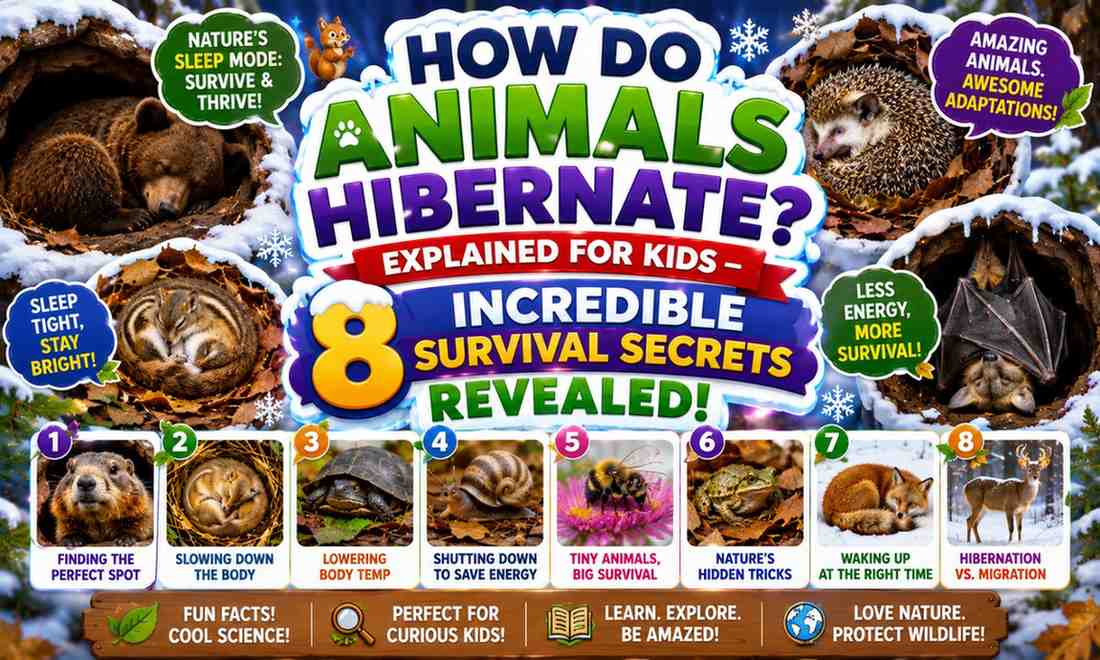
Introduction: The World’s Longest Nap
Imagine going to sleep in October and not waking up until March. No school, no breakfast, no getting up to go to the bathroom — just one long, deep, peaceful sleep all winter long!
That’s exactly what some animals do. And understanding how do animals hibernate, explained for kids, is one of the most fascinating wildlife science lessons you’ll ever learn.
But here’s the thing—hibernation is not just a very long nap. It’s a remarkable biological superpower that allows animals to survive months of freezing cold and food scarcity without eating, drinking, or moving. Let’s explore this incredible survival strategy together! 🐻❄️
What Is Hibernation?
Hibernation is a state of deep rest that some animals enter during winter. During hibernation, an animal’s body slows down dramatically to save energy.
Here’s what happens to an animal’s body during hibernation:
| Body Function | Normal State | During Hibernation |
|---|---|---|
| Body Temperature | 37°C / 98°F | Can drop to just above freezing! |
| Heart Rate | 60–100 bpm | As slow as 1 beat per minute |
| Breathing | 12–20 breaths/min | Just 1–2 breaths per minute |
| Energy Use | Normal | Drops by up to 99%! |
This is the core of how do animals hibernate, explained for kids — the body essentially enters a state of ultra-low-power mode, like a phone with its screen off and all apps closed, using just enough battery to stay alive.
Why Do Animals Hibernate?
Animals hibernate for one critical reason: survival.
Winter brings two enormous challenges:
- Cold temperatures — It takes enormous energy to stay warm in freezing conditions.
- Food shortage — Many animals eat insects, berries, or plants that simply aren’t available in winter.
Rather than burning through enormous amounts of energy trying to find food that doesn’t exist, animals that hibernate take the smartest route possible: they shut down non-essential body functions, live off stored fat reserves, and wait until spring when food is plentiful again.
It’s the ultimate survival strategy — and it’s been perfecting itself in nature for millions of years.
How Do Animals Prepare for Hibernation?
Understanding how do animals hibernate, explained for kids, also means understanding what happens before the big sleep.
In late summer and autumn, animals begin preparing intensively. Here’s how:
🍇 Hyperphagia — Eating Like Crazy!
In the weeks before hibernation, animals go through a phase called hyperphagia (say it: hi-PER-fay-jee-ah) — which simply means eating a LOT.
A grizzly bear, for example, can eat up to 20,000 calories per day in autumn — that’s the equivalent of about 40 large pizzas! All this extra food is stored as fat, which will fuel the bear through its entire winter sleep.
🏠 Finding a Den or Burrow
Animals need a safe, sheltered, warm place to hibernate. Different animals choose different homes:
- Bears find caves or hollow logs or dig dens in hillsides.
- Hedgehogs build nests from leaves and twigs under bushes or in compost heaps.
- Bats hang upside down in caves, attics, or tree hollows.
- Ground squirrels dig deep underground burrows below the frost line.
❄️ Responding to Temperature Drops
As temperatures fall and days get shorter, the animal’s brain detects these changes. Hormones signal the body to begin slowing down — the hibernation process has begun.
What Happens Inside the Body During Hibernation?
This is the most amazing part of how do animals hibernate, explained for kids — the incredible physiological changes that occur!
🧠 The Brain Goes Quiet
The brain enters a low-activity state. The animal is not conscious and does not dream (as far as scientists can tell). It’s much deeper than regular sleep.
❤️ The Heart Slows to Almost Nothing
A ground squirrel’s heart normally beats about 200 times per minute. During hibernation? Just 5–10 times per minute. The body needs so little oxygen that the heart barely needs to work.
🌡️ Body Temperature Plummets
Some hibernating animals allow their body temperature to drop incredibly low. Arctic ground squirrels can survive with a body temperature of -2.9°C — actually below freezing! Their blood contains special chemicals that prevent it from turning to ice.
🫁 Breathing Nearly Stops
A hibernating animal may take just one breath every few minutes. Because the body is working so slowly, it needs very little oxygen.
🔋 Living Off Fat Reserves
Throughout winter, the animal burns its stored fat very slowly. This fat provides all the energy, water, and warmth the animal needs to survive until spring.
Which Animals Hibernate?
Now for the exciting part of how do animals hibernate, explained for kids — which animals actually do it?
🐻 Bears
Bears are probably the most famous hibernators. However, bears actually experience a lighter form of hibernation sometimes called “torpor.” Their body temperature doesn’t drop as dramatically as smaller animals, and they can wake up more easily.
Mother bears even give birth and nurse their cubs during winter—an extraordinary feat of nature! The cubs are born tiny and helpless while their mother sleeps, kept warm by her fur and body heat.
🦔 Hedgehogs
Hedgehogs are true hibernators. They curl into a tight ball, lower their heart rate from 190 bpm to about 20 bpm, and can lose up to a third of their body weight by spring. Interestingly, if a hedgehog doesn’t eat enough in autumn, it may not survive its hibernation — which is why leaving out food for hedgehogs in late autumn can save lives!
🦇 Bats
All UK bat species hibernate. Bats are especially vulnerable during hibernation — if disturbed, they burn precious fat reserves waking up and may not survive until spring. That’s why it’s so important to never disturb bat roosts in winter.
🐿️ Ground Squirrels and Chipmunks
These are among the deepest hibernators of all. Arctic ground squirrels hold the record for the coldest body temperature of any hibernating mammal. Chipmunks wake periodically to eat from food caches they stored in autumn.
🐸 Frogs and Toads
Amphibians hibernate too! Most frogs burrow into mud at the bottom of ponds, where the water doesn’t freeze completely. They absorb oxygen through their skin. Wood frogs go even further — they actually allow their bodies to partially freeze and survive!
🐢 Tortoises and Turtles
Reptiles hibernate in a process called “brumation”—similar to hibernation but not quite the same. Tortoises bury themselves in soil or leaf litter, while freshwater turtles sink to the bottom of ponds.
🐝 Queen Bees
When winter comes, most honeybees die. But the queen bee hibernates underground and emerges in spring to start a new colony!
You can explore more about hibernating animals on WWF Wildlife Facts—an excellent DoFollow resource that’s packed with accurate wildlife information.
True Hibernation vs. Torpor — What’s the Difference?
Scientists make an important distinction:
True hibernation—very deep, prolonged, hard to wake from (ground squirrels, hedgehogs, dormice)
Torpor—a lighter, shorter version of hibernation, easier to wake from (bears, raccoons, some birds)
In true hibernation, the animal cannot be easily woken, and their body processes are dramatically slowed. In torpor, the animal is in a lighter sleep and may wake more easily.
Do Any Animals Hibernate in Summer?
Yes! Some animals in hot desert environments experience a similar process called “estivation”—essentially summer hibernation.
When it gets too hot and dry, animals like lungfish, snails, and some salamanders seal themselves in mud or burrows and enter a dormant state to survive the heat, waiting for cooler or wetter conditions.
It’s the same brilliant principle as winter hibernation—survive difficult conditions by temporarily shutting down.
How Do Animals Know When to Wake Up?
As winter ends and temperatures begin to rise, the animal’s body temperature gradually increases. The warming triggers chemical signals that tell the brain it’s time to wake up.
Waking from deep hibernation actually takes energy and time. A hibernating animal shivers intensely to warm itself up—this is called thermogenesis. A ground squirrel may take up to several hours to fully wake up from deep hibernation.
When they finally emerge, they’re hungry, groggy, and a bit wobbly—but alive! And the whole remarkable cycle begins again.
Frequently Asked Questions (FAQ)
❓ Q1: Do animals eat or drink during hibernation?
Most true hibernators don’t eat or drink at all during hibernation. They live entirely off their stored fat reserves. Some animals, like chipmunks, wake up occasionally to eat cached food, but most hibernate without any food or water.
❓ Q2: Can you wake a hibernating animal?
Technically yes, but it can be very dangerous for the animal. Waking from deep hibernation burns enormous amounts of fat reserves. If an animal is woken too early and repeatedly disturbed, it may not have enough energy stores left to survive until spring.
❓ Q3: Do dogs or cats ever hibernate?
No, domestic cats and dogs do not hibernate. They are adapted to live alongside humans and have access to food and shelter all year round. However, cats may sleep more during cold winter days — a very mild form of seasonal behavior.
❓ Q4: Is hibernation the same as sleeping?
No — hibernation is much, much deeper than sleep. During sleep, our brains are very active. During hibernation, brain activity is dramatically reduced, body temperature falls, and breathing and heart rate slow to almost nothing. It’s more like a state of controlled suspended animation.
❓ Q5: Why don’t humans hibernate?
Humans evolved in environments where food was available year-round (or we found ways to store and trade food). We also use fire, clothing, and shelter to stay warm. There was never an evolutionary pressure for humans to develop hibernation—but scientists are studying hibernation in animals to understand if it could be useful for long-distance space travel!
Conclusion
Now you know all about how do animals hibernate, explained for kids—and it truly is one of nature’s most astonishing superpowers. From bears that give birth while sleeping to frogs that partially freeze and survive, the animal kingdom has evolved the most remarkable strategies to endure winter.
Hibernation is not weakness—it is genius. It’s the ultimate act of working smarter, not harder. Instead of fighting the cold and the food shortage, these animals simply press pause on life itself, wait patiently, and emerge in spring as if they never left.
So the next time winter feels tough, take a page from the hedgehog’s book: curl up, stay warm, and know that spring is always just around the corner.