 creator@scienceexplore.site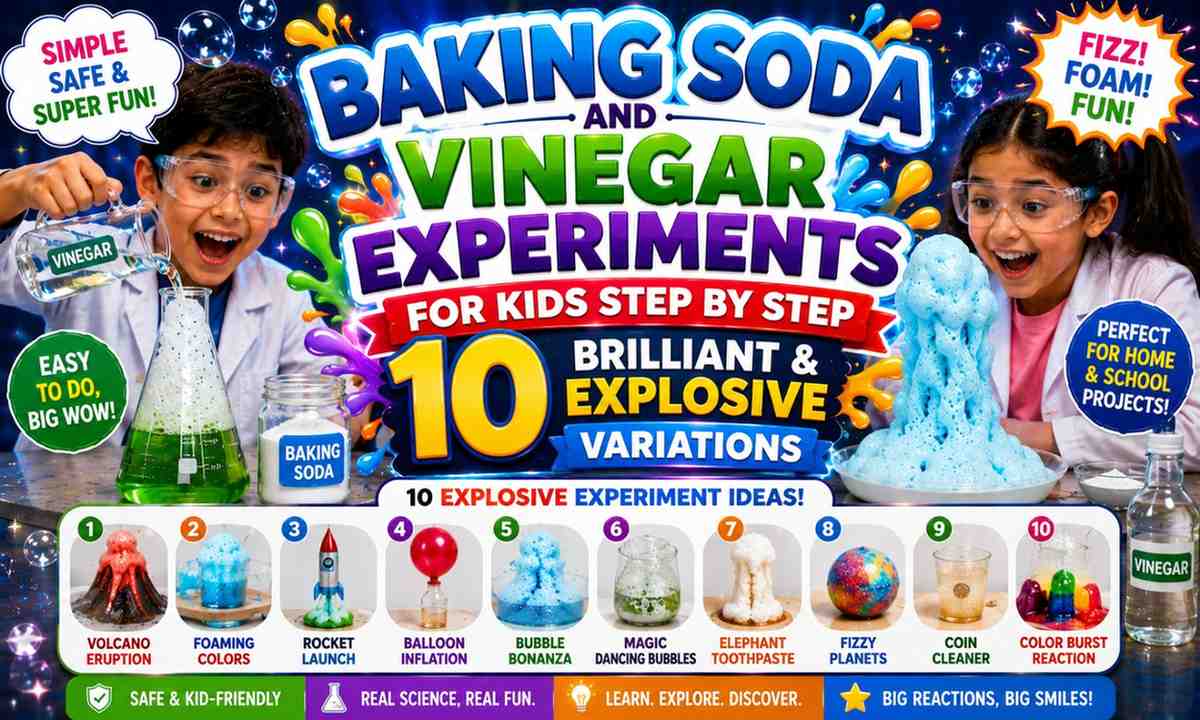
Introduction
Every child has seen the classic baking soda volcano, but did you know that reaction is just the beginning? Baking soda and vinegar experiments for kids, step-by-step, offer a world of bubbly, foamy, fizzy possibilities that go far beyond the papier-mâché mountain. These two humble kitchen ingredients, when combined, unleash one of the most dramatic and teachable chemical reactions in all of science.
In this guide, you will find 10 creative, step-by-step variations of the baking soda and vinegar reaction—each one designed to be safe, simple, and genuinely thrilling for children aged 4 to 12. Whether you are a parent looking for a rainy-day activity, a teacher building a science lesson, or a curious kid who wants to blow something up (safely!), these baking soda and vinegar experiments for kids step by step deliver every single time.
The best part? Everything you need is already in your kitchen.
The Science Behind Baking Soda and Vinegar Experiments for Kids Step by Step
Before diving into the variations, it helps to understand why this reaction is so spectacular. When baking soda (sodium bicarbonate — a base) meets vinegar (acetic acid — an acid), they undergo a rapid acid-base neutralization reaction.
The products of this reaction are:
- Carbon dioxide gas (CO₂) — the fizz and foam you see
- Water (H₂O)
- Sodium acetate — a harmless salt
The CO₂ gas is the real star of the show. It escapes rapidly, creating bubbles, foam, and pressure—which is what makes balloons inflate, foam snakes crawl out of bottles, and volcanoes erupt dramatically.
This reaction is also endothermic—it absorbs a tiny amount of heat, so the mixture feels slightly cool to the touch. Understanding this simple chemistry unlocks all 10 variations below.
For a deeper scientific explanation of acid-base chemistry, the American Chemical Society’s resources for kids offer excellent, educator-approved reading material.
Baking Soda and Vinegar Experiments for Kids Step by Step — 10 Cool Variations
Variation 1: Rainbow Fizz Tray
What You Need:
- Large baking tray or shallow dish
- Baking soda (enough to cover the tray bottom)
- White vinegar in a small dropper or squeeze bottle
- Red, blue, yellow, and green food coloring
Steps:
- Spread a thick, even layer of baking soda across the tray.
- Add drops of different food coloring in clusters around the tray — do not mix them.
- Add a few drops of vinegar directly onto each color cluster.
- Watch as each color fizzes, bubbles, and bleeds into the others, creating a rainbow of reactions.
- Keep adding vinegar to keep the fizzing going!
The Science: Each colored spot reacts individually at first, then the colors mix as the liquid spreads—demonstrating both the acid-base reaction and color mixing at the same time.
Age Tip: Perfect for ages 3–7. Great as a sensory activity combined with science.
Variation 2: Fizzy Balloon Inflation
What You Need:
- An empty plastic bottle (500ml works well)
- White vinegar (about 3–4 tablespoons)
- Baking soda (1–2 teaspoons)
- A balloon
- A small funnel
Steps:
- Pour the vinegar into the bottom of the plastic bottle.
- Using the funnel, spoon baking soda carefully into the balloon (not into the bottle yet).
- Stretch the balloon’s opening over the bottle neck, letting the balloon hang to one side.
- Lift the balloon upright so the baking soda falls into the vinegar.
- Watch the balloon inflate as CO₂ gas fills it!
The Science: The carbon dioxide gas produced has nowhere to go except into the balloon, inflating it without any blowing required. This is a fantastic demonstration of gas production in a chemical reaction.
Age Tip: Great for ages 6–12. Older children can measure how much baking soda produces the most inflation — turning it into a proper controlled experiment.
Variation 3: Baking Soda-Powered Boat
What You Need:
- Aluminum foil
- Baking soda
- Dish soap
- A large tub or bathtub filled with water mixed with a splash of vinegar
Steps:
- Shape a piece of aluminum foil into a small flat-bottomed boat with raised edges.
- Mix a small amount of baking soda with dish soap to create a thick paste.
- Place a small blob of the paste at the back of the boat like an engine.
- Set the boat gently onto the surface of the vinegar water.
- Watch it fizz and propel forward!
The Science: The CO₂ bubbles escaping from the back create a thrust force — a real-world demonstration of Newton’s Third Law of Motion. Every action (gas escaping backward) has an equal and opposite reaction (boat moving forward).
Variation 4: Erupting Citrus Volcano
What You Need:
- 1 large lemon or orange
- Baking soda (1 teaspoon)
- Dish soap (a few drops)
- Food coloring (optional)
- A plate
Steps:
- Cut the lemon in half and place it cut-side up on a plate.
- Add a few drops of food coloring directly onto the lemon flesh.
- Add a few drops of dish soap on top.
- Sprinkle the baking soda over the lemon.
- Watch the slow, fragrant, colorful eruption begin—use a spoon or stick to keep stirring and the reaction continues!
The Science: Lemons contain citric acid, a natural acid that reacts with baking soda just like vinegar does. The dish soap captures the CO₂ into foamy bubbles, creating a longer, slower, more fragrant eruption. This teaches kids that acids exist naturally in everyday foods.
Variation 5: Color-Changing Cabbage Juice pH Lab
What You Need:
- Half a red cabbage
- Water
- Vinegar
- Baking soda dissolved in water
- Several small glasses
Steps:
- Chop the red cabbage and boil it in water for 10 minutes. Let it cool.
- Strain the purple liquid (this is your pH indicator) into a jug.
- Pour equal amounts into several glasses.
- Add vinegar to one glass, baking soda water to another, lemon juice to a third, and plain water to a fourth.
- Observe the dramatic color changes — purple turns pink/red in acids and green/yellow in bases!
The Science: Red cabbage contains a pigment called anthocyanin that changes color depending on pH. This is one of the most impressive baking soda and vinegar experiments for kids, step-by-step, because it transforms a simple reaction into a full pH chemistry lab using nothing but food.
Age Tip: Ideal for ages 8–12. Older kids can test even more household liquids and rank them by pH.
Variation 6: Fizzy Ice Cube Reaction
What You Need:
- Ice cube tray
- Baking soda
- Water
- Vinegar
- Food coloring
Steps:
- Mix baking soda and water (roughly 1 teaspoon per cup of water) and pour into ice cube trays.
- Add a drop of food coloring to each cube section.
- Freeze overnight.
- Place the frozen baking soda cubes in a shallow dish.
- Pour vinegar over them and watch the slow, dramatic, colorful fizzing as they melt and react simultaneously!
The Science: The frozen state slows the reaction down, giving a longer, more sustained fizzing effect. As the ice melts, it continuously exposes fresh baking soda to the vinegar—demonstrating how temperature affects reaction rates.
Variation 7: Bath Bomb Chemistry
What You Need:
- 1 cup baking soda
- 1/2 cup citric acid powder (available at pharmacies or health stores)
- 1/2 cup cornstarch
- 3 tablespoons coconut oil or almond oil
- Food coloring and essential oil (optional)
- Bath bomb molds or a muffin tin
Steps:
- Mix all dry ingredients thoroughly in a bowl.
- Slowly add the oil, mixing quickly to prevent premature fizzing.
- Add coloring and scent if using.
- Pack tightly into molds.
- Let dry for 24 hours. Drop one into water and watch it fizz and dissolve!
The Science: Citric acid and baking soda react when water is introduced—a perfect demonstration of how moisture triggers a chemical reaction. This is also a practical, real-world chemistry application that kids can keep, gift, or use in a bath.
Variation 8: Rubber Egg (Vinegar Egg Shell Dissolve)
What You Need:
- 1 raw egg (in its shell)
- White vinegar
- A glass jar with a lid
- 24–48 hours of patience
Steps:
- Place the raw egg gently into the jar.
- Pour enough white vinegar to completely submerge the egg.
- Watch the bubbles form on the shell immediately — that is the reaction starting!
- Cover loosely and leave for 24 hours. Check and replace vinegar if bubbling has stopped.
- After 48 hours, remove gently, rinse carefully with water, and feel the rubbery, shell-free egg!
The Science: The eggshell is made of calcium carbonate—the same material in chalk and some rocks. Vinegar (acetic acid) dissolves it in a slow but thorough acid-base reaction, leaving behind only the flexible inner membrane. This experiment beautifully illustrates how acids interact with minerals and carbonate compounds.
Age Tip: Perfect for ages 8 and up — it teaches patience as well as science!
Variation 9: CO₂ Candle Extinguisher
What You Need:
- A candle (adult supervision required)
- A tall glass or jug
- Baking soda (2 tablespoons)
- Vinegar (4 tablespoons)
Steps:
- Place the candle on a stable surface and light it (adult supervision required).
- Add baking soda to the tall glass.
- Add vinegar to the glass — let the reaction produce CO₂ gas. Do not swirl.
- Slowly tilt the glass toward the candle flame without letting any liquid pour out.
- Watch the invisible CO₂ gas “pour” out and extinguish the flame like an invisible blanket!
The Science: CO₂ is denser than air and sinks to the bottom of the glass. When you tilt the glass, the heavy gas pours out and smothers the flame by cutting off its oxygen supply. Fire needs oxygen to burn — remove it, and the flame dies. This is exactly how CO₂ fire extinguishers work in real life.
Variation 10: Giant Baking Soda Foam Snake
What You Need:
- A large plastic bottle (1–2 liter)
- 4–5 tablespoons of baking soda
- 1 cup of vinegar
- Several squirts of dish soap
- Food coloring
Steps:
- Add baking soda to the bottle first.
- Mix vinegar, dish soap, and food coloring in a separate cup.
- Quickly pour the vinegar mixture into the bottle.
- Stand back — a giant foam snake will erupt from the bottle opening!
- For maximum effect, stand the bottle in a tray to catch the overflow.
The Science: The dish soap captures millions of CO₂ bubbles as they form, creating a thick, stable foam that has nowhere to go except up and out of the bottle. The food coloring makes the foam visually dramatic. This is one of the most spectacular baking soda and vinegar experiments for kids, step-by-step—and the one that makes the biggest mess!
Tips to Get the Best Results Every Time
Getting great results from baking soda and vinegar experiments for kids step by step comes down to a few key principles:
Use fresh baking soda — old baking soda loses potency. Test it by dropping a teaspoon into plain vinegar. If it barely fizzes, buy a new box.
Use white vinegar for the strongest reaction. Apple cider vinegar works but is slightly weaker and more expensive.
More baking soda does not always mean more reaction — there is a limit to how much acid is available to react with. For the biggest foam, increase the vinegar before increasing the baking soda.
Dish soap dramatically increases foam volume—add it generously when foam is the desired effect.
Warm vinegar reacts faster than cold vinegar because higher temperatures increase the speed of molecular collisions.
Safety Notes for Parents and Teachers
All baking soda and vinegar experiments for kids step by step in this guide are completely safe with basic precautions:
Work on a covered surface or in a tray to manage the mess. Keep vinegar away from your eyes—it stings. Supervise young children near lit candles in Variation 9. All ingredients are non-toxic and food-safe.
Frequently Asked Questions (FAQ)
Q1: What ratio of baking soda to vinegar works best for experiments? A general starting point is 1 teaspoon of baking soda to 2 tablespoons of vinegar. For bigger foam, increase both proportionally, keeping a 1:6 ratio by volume.
Q2: Can you reuse the mixture after the reaction stops? No—once the reaction is complete, the acid and base have neutralized each other. You get sodium acetate solution, not vinegar or baking soda. Always start fresh with new ingredients.
Q3: Why does adding dish soap create more foam? Dish soap lowers the surface tension of the liquid, allowing the CO₂ bubbles to form a stable foam rather than just popping immediately. More bubbles stay intact, creating more visible foam.
Q4: Are baking soda and vinegar experiments step by step safe for toddlers? Yes, both ingredients are non-toxic and food-safe. Always supervise closely and avoid eye contact with vinegar. Use shallow trays to contain splashes.
Q5: What is the best vinegar for these experiments? Plain white vinegar (5% acidity) gives the strongest, most consistent reaction and is the cheapest option. Avoid balsamic or flavored vinegars, as the acidity varies.
Conclusion
Baking soda and vinegar experiments for kids step by step are far more than a one-trick volcano. From inflating balloons with invisible gas to dissolving eggshells to building CO₂ fire extinguishers from a kitchen glass—these ten variations prove that two humble pantry staples can teach some of the most important concepts in chemistry, physics, and biology.
Each experiment in this guide is designed to do three things: work reliably every time, teach a real and meaningful scientific concept, and make children lean forward with genuine excitement. Because when a child watches a foam snake crawl out of a bottle or sees an invisible gas snuff out a candle flame, they are not just entertained — they are thinking like scientists.
And that curiosity, once sparked, never really goes out.
So grab your baking soda, pour the vinegar, and let the fizzing begin. Science is waiting right there in your kitchen cupboard.
External Resource (DoFollow): For educator-reviewed chemistry activities and science fair project guides, visit Science Buddies — the leading free STEM resource for K–12 students and teachers.