 creator@scienceexplore.site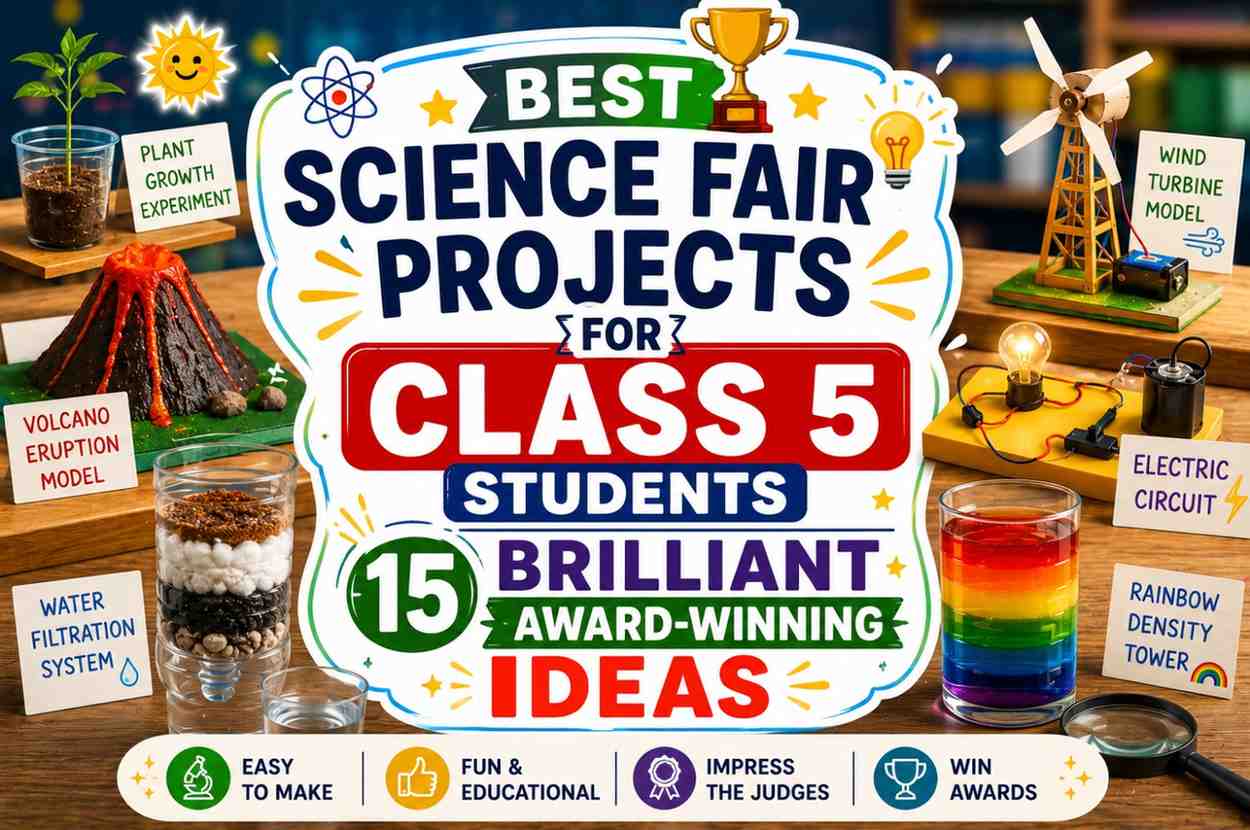
Introduction: Why Science Fairs Matter More Than You Think
The best science fair projects for class 5 students do more than earn a ribbon — they spark curiosity, build confidence, and teach kids how to think like real scientists.
Class 5 is a turning point. Students are old enough to handle real experiments but young enough to be amazed by the world around them. That combination makes it the perfect age to dive deep into hands-on science.
Whether your child is a budding engineer, a nature lover, or a chemistry enthusiast, this guide has something exciting for every type of learner. We’ve compiled 15 proven, teacher-approved, and judge-impressed projects—complete with full step-by-step instructions.
What Judges Look For in Class 5 Science Fair Projects
Before picking a project, understand what science fair judges actually want to see.
Judges consistently evaluate five key areas: a clear hypothesis, proper use of the scientific method, original thinking beyond a kit, strong presentation skills, and a well-reasoned conclusion that reflects what the student actually learned.
Keep these five points in mind as you explore the best science fair projects for class 5 students listed below.
15 Best Science Fair Projects for Class 5 Students
1. Homemade Volcano With Baking Soda and Vinegar Difficulty: Easy | Time: 2–3 hours
Build a papier-mâché cone around a plastic bottle. Once dry, paint it like a real volcano. Add 2 tablespoons of baking soda, dish soap, and red food coloring inside the bottle. Pour vinegar in and watch the spectacular eruption. Students learn chemical reactions between acids and bases, gas production, and real volcanic geology.
2. Water Purification System Difficulty: Medium | Time: 4–5 hours
Cut the bottom off a plastic bottle and flip it upside down. Layer cotton balls, activated charcoal, fine sand, and coarse gravel from bottom to top. Pour dirty water through the top and collect cleaner water below. Compare clarity using a simple chart. Students learn water filtration and environmental science — a highly relevant topic for judges today.
3. Solar-Powered Pizza Box Oven Difficulty: Medium | Time: 3 hours
Cut a flap in the lid of a pizza box and line it with aluminum foil to reflect sunlight. Line the inside of the box with black paper to absorb heat and cover the opening with plastic wrap. Place food inside and measure how long it takes the sun to melt chocolate. Students learn solar energy and renewable resource concepts.
4. Egg Drop Challenge Difficulty: Medium-Hard | Time: 3–4 hours
Design a protective case for a raw egg using only straws, cotton balls, rubber bands, and tape. Drop it from a second-floor window. Record whether the egg survived and analyze why or why not. This is one of the best science fair projects for class 5 students who love engineering challenges.
5. Plant Growth Under Different Light Colors Difficulty: Easy | Time: 2 weeks
Plant identical seeds in identical soil pots. Cover each light source with a different colored cellophane—red, blue, and green. Water equally and measure growth daily. Chart results over two weeks. Students learn photosynthesis, the light spectrum, and how to design controlled experiments properly.
6. Electromagnet Strength Tester Difficulty: Medium | Time: 3–4 hours
Wrap copper wire tightly around an iron nail with at least 20 coils. Connect both wire ends to a battery. Test how many paper clips the electromagnet lifts. Then add more coils and test again. Students learn electromagnetism and variable experiment design—skills that impress judges at any level.
7. Mold Growth on Bread Difficulty: Easy | Time: 1 week
Place bread slices in sealed bags under different conditions: dry, moist, warm, and cold. Observe and photograph mold growth daily. Graph which condition produced the fastest growth. Students learn about fungi biology, decay processes, and food preservation science.
8. Lung Capacity Experiment Difficulty: Easy | Time: 2 hours
Have participants take a deep breath and blow into a balloon in one breath. Measure the diameter immediately. Compare athletes to non-athletes or different age groups. Discuss what physical factors affect lung capacity. Simple, relatable, and excellent for data collection practice.
9. Density Tower With Liquids Difficulty: Easy | Time: 1–2 hours
Carefully pour honey, corn syrup, dish soap, water, vegetable oil, and rubbing alcohol into a tall glass jar in that order. Each liquid settles into a distinct layer. Drop small objects and observe where they float. Students learn density, physical properties of liquids, and careful scientific observation.
10. Paper Bridge Load Test Difficulty: Easy | Time: 2 hours
Build a bridge spanning 20 cm between two book stacks using only paper and tape. Add coins one at a time to test load capacity. Try accordion, tube, and flat folding techniques and compare results. Students learn structural engineering, force distribution, and iterative design improvement.
11. Acid-Base Testing With Cabbage Juice Difficulty: Easy | Time: 2–3 hours
Boil red cabbage in water and strain the liquid to create a natural pH indicator. Add different household liquids — lemon juice, vinegar, baking soda, and milk — to separate cups of the indicator. Record the color change: pink means acid, green means base. A visually stunning and highly educational project.
12. Static Electricity Butterfly Difficulty: Easy | Time: 1 hour
Cut butterfly shapes from tissue paper. Rub a balloon vigorously on wool for 30 seconds to build up static charge. Hold it near the butterflies and watch them leap upward. Students learn static electricity, charge transfer, and electrostatic attraction in an unforgettable visual demonstration.
13. Sound Wave Visualizer Difficulty: Medium | Time: 3 hours
Stretch balloon rubber over an open can. Glue a tiny mirror piece to the center of the balloon. In a darkened room, shine a laser pointer at the mirror. Speak or play music into the can and watch the reflected laser dot dance on the wall. Students learn how sound waves physically move matter.
14. Germination Rate Experiment Difficulty: Easy | Time: 10 days
Place equal numbers of mung bean, sunflower, and mustard seeds on wet cotton on separate labeled plates. Keep all plates in identical conditions. Count and record germination rates every day. Students learn botany, seed biology, and how to run a properly controlled long-term experiment.
15. DIY Weather Station Difficulty: Medium-Hard | Time: 1 weekend
Build a simple barometer from a plastic bottle and clay to track air pressure. Create a rain gauge from a cut bottle and ruler. Record daily weather data for one full week. Compare your readings to official local forecasts. Students learn real meteorology and professional data recording habits.
Tips for a Winning Presentation
Practice your explanation at least five times before the fair. Use a trifold board with clearly labeled sections covering your question, hypothesis, method, results, and conclusion. Display your data in charts or graphs — judges always respond well to real quantified results. Dress neatly, make eye contact, and above all, be ready to explain why your topic matters.
For additional presentation strategy and project planning tools, visit the Science Buddies Project Guide — one of the most respected free resources for student science worldwide.
How to Write a Strong Hypothesis
Use this formula: “If [I do this], then [this will happen] because [reason].”
Example: “If I grow plants under blue light instead of white light, then they will grow taller because blue light wavelengths are most efficiently absorbed by chlorophyll.”
This simple structure immediately signals to judges that your child understands the process of science, not just the result.
Frequently Asked Questions
Q: What are the best science fair projects for class 5 students that need no special equipment? A: The cabbage juice pH test, mold growth experiment, static electricity butterfly, paper bridge, and lung capacity balloon test all use only items you likely already have at home. No special purchases required.
Q: How long should a class 5 project take to complete? A: Simple demonstration projects take 1–3 hours. Observation-based experiments like plant growth or mold growth need 7–14 days of daily data recording for results strong enough to impress judges.
Q: How do I help my child stand out at the science fair? A: Encourage them to test multiple variables, collect real numerical data, and display results clearly in a graph. Original thinking — even a small twist on a familiar experiment — always stands out to experienced judges.
Q: Does every class 5 project need to follow the scientific method? A: Yes. Every project should include a question, hypothesis, procedure, results, and conclusion. This is the structure judges score on, regardless of how impressive the experiment itself looks.
Q: What are the most popular science fair topics at the class 5 level? A: Volcanoes, plant biology, water purification, electricity, and density experiments are perennial favorites. Environmental topics like solar energy and water conservation are increasingly popular and well-received by modern judges.
Related Articles
- Simple Machine Science Project for Kids Class 6 — Lever, Pulley & Wheel Guide
- Water Cycle Project for Kids 3D Model — Step-by-Step Build Guide
- Plant Growth Science Project for Kids Hypothesis — Design a Real Experiment
Conclusion
The best science fair projects for class 5 students transform a school assignment into a genuine scientific adventure. From volcanic eruptions and solar ovens to electromagnetic experiments and biodiversity studies, the 15 ideas in this guide cover every interest, every budget, and every skill level.
The secret to winning isn’t choosing the flashiest experiment. It’s choosing a topic your child is genuinely curious about—and then following the scientific method with care, consistency, and enthusiasm.
Pick a project. Follow the steps. Record everything. Present it proudly.
Science doesn’t just happen in labs. It happens when a curious 10-year-old decides to ask why — and then actually finds out. 🔬